
Session Information
Date: Tuesday, November 12, 2019
Title: Orthopedics, Low Back Pain, & Rehabilitation Poster – ACR/ARP
Session Type: Poster Session (Tuesday)
Session Time: 9:00AM-11:00AM
Background/Purpose: Research has shown loaded exercise programmes to be beneficial for patients with rotator cuff related shoulder pain in terms of improving shoulder function, self-reported disability and pain1,2. The optimal duration for which these patients should complete a loaded exercise programme to achieve beneficial effects remains unclear. The purpose of this study is to determine if 6 weeks of a supervised shoulder specific exercise programme is as effective as 12 weeks of the same programme, for improving shoulder function, self-reported disability and pain, in patients with rotator cuff related shoulder pain.
Methods: In this randomised controlled single-blinded study patients with a history of lateral upper arm pain with MRI confirmation of rotator cuff pathology or positive testing on a cluster of clinical rotator cuff tests were included. Patients with a recent history of shoulder surgery or a shoulder fracture were excluded. Participants were randomly assigned to complete either 6 weeks (short group) or 12 weeks (long group) of the exercise programme. Both groups performed the same specific set of loaded exercises daily at home and attended 6 clinic-based group exercise sessions. Participants were assessed by a blinded assessor at 6 weeks, 3 and 6 months. Shoulder function was assessed using the Constant-Murley (CM) score. Disability was assessed using the QuickDash and the Shoulder Pain and Disability Index (SPADI). Pain was assessed using a visual analogue scale. Group comparisons were made using univariate generalised linear models.
Results: 85 patients were included in this study as per Table 1. An independent samples t test showed the two groups did not differ significantly in any of the outcome measurements at baseline (p > .05). Within each group all outcomes improved significantly at 3 months (p < .05). The mean difference between groups for each of the outcome measures are shown in Table 2. Results indicated that the long group had significantly lower pain scores at 3 months (p = .02). At 3 months there was no significant difference between the two groups in the CM score (p = .415), the SPADI score (p = .053) and the QuickDash score (p = .249). However, at 6 months, the long group had significantly greater changes in both the CM score (p = .007) and the SPADI score (p = .002). The results at six months indicate that receiving a corticosteroid injection in the three months prior to inclusion in the study did not influence participants’ results within each group (p = .97).
Conclusion: In the management of patients with rotator cuff related shoulder pain the findings of this study indicate that a 12 week exercise programme results in better outcomes for pain at 3 months and self-reported disability and shoulder function at 6 months.
References:
- Littlewood C, et al. Exercise for rotator cuff tendinopathy: A systematic review. Physiotherapy. 2012; 98(2), 101 – 109.
- Holmgren T, et al. Effect of specific exercise strategy on need for surgery in patients with subacromial impingement syndrome: randomised controlled study. Br J Sports Med. 2014; 48(19), 1456-1457.

Table 1
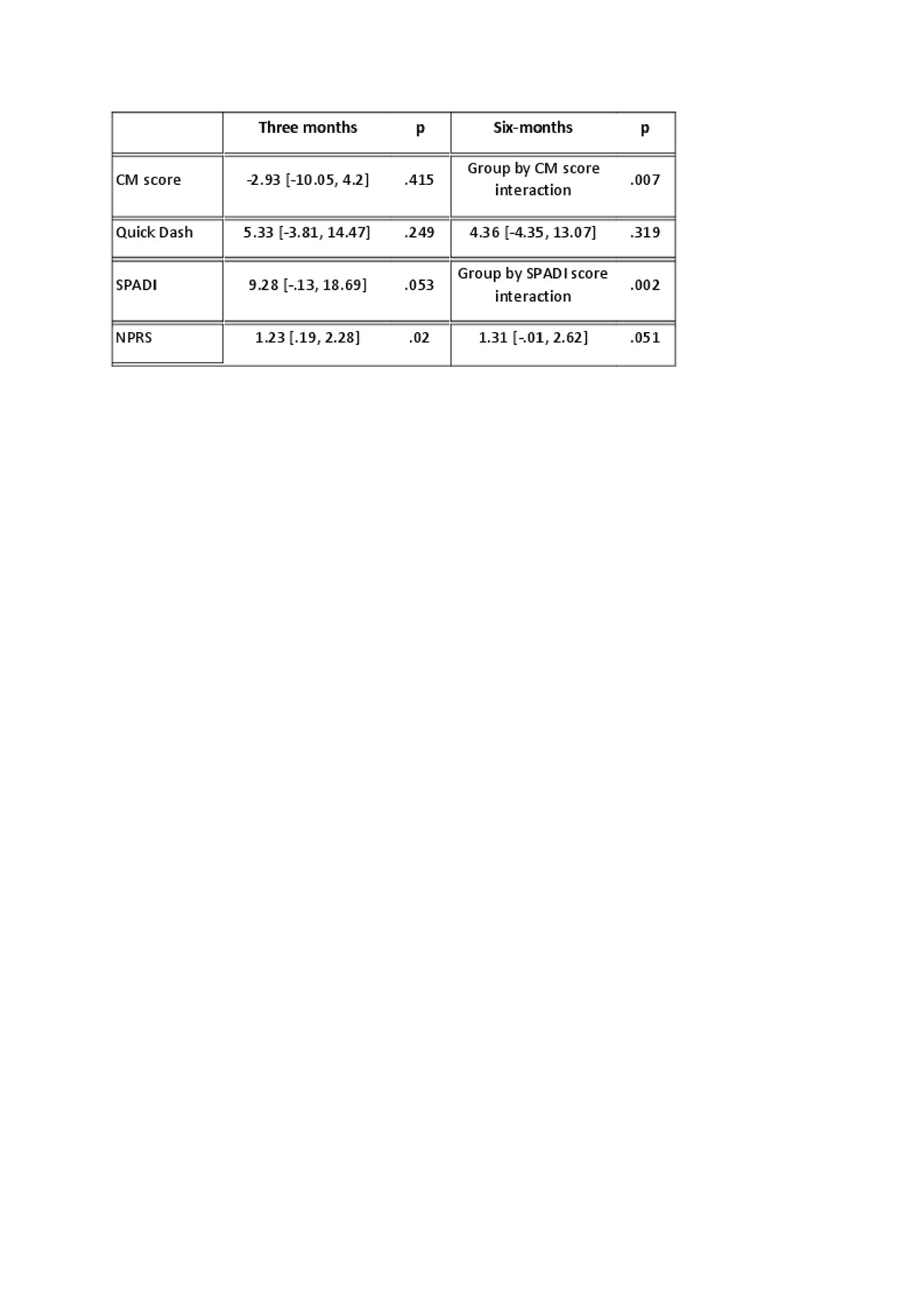
Table 2
To cite this abstract in AMA style:
Keyes S, Walsh N, Phelan M. A Randomised Controlled Clinical Trial Comparing the Effectiveness of 6 and 12 Weeks of a Shoulder Specific Exercise Programme for Patients with Rotator Cuff Related Shoulder Pain [abstract]. Arthritis Rheumatol. 2019; 71 (suppl 10). https://acrabstracts.org/abstract/a-randomised-controlled-clinical-trial-comparing-the-effectiveness-of-6-and-12-weeks-of-a-shoulder-specific-exercise-programme-for-patients-with-rotator-cuff-related-shoulder-pain/. Accessed .« Back to 2019 ACR/ARP Annual Meeting
ACR Meeting Abstracts - https://acrabstracts.org/abstract/a-randomised-controlled-clinical-trial-comparing-the-effectiveness-of-6-and-12-weeks-of-a-shoulder-specific-exercise-programme-for-patients-with-rotator-cuff-related-shoulder-pain/