
Session Information
Session Type: ACR Poster Session A
Session Time: 9:00AM-11:00AM
Background/Purpose: Reported symptom onset and diagnosis debut in rheumatoid arthritis (RA) patients may be influenced by environmental factors, genetics and gene-environmental interactions, but also by cultural and socioeconomic differences. We have shown high burden of RA in younger women in our population surveys.1,2 We aimed to compare symptom onset and diagnosis debut in an Indian and a Dutch cohort.
Methods: METEOR, an international database capturing daily clinical practice, has registered RA patients using a comprehensive online case record form for over two decades. 3500 Indian patients were registered from 2007-2012. We randomly selected a retrospective, cross sectional sample of 500 subjects to contain 125 subjects in each of the four disease duration a-priori categories [ 0-2, 2-5, 5-10, >10 years]. Using similar methods, a Dutch cohort (500 out of 7899 patients, registered between 2000–2012) was selected. Between group differences were compared using Chi-square & Mann-Whitney tests, p-values <0.05 were considered statistically significant.
Results: 85% and 72.5% of patients in the Indian and Dutch cohort were women. The mean age (SD) at symptom onset and diagnosis debut was 39.8 (11.7) and 43.8 (12.1) years respectively in the Indian cohort; these were 52.7 (14.1) and 53.2 (13.9) years in the Dutch cohort (p <0.001). Figure 1 shows the proportion of patients at onset of symptoms as per age groups. Mean disease duration (years) at Meteor entry was not significantly different ( Indian 7.4, Dutch 7.2 ). 33% Indian women and 11% Dutch women in the study data belonged to 16-40 years age group (p<0.05). Indian patients were more often active-severe. 84.2% and 65.2% Indian respectively were RF and ACPA positive: this was 65.1% and 64.4% in the Dutch cohort.
Conclusion: The earlier age at onset in the Indian compared to the Dutch cohort is strikingly significant and merits further research. It has several important implications which are not merely confined to socioeconomic and health care disparities in the study populations.
Acknowledgement: Sponsored by METEOR (The Netherlands) and Arthritis Research Care Foundation (Pune India).
References
1) Chopra A, Ghorpade R, Sarmukkadum S, et al.5 million patients and not 0.34% is worrisome: Burden of rheumatoid arthritis in India. Arthritis Rheumatism 2012; 64: V 10 (Suppl):58: S23
2) Report of a WHO scientific group. The burden of musculoskeletal conditions at the start of the new millennium. Geneva (Switzerland): World Health Organization 2003. WHO Technical Report Series 919
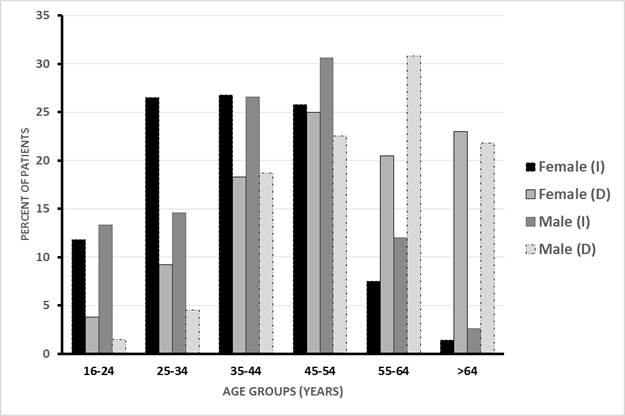
Figure 1. Proportion of patients (percent) in the Indian (I) and Dutch (D) cohort as per onset of symptoms of RA in different age groups
To cite this abstract in AMA style:
Chopra A, Saluja M, Bergstra SA, Kainifard T, Venugopalan A, Huizinga TWJ. A Decade Earlier- Onset of Symptoms of RA in the Indian (Asian) Cohort Compared to Dutch Cohort: Based on Meteor, a Global Database [abstract]. Arthritis Rheumatol. 2018; 70 (suppl 9). https://acrabstracts.org/abstract/a-decade-earlier-onset-of-symptoms-of-ra-in-the-indian-asian-cohort-compared-to-dutch-cohort-based-on-meteor-a-global-database/. Accessed .« Back to 2018 ACR/ARHP Annual Meeting
ACR Meeting Abstracts - https://acrabstracts.org/abstract/a-decade-earlier-onset-of-symptoms-of-ra-in-the-indian-asian-cohort-compared-to-dutch-cohort-based-on-meteor-a-global-database/