
Session Information
Session Type: ACR Poster Session B
Session Time: 9:00AM-11:00AM
Background/Purpose: Osteoporosis is underdiagnosed and undertreated in the Veterans Health Administration (VHA), especially in rural Veterans. Tools to identify risk factors in Veterans are available. To address this issue, VHA Salt Lake City Rural Bone Health Team (BHT) developed the Enrollment Report, a health information technology (HIT). The Enrollment Report operationalizes evidence-based screening guidelines to capture risk factors. Identified Veterans were contacted to participate in the BHT program, a population health osteoporosis management program. This investigation compared the proportion of Veterans with risk factors receiving bone health services, based on participation in the BHT program.
Methods: This study evaluated the impact of a HIT, Bone Health Team Enrollment Report (BHT-ER), on directing bone health services to at-risk Veterans. Risk factors were captured using the VHA Corporate Data Warehouse, a health data repository. For this study, we included Veterans contacted for enrollment between 10/13/2017 and 02/01/2018. A non-experimental cohort design was used to evaluate for changes in the proportion of Veterans with completed diagnostic imaging, ≥ 1 clinical encounter with an osteoporosis diagnosis and prescribed pharmacotherapy, before and after the index date, defined as the first date BHT contacted the Veteran.
Results: Medical and pharmacy records for 81,116 rural Veterans at 4 healthcare systems were queried, with 9,845 (12.1%) Veterans having ≥ 1 risk factor. In the first batch, 750 Veterans have been contacted to participate, 234 (31.2%) have enrolled and 516 (68.8%) have not enrolled. Efforts to enroll the remaining 9,095 Veterans is ongoing. A higher proportion of males have enrolled in the BHT program, with a higher mean Osteoporosis Self-Assessment Tool (OST) score, compared to the Non-Enrolled group. An OST score ≤ 1 was the most commonly identified risk factor in both groups. In the 5 years preceding the index date, a higher proportion of the Non-Enrolled group received bone health services, compared to the Enrolled group. After the index date, a significantly higher proportion of the Enrolled group had a complete DEXA scan, ≥ 1 clinical encounter with an osteoporosis diagnosis and were prescribed anti-resorptive pharmacotherapy, compared to the Non-Enrolled group.
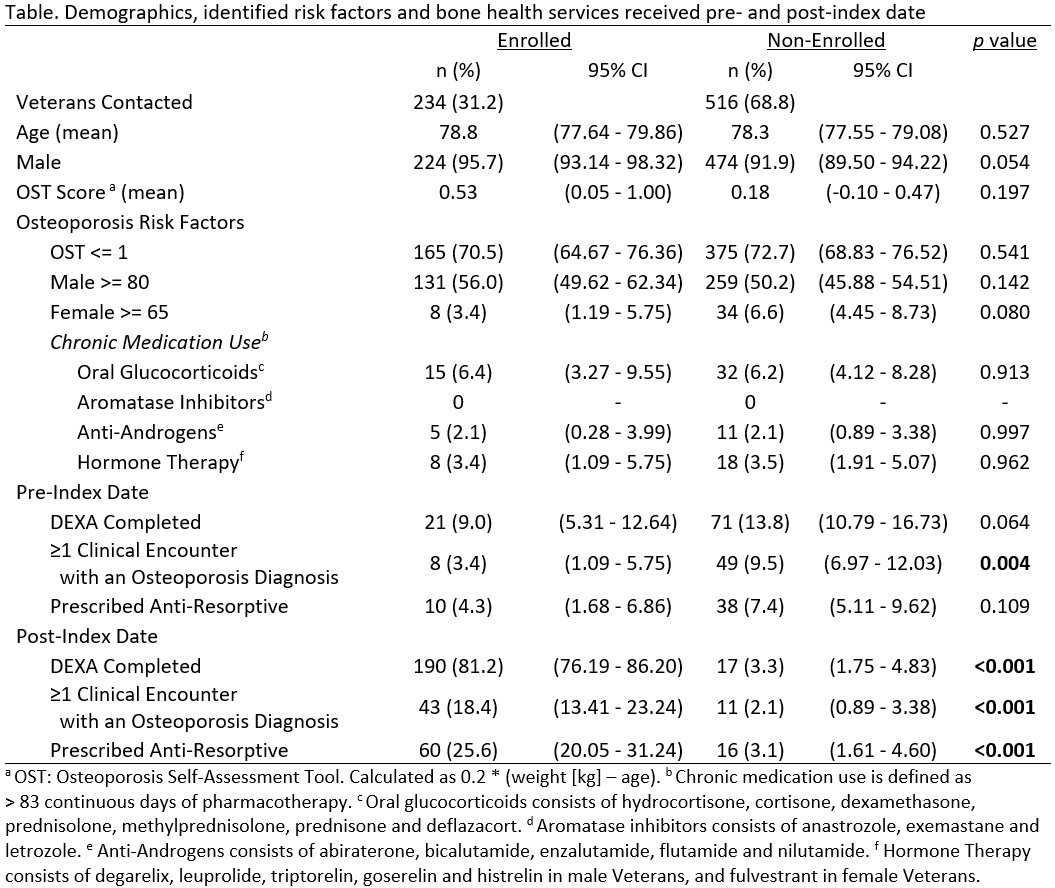
Conclusion: A higher proportion of Veterans received bone health services when enrolled in the BHT program, compared to Veterans who did not enroll. The synergy between the BHT-ER and the BHT program increased the delivery of bone health services to at-risk Veterans. Embedding evidence-based guidelines into HIT effectively identifies risk factors and reduces disparities in bone health care provided to rural Veterans. The BHT program concept and use of HIT can be replicated to increase the delivery of other important clinical services within VHA and medical communities outside VHA.
To cite this abstract in AMA style:
Patel S, Anderson ZL, Cannon GW, Sauer BC, Miller KL. A Customized Health Information Technology Effectively Identifies and Directs Bone Health Services in Rural Veterans with Osteoporosis Risk Factors [abstract]. Arthritis Rheumatol. 2018; 70 (suppl 9). https://acrabstracts.org/abstract/a-customized-health-information-technology-effectively-identifies-and-directs-bone-health-services-in-rural-veterans-with-osteoporosis-risk-factors/. Accessed .« Back to 2018 ACR/ARHP Annual Meeting
ACR Meeting Abstracts - https://acrabstracts.org/abstract/a-customized-health-information-technology-effectively-identifies-and-directs-bone-health-services-in-rural-veterans-with-osteoporosis-risk-factors/