
Session Information
Session Type: Poster Session A
Session Time: 8:30AM-10:30AM
Background/Purpose: Previous studies using cluster analysis technique in axial spondyloarthritis (axSpA) patients have consistently identified distinct groups of patients in terms of their clinical characteristics: those with pure axial symptoms and those with a high frequency of peripheral manifestations. Due to the cross-sectional nature of these studies, however, prognostic information such as drug survival of anti-TNF agents in these group were not provided.
Methods: Clinical characteristics and demographic data of axSpA patients in KOBIO registry were analyzed using hierarchical clustering analysis. After clustering, drug survivals of anti-TNF agents were compared between these groups.
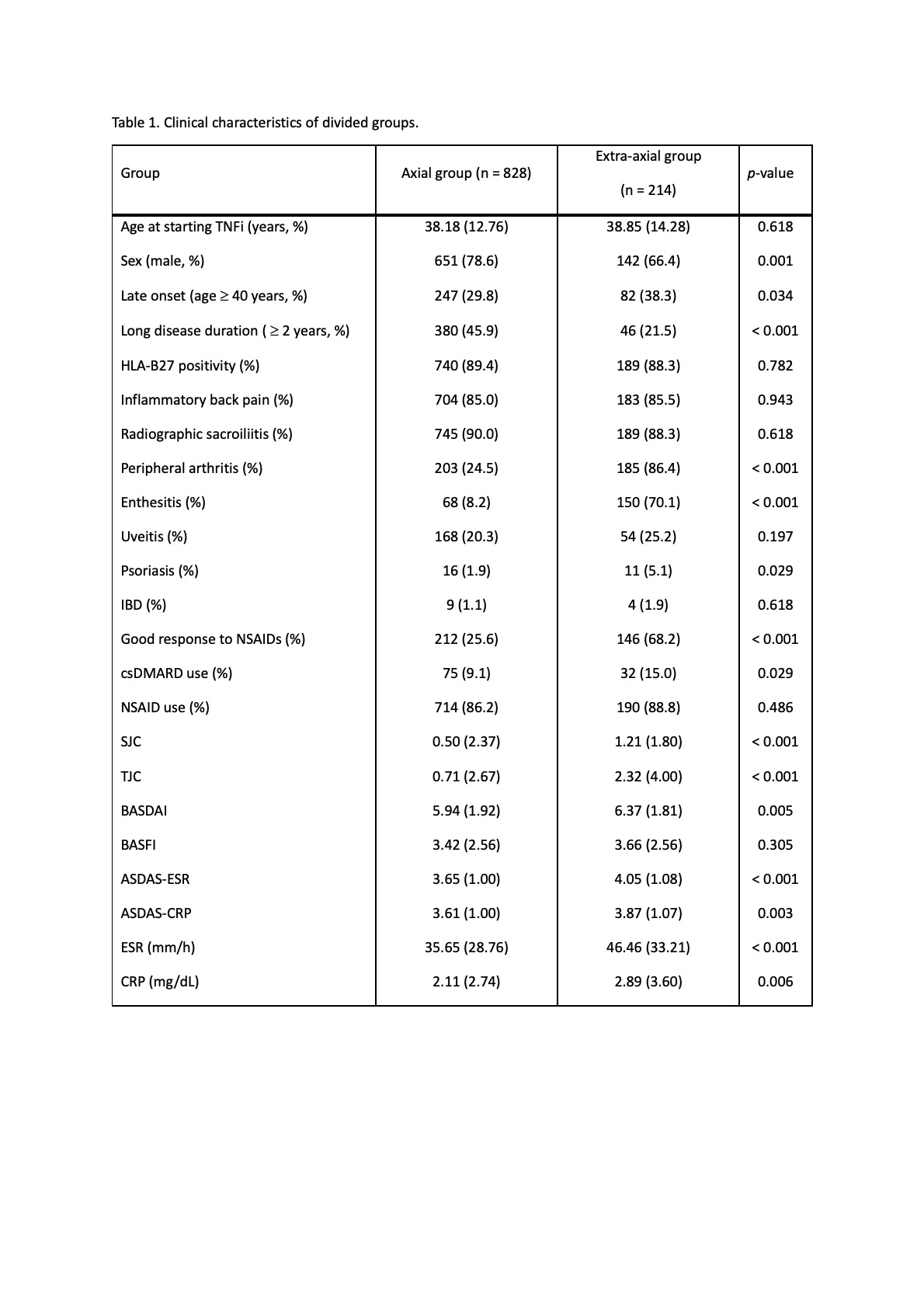
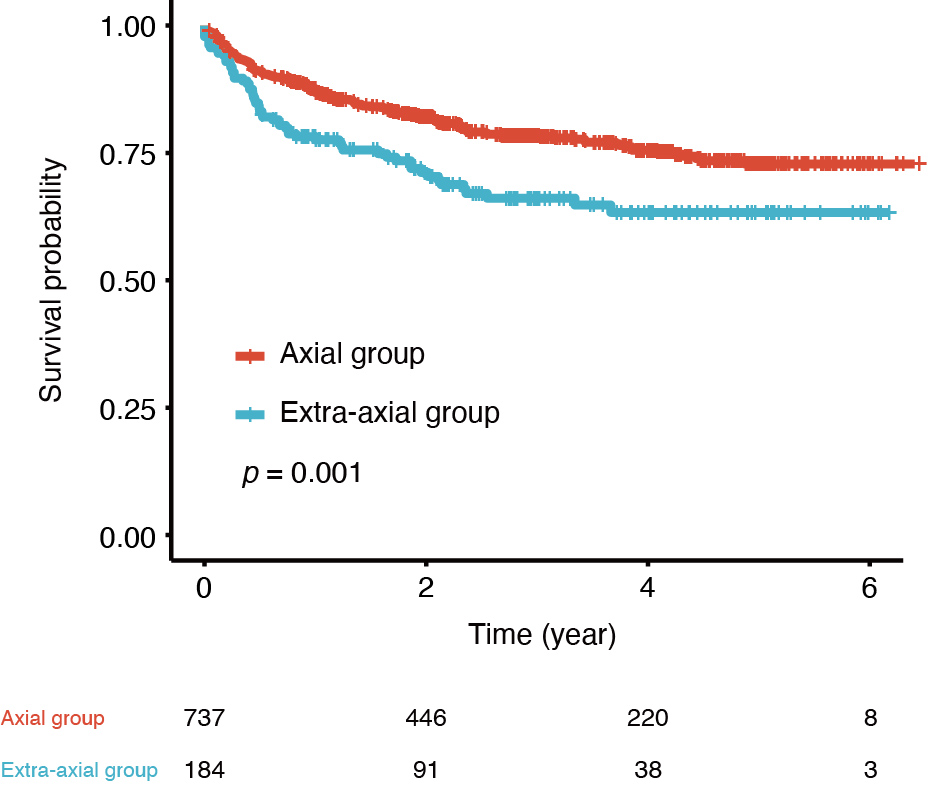
Results: 1,042 patients were included in the study with no missing data. The hierarchical cluster analysis classified patients in two groups; one with predominant isolated axial manifestations (axial group, n=828) and the other with more frequent extra-axial symptoms (extra-axial group, n=214). Almost all extra-axial symptoms (peripheral arthritis, enthesitis, uveitis, and psoriasis) were more frequently observed in extra-axial group than axial group. In addition, patients with shorter disease duration, late disease onset, and high disease activity were classified in extra-axial group (Table 1). Interestingly, the extra-axial group had lower drug survival probability than the axial group (p=0.001, Figure 1).
Conclusion: Cluster analysis of AS patients using anti-TNF agents classified two distinct groups of patients in terms of their clinical phenotypes and revealed that the patients with prominent extra-axial manifestations had lower drug survival with anti-TNF agents.
To cite this abstract in AMA style:
Lee S, Kang S, Eun Y, Kim H, Cha H, Koh E, Lee J. A Cluster Analysis in Patients with Axial Spondyloarthritis Using TNFi Based on Clinical Characteristics [abstract]. Arthritis Rheumatol. 2021; 73 (suppl 9). https://acrabstracts.org/abstract/a-cluster-analysis-in-patients-with-axial-spondyloarthritis-using-tnfi-based-on-clinical-characteristics/. Accessed .« Back to ACR Convergence 2021
ACR Meeting Abstracts - https://acrabstracts.org/abstract/a-cluster-analysis-in-patients-with-axial-spondyloarthritis-using-tnfi-based-on-clinical-characteristics/