ACR Meeting Abstracts

ACR Meeting Abstracts

  • Meetings
    • 2026 ACR/ARP PRSYM
    • ACR Convergence 2025
    • ACR Convergence 2024
    • ACR Convergence 2023
    • 2023 ACR/ARP PRSYM
    • ACR Convergence 2022
    • ACR Convergence 2021
    • 2020-2009 Meetings
    • Download Abstracts
  • Keyword Index
  • Advanced Search
  • Your Favorites
    • Favorites
    • Login
    • View and print all favorites
    • Clear all your favorites
  • ACR Meetings

Abstract Number: 059

Use of Multimodal Teaching to Improve Resident Confidence in Evaluating Rheumatic Conditions

Brittany Anderson1, Kristina Ciaglia2 and Simrat Morris3, 1UT Southwestern, 2UT Southwestern, Dallas, TX, 3University of Texas Southwestern Medical Center, Dallas, TX

Meeting: 2026 Pediatric Rheumatology Symposium

  • Tweet
  • Email a link to a friend (Opens in new window) Email
  • Print (Opens in new window) Print
Session Information

Date: Thursday, March 19, 2026

Title: Posters: Quality, Health Services, and Education Research I

Session Time: 6:00PM-7:00PM

Background/Purpose: Pediatric rheumatology is underrepresented in residency core competencies, and many trainees report limited exposure to core rheumatic conditions.1 As a result, residents may feel insufficiently prepared to evaluate common presentations. To address this educational gap, we implemented a teaching intervention incorporating case-based learning, audiovisual presentation, and hands-on guidance and assessed its impact on pediatric residents’ confidence in evaluating rheumatologic conditions.

Methods: We conducted two academic half-day sessions discussing high yield topics in pediatric rheumatology relevant to both pediatric boards and clinical care. We utilized a case-based approach and incorporated hands-on musculoskeletal joint examination, as well as a video on how to perform a joint exam. Categories evaluated included confidence in performing joint exams as well as identifying rheumatologic emergencies, scleroderma, and periodic fever syndromes. Residents completed de-identified pre- and post-session surveys measuring residents’ confidence (1-4 Likert scale) in evaluating rheumatic conditions.

Results: A total of 33 residents (PGY-2 to PGY-4) attended the session and completed both surveys. Baseline confidence was highest for performing a joint examination (mean 2.2) and lowest for identifying periodic fever syndromes (mean 1.99). The greatest improvement occurred in identifying scleroderma (mean increase of 1.25). Across all categories, average confidence increased by 1.07 (Table 1).

Conclusion: Hands-on and case-based teaching improves resident confidence in recognizing pediatric rheumatologic conditions. By utilizing these tools to provide insight into common topics and emergencies within this field, residents have shown increased confidence in identifying these conditions. This evaluation of residents’ confidence in identifying pediatric rheumatology conditions shows potential for future multimodal lectures that better target weaknesses in rheumatology education.1. Shalen J, Austenfeld E, Vater M, Curran M, Hayward K, Mehta J, et al. Essential Areas of Knowledge in Rheumatology for Pediatric Residents: A Modified Delphi Study. Pediatrics. 2025;156(1). 

Table 1. Pediatric Resident Confidence Scores Pre/Post Teaching Module Supporting image 1
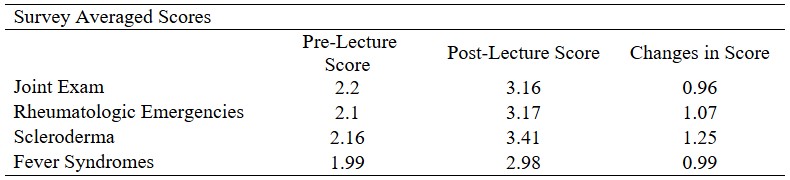
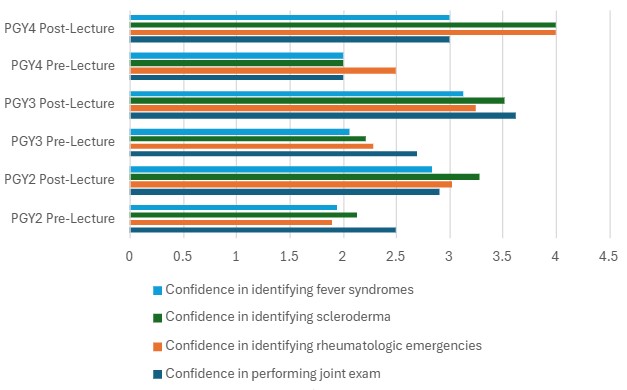
Figure 1. Pediatric Resident Confidence Scores Pre/Post Teaching Module by Year of TrainingSupporting image 2

Disclosures: B. Anderson: None; K. Ciaglia: None; S. Morris: None.

To cite this abstract in AMA style:

Anderson B, Ciaglia K, Morris S. Use of Multimodal Teaching to Improve Resident Confidence in Evaluating Rheumatic Conditions [abstract]. Arthritis Rheumatol. 2026; 78 (suppl 3). https://acrabstracts.org/abstract/use-of-multimodal-teaching-to-improve-resident-confidence-in-evaluating-rheumatic-conditions/. Accessed .
  • Tweet
  • Email a link to a friend (Opens in new window) Email
  • Print (Opens in new window) Print

« Back to 2026 Pediatric Rheumatology Symposium

ACR Meeting Abstracts - https://acrabstracts.org/abstract/use-of-multimodal-teaching-to-improve-resident-confidence-in-evaluating-rheumatic-conditions/

Advanced Search

Your Favorites

You can save and print a list of your favorite abstracts during your browser session by clicking the “Favorite” button at the bottom of any abstract. View your favorites »

Embargo Policy

All abstracts accepted to PRYSM are under media embargo once the ACR has notified presenters of their abstract’s acceptance. They may be presented at other meetings or published as manuscripts after this time but should not be discussed in non-scholarly venues or outlets. The following embargo policies are strictly enforced by the ACR.

Accepted abstracts are made available to the public online in advance of the meeting and are published in a special online supplement of our scientific journal, Arthritis & Rheumatology. Information contained in those abstracts may not be released until the abstracts appear online. In an exception to the media embargo, academic institutions, private organizations, and companies with products whose value may be influenced by information contained in an abstract may issue a press release to coincide with the availability of an ACR abstract on the ACR website. However, the ACR continues to require that information that goes beyond that contained in the abstract (e.g., discussion of the abstract done as part of editorial news coverage) is under media embargo until 6:00 PM CT on March 18. Journalists with access to embargoed information cannot release articles or editorial news coverage before this time. Editorial news coverage is considered original articles/videos developed by employed journalists to report facts, commentary, and subject matter expert quotes in a narrative form using a variety of sources (e.g., research, announcements, press releases, events, etc.).

Violation of this policy may result in the abstract being withdrawn from the meeting and other measures deemed appropriate. Authors are responsible for notifying colleagues, institutions, communications firms, and all other stakeholders related to the development or promotion of the abstract about this policy. If you have questions about the ACR abstract embargo policy, please contact ACR abstracts staff at [email protected].

Wiley

  • Online Journal
  • Privacy Policy
  • Permissions Policies
  • Cookie Preferences

© Copyright 2026 American College of Rheumatology