
Session Information
Session Time: 6:00PM-7:00PM
Background/Purpose: Biologic agents form the cornerstone of therapy for Juvenile Idiopathic Arthritis (JIA); however, the optimal management of flares that occur during ongoing treatment remains unclear. This study aimed to to compare various flare-management strategies.
Methods: A multicenter retrospective cohort study was conducted across four Israeli tertiary pediatric centers, analyzing data from January 2005 to December 2024. The study included non-systemic polyarticular JIA patients who had achieved clinically inactive disease (CID) on a biologic agent and subsequently experienced an articular flare. The primary outcome was maintaining CID for more than three months after a flare intervention. Multivariable logistic regression, Kaplan–Meier curves, and Cox models were used for statistical analysis.
Results: Among 65 patients who experienced a total of 116 flares, five treatment strategies were compared: NSAIDs alone (3/116), intra-articular corticosteroid injection (ICSI, 33/116), biologic dose escalation or interval shortening (50/116), ICSI combined with dose escalation (16/116), and switching biologics (14/116). Overall, 71.6% of flares achieved CID following intervention. The highest success rates were observed with NSAIDs (100%) and ICSI (81.8%), followed by dose escalation (76.0%), ICSI+escalation (62.5%), and the lowest rate with biologic switching (35.7%). Multivariable analysis identified biologic switching as an independent predictor of lower CID success (adjusted OR ~0.27; p=0.036) and delayed remission (HR=0.40; P=0.006). Dose escalation and ICSI+escalation did not differ significantly from ICSI alone.
Conclusion: These findings suggest that in managing non-systemic polyarticular JIA flares occurring while on biologics, local and incremental strategies such as ICSI and optimization of the current biologic agent result in better CID outcomes and faster remission compared to immediately switching biologics. A pragmatic, stepwise algorithm that prioritizes ICSI and biologic optimization before considering a switch may maximize a rapid return to CID and minimize unnecessary cycling of biologic medications.
Comparison of the success probabilities between each of the treatment arms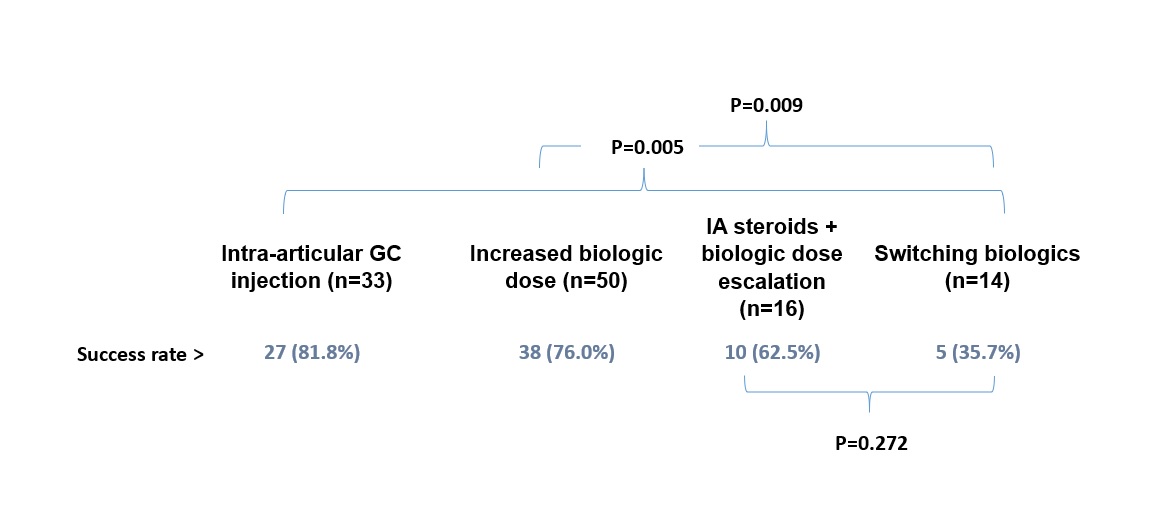
Kaplan-Meier curve showing the success probabilities of the therapeutic strategy according to the different groups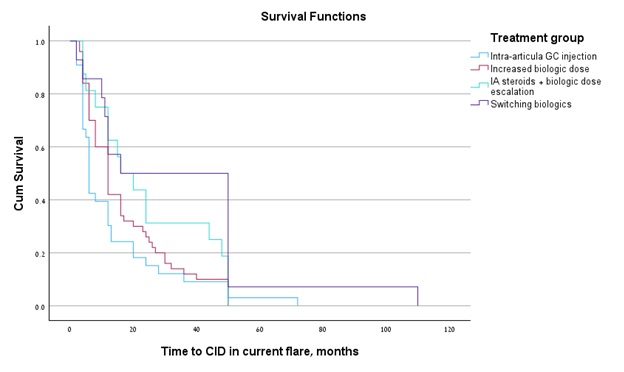
Comparison of clinical and demographic characteristics by treatment outcome (successful vs. unsuccessful)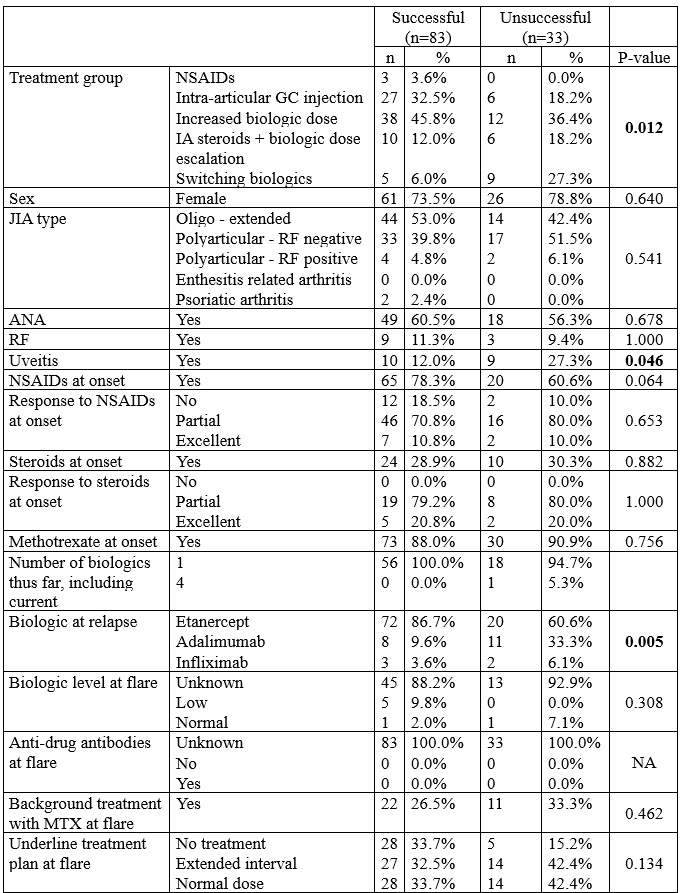
To cite this abstract in AMA style:
zalcman J, Levinsky Y, Harel L, Livny R, amarilyo g. Treatment strategies for articular flares in JIA patients receiving biologic therapy [abstract]. Arthritis Rheumatol. 2026; 78 (suppl 3). https://acrabstracts.org/abstract/treatment-strategies-for-articular-flares-in-jia-patients-receiving-biologic-therapy/. Accessed .« Back to 2026 Pediatric Rheumatology Symposium
ACR Meeting Abstracts - https://acrabstracts.org/abstract/treatment-strategies-for-articular-flares-in-jia-patients-receiving-biologic-therapy/