ACR Meeting Abstracts

ACR Meeting Abstracts

  • Meetings
    • 2026 ACR/ARP PRSYM
    • ACR Convergence 2025
    • ACR Convergence 2024
    • ACR Convergence 2023
    • 2023 ACR/ARP PRSYM
    • ACR Convergence 2022
    • ACR Convergence 2021
    • 2020-2009 Meetings
    • Download Abstracts
  • Keyword Index
  • Advanced Search
  • Your Favorites
    • Favorites
    • Login
    • View and print all favorites
    • Clear all your favorites
  • ACR Meetings

Abstract Number: 074

Tissue Protein Expression Profiling of Interferon Gamma and Frizzled-Wnt-related Signaling Show Increased Periadnexal and Perivascular Localization in Juvenile Localized Scleroderma Skin

Daniel Barnett1, Samantha Branton1, Deren Esencan2, Jinseo Lee2 and Kathryn Torok2, 1UPMC Children's Hospital of Pittsburgh, Pittsburgh, PA, 2University of Pittsburgh, Pittsburgh, PA

Meeting: 2026 Pediatric Rheumatology Symposium

  • Tweet
  • Email a link to a friend (Opens in new window) Email
  • Print (Opens in new window) Print
Session Information

Date: Thursday, March 19, 2026

Title: Posters: Genetics and Pathogenesis I

Session Time: 6:00PM-7:00PM

Background/Purpose: Localized scleroderma (LS) is a disease of inflammatory fibrosis affecting skin and deeper tissue, but the mechanisms driving fibrosis are poorly understood.  Although fibroblasts actively produce fibrotic material, disease tissues show significant immune cell infiltration with a clear role for interactions between T cells, macrophages, and fibroblasts seen in molecular data.  Single cell transcriptomic skin and blood cytokine data  suggests a role for interferon gamma (IFNγ) as a driver of inflammation affected through CXCL9, CXCL10, and their receptor CXCR3 as well as a role for secreted frizzled proteins (SFRP2, SFRP4) and serine protease (PRSS23), with increased transcription in fibroblast subpopulations of affected skin.  The localization of these effectors in skin and their roles in initiating or propagating fibrosis is unclear.  We hypothesized that these cell populations and localization of secreted proteins will show cell interactions affected by these inflammatory and fibrosis-driving signaling pathways.

Methods: Multiplex immunofluorescence (IF) assays were used to stain 4mm skin punch biopsy tissues including 21 LS (8 clinically active, 13 clinically inactive) and 12 healthy controls.  Staining was performed in 2 panels with DAPI, CD3, CD68, and αSMA on both panels, CXCL9, CXCL10, and CXCR3 on panel 1 and SFRP2, SFRP4, and PRSS23 on panel 2.  Cell and IF signal detection was performed by QuPath.

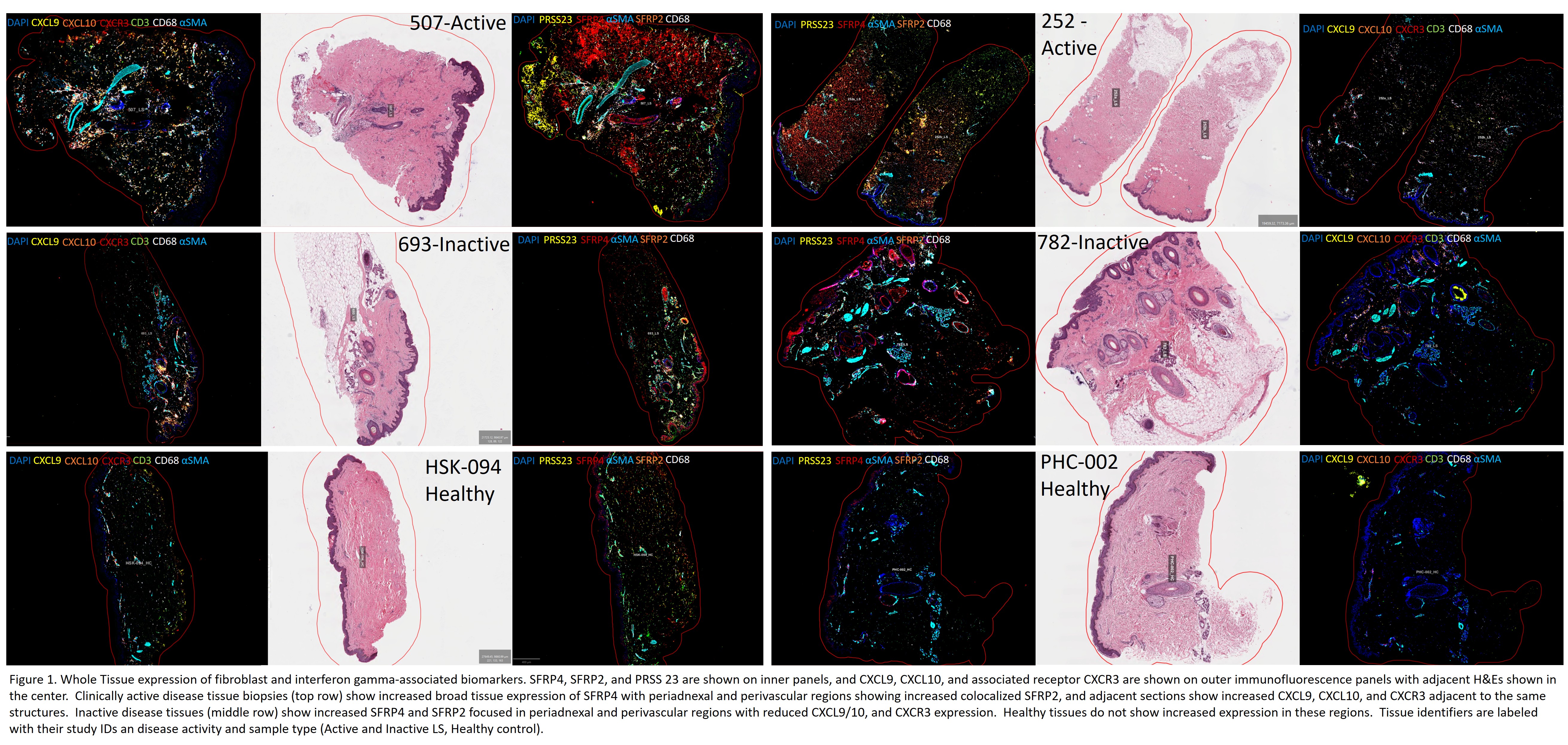
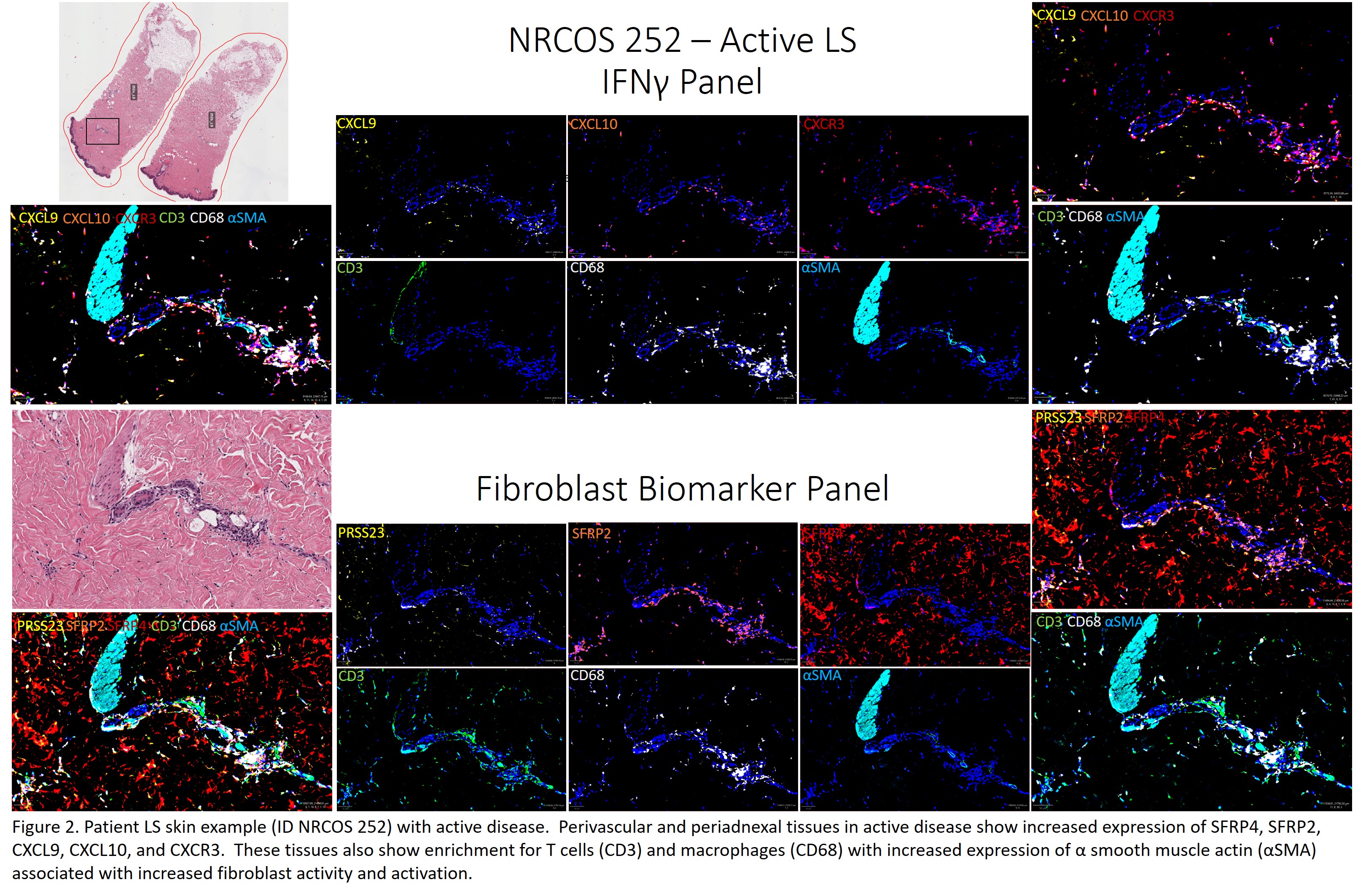
Results: Active localized scleroderma patient tissues show broader increased expression of SFRP4 and more specific SFRP2 and SFRP4 expression in periadnexal and perivascular regions that colocalized with CXCL9, CXCL10, and CXCR3.  Clinically inactive disease tissues also showed increased SFRP4 and SFRP2 in periadnexal and perivascular regions with reduced CXCL9, CXCL10, and CXCR3, while similar regions in healthy control tissues showed low expression of each of these proteins in periadnexal and perivascular regions.  Regions with increased IFN and secreted frizzled proteins are similarly enriched for T cells (CD3) and macrophages (CD68).

Conclusion: Expression of key fibroblast (secreted frizzled proteins 2/4) and inflammatory (CXCL9/10, CXCR3) biomarkers show increased expression and localization to periadnexal and perivascular niches in juvenile localized scleroderma tissues with colocalization of T cells and macrophages in clinically active patients with more focused and reduced expression and localization in inactive and healthy control tissues. 

Whole Tissue Expression of SFRP4, SFRP2, PRSS23, CXCL9, CXCL10, CXCR3, aSMA, CD3, CD68 in Localized Scleroderma and Healthy Control SkinSupporting image 1
Example Feature of Periadnexal and Perivascular Expression of Secreted Frizzled Proteins and IFNg-related ChemokinesSupporting image 2

Disclosures: D. Barnett: None; S. Branton: None; D. Esencan: None; J. Lee: None; K. Torok: None.

To cite this abstract in AMA style:

Barnett D, Branton S, Esencan D, Lee J, Torok K. Tissue Protein Expression Profiling of Interferon Gamma and Frizzled-Wnt-related Signaling Show Increased Periadnexal and Perivascular Localization in Juvenile Localized Scleroderma Skin [abstract]. Arthritis Rheumatol. 2026; 78 (suppl 3). https://acrabstracts.org/abstract/tissue-protein-expression-profiling-of-interferon-gamma-and-frizzled-wnt-related-signaling-show-increased-periadnexal-and-perivascular-localization-in-juvenile-localized-scleroderma-skin/. Accessed .
  • Tweet
  • Email a link to a friend (Opens in new window) Email
  • Print (Opens in new window) Print

« Back to 2026 Pediatric Rheumatology Symposium

ACR Meeting Abstracts - https://acrabstracts.org/abstract/tissue-protein-expression-profiling-of-interferon-gamma-and-frizzled-wnt-related-signaling-show-increased-periadnexal-and-perivascular-localization-in-juvenile-localized-scleroderma-skin/

Advanced Search

Your Favorites

You can save and print a list of your favorite abstracts during your browser session by clicking the “Favorite” button at the bottom of any abstract. View your favorites »

Embargo Policy

All abstracts accepted to PRYSM are under media embargo once the ACR has notified presenters of their abstract’s acceptance. They may be presented at other meetings or published as manuscripts after this time but should not be discussed in non-scholarly venues or outlets. The following embargo policies are strictly enforced by the ACR.

Accepted abstracts are made available to the public online in advance of the meeting and are published in a special online supplement of our scientific journal, Arthritis & Rheumatology. Information contained in those abstracts may not be released until the abstracts appear online. In an exception to the media embargo, academic institutions, private organizations, and companies with products whose value may be influenced by information contained in an abstract may issue a press release to coincide with the availability of an ACR abstract on the ACR website. However, the ACR continues to require that information that goes beyond that contained in the abstract (e.g., discussion of the abstract done as part of editorial news coverage) is under media embargo until 6:00 PM CT on March 18. Journalists with access to embargoed information cannot release articles or editorial news coverage before this time. Editorial news coverage is considered original articles/videos developed by employed journalists to report facts, commentary, and subject matter expert quotes in a narrative form using a variety of sources (e.g., research, announcements, press releases, events, etc.).

Violation of this policy may result in the abstract being withdrawn from the meeting and other measures deemed appropriate. Authors are responsible for notifying colleagues, institutions, communications firms, and all other stakeholders related to the development or promotion of the abstract about this policy. If you have questions about the ACR abstract embargo policy, please contact ACR abstracts staff at [email protected].

Wiley

  • Online Journal
  • Privacy Policy
  • Permissions Policies
  • Cookie Preferences

© Copyright 2026 American College of Rheumatology