
Session Information
Session Time: 6:00PM-7:00PM
Background/Purpose: Autoimmune encephalitis (AE) is a severe neuroinflammatory disorder mediated by antibodies against neuronal receptors. Therapeutic plasma exchange (TPE) can remove autoantibodies, immune complexes, and inflammatory mediators, offering potential benefit in refractory cases. We present the clinical experience of five pediatric patients with AE treated with TPE.
Methods: A retrospective review was conducted of five patients aged 4–14 years (median 9), three males and two females, diagnosed with AE according to Graus et al. (2016). Four had anti-NMDAR antibodies and one was seronegative. Clinical, neuroimaging, EEG findings, therapeutic approach, and outcomes were analyzed.
Results: All patients exhibited acute or subacute onset of seizures, behavioral changes, movement disorders, and encephalopathy. Neuroimaging findings ranged from normal studies to demyelinating or ischemic-like lesions. EEG and video-EEG showed generalized cortical dysfunction and continuous epileptic activity. Each received 3–7 TPE sessions (median 5) using 5% albumin as replacement fluid. Concomitant immunotherapy included corticosteroids in all, IV immunoglobulin in three, mycophenolate in two, and rituximab in one partial responder. No major adverse events directly related to TPE occurred. Intercurrent infections (pneumonia, urinary tract infection, catheter-related bacteremia) were observed in three patients (60%). Four patients (80%) achieved complete or partial remission, while one developed persistent neurologic sequelae.
Conclusion: TPE was associated with meaningful clinical improvement and an acceptable safety profile in children with AE, particularly when introduced early and combined with standard immunotherapy. Despite the small sample and retrospective design, this series supports TPE as an effective adjunctive treatment for pediatric AE and highlights the need for prospective studies to define its long-term impact.
Figure 1. Clinical features and outcomes of five pediatric patients with autoimmune encephalitis treated with plasma exchange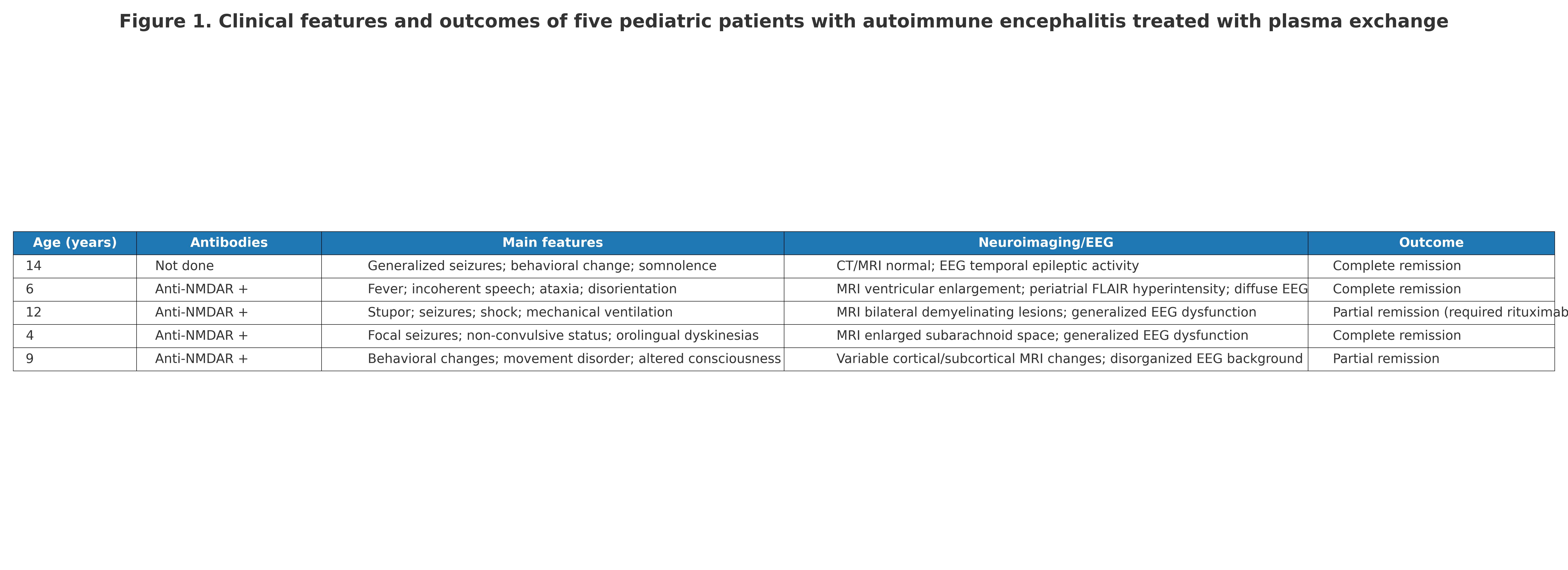 Therapeutic plasma exchange (TPE) was administered to five children with autoimmune encephalitis (four anti-NMDAR positive, one seronegative). The table summarizes age, antibody status, predominant clinical manifestations, neuroimaging and EEG findings, and clinical outcomes. Most patients achieved complete or partial remission with acceptable safety, supporting early TPE as an effective adjunctive therapy in pediatric autoimmune encephalitis.
To cite this abstract in AMA style:
Kattan I, LARA HERERA P, FAUGIER FUENTES E, Leon, MD C, Sanchez A, De Leon V, Juarez E. Therapeutic Plasma Exchange in Pediatric Autoimmune Encephalitis [abstract]. Arthritis Rheumatol. 2026; 78 (suppl 3). https://acrabstracts.org/abstract/therapeutic-plasma-exchange-in-pediatric-autoimmune-encephalitis/. Accessed .« Back to 2026 Pediatric Rheumatology Symposium
ACR Meeting Abstracts - https://acrabstracts.org/abstract/therapeutic-plasma-exchange-in-pediatric-autoimmune-encephalitis/