
Session Information
Session Type: ACR Poster Session C
Session Time: 9:00AM-11:00AM
Background/Purpose: The “Rheumatoid Arthritis Impact of Disease” (RAID)
score is a Patient Reported Outcome (PRO) that comprises seven domains of disease[1], that may reflect the patient’s perspective more
widely than other PROs. A cut-off corresponding to
the patient acceptable symptom state (PASS) has been defined as RAID score <=2
[2]. This study aims: 1) to
assess the associations between the RAID and established measures used in RA
(disease activity measures and other PROs); 2) to analyse the relationship
between clinical remission and PASS by RAID.
Methods: Consecutive
RA patients (ACR/EULAR 2010 or ACR 1987 criteria) followed in a tertiary rheumatology
department were included in this cross-sectional study. Patient demographics
and clinical data collected were: DAS28, SDAI, CDAI and HAQ; patient and
physician global assessment (PGA and PhGA); the Hospital Anxiety and Depression Scale (HADS), the
Happiness Scale (HS) and the EuroQOL (EQ5D) score.
RAID and DAS28 (4vCRP) scores were classified according to PASS and remission
definitions (<=2 and <=2.6, respectively). We used Spearman correlation
coefficient, Qui-square and Kappa as statistic tests.
Results: 101
patients were included (82% females, 58.8±12.4 years and 13.0±8.6 years of
disease duration). Disease impact and activity were moderate: mean RAID=4.8±2.2
and mean DAS28(4vCRP)=2.9±1.2. RAID showed moderate
correlations with most of the established combined indices of disease activity,
with the HAQ having the highest correlation (r=0.66). Regarding other PROs,
RAID was strongly correlated with PGA (r=0.70) and moderately with the
remaining (Table 1).

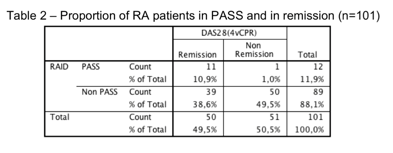
Out of 50 patients in DAS28
remission, 11 had a RAID score consistent with PASS but 39 had higher scores.
Of the 51 patients not in remission, only one patient had a RAID score
consistent with PASS (Table 2). This difference of proportions was
statistically significant (X2(1)=9.684; p=0.002; Kappa=0.20).
Conclusion: RAID
correlates well with different PROs and moderately with disease activity
scores. Its use in clinical practice may allow a better representation of the
global impact of RA in patient’s lives.
As disease remission by DAS and
PASS by RAID are in disagreement for a considerable percentage of patients,
further research on this topic is warranted.
References:
1. Gossec
L, et al. Ann Rheum Dis 2011;70(6):935-42.
2. Dougados
M, et al. Arth Res & Ther
2012;14(3):R129.
To cite this abstract in AMA style:
Ferreira RJO, Duarte C, Batista S, Medeiros C, Sousa JP, Eugénio G, Costa C, Carvalho P, Ferreira JF, Coutinho M, Salvador MJ, Gossec L, da Silva JAP. The “Rheumatoid Arthritis Impact of Disease”� Score Correlates with Other Patient Reported Outcomes and with Disease Activity Scores in Patients with RA and Its Patient Acceptable Symptom State Is More Stringent Than DAS28-Remission [abstract]. Arthritis Rheumatol. 2015; 67 (suppl 10). https://acrabstracts.org/abstract/the-rheumatoid-arthritis-impact-of-disease%ef%bf%bd-score-correlates-with-other-patient-reported-outcomes-and-with-disease-activity-scores-in-patients-with-ra-and-its-patient-acceptable-symptom-stat/. Accessed .« Back to 2015 ACR/ARHP Annual Meeting
ACR Meeting Abstracts - https://acrabstracts.org/abstract/the-rheumatoid-arthritis-impact-of-disease%ef%bf%bd-score-correlates-with-other-patient-reported-outcomes-and-with-disease-activity-scores-in-patients-with-ra-and-its-patient-acceptable-symptom-stat/