
Session Information
Session Time: 6:00PM-7:00PM
Background/Purpose: Takayasu arteritis (TAK) can occur throughout the lifespan and impacts health-related quality of life (HRQoL). This study examined the relationship between age at diagnosis of TAK and HRQoL.
Methods: The source of data was a longitudinal, prospective cohort of patients with TAK followed in the physician- and patient-led Vasculitis Patient-Powered Research Network (VPPRN, online patient-reported data). The cohort was stratified by age at diagnosis: < 40 years (younger) and ≥ 40 years (older). Descriptive statistics were summarized. Univariable and multivariable linear regressions assessed associations between age at diagnosis and Patient-Reported Outcomes Measurement Information System (PROMIS) scores. The multivariable model adjusted for glucocorticoid use and age at HRQoL assessment.
Results: Analysis included 202 patients with TAK, 139 (68.8%) diagnosed at a younger age and 63 (31.2%) at an older age (Table 1). Both cohorts had a similar proportion of females (95%) and length of follow up at quality of life assessment (11.3 and 11.7 years respectively). Glucocorticoid use impacted HRQoL. In univariable analyses, only HRQoL scores related to sleep disturbance and physical functioning differed by age at diagnosis (Table 1). When adjusted, the HRQoL score related to sleep disturbance for those diagnosed younger was estimated to be 3.84 points lower (i.e. better) than those diagnosed older (95%CI: [-7.35, -0.34], p < 0.03), with no difference in HRQoL scores related to fatigue, depression, pain interference, satisfaction with participation in social roles, physical functioning, or anxiety between age at diagnosis groups (Table 2).
Conclusion: Compared to patients diagnosed with TAK at older ages, those diagnosed at younger ages have better HRQoL related to sleep disturbance and similar HRQoL related to fatigue, depression, pain interference, satisfaction with participation in social roles, physical functioning, and anxiety. Glucocorticoid use impacts the HRQoL of patients with TAK. Future studies of larger cohorts are needed during childhood and young adulthood to further assess the impact of age at diagnosis on HRQoL and guide interventional tools for people with TAK.
Table 1. Characteristics of patients with Takayasu Arteritis based on age at diagnosis.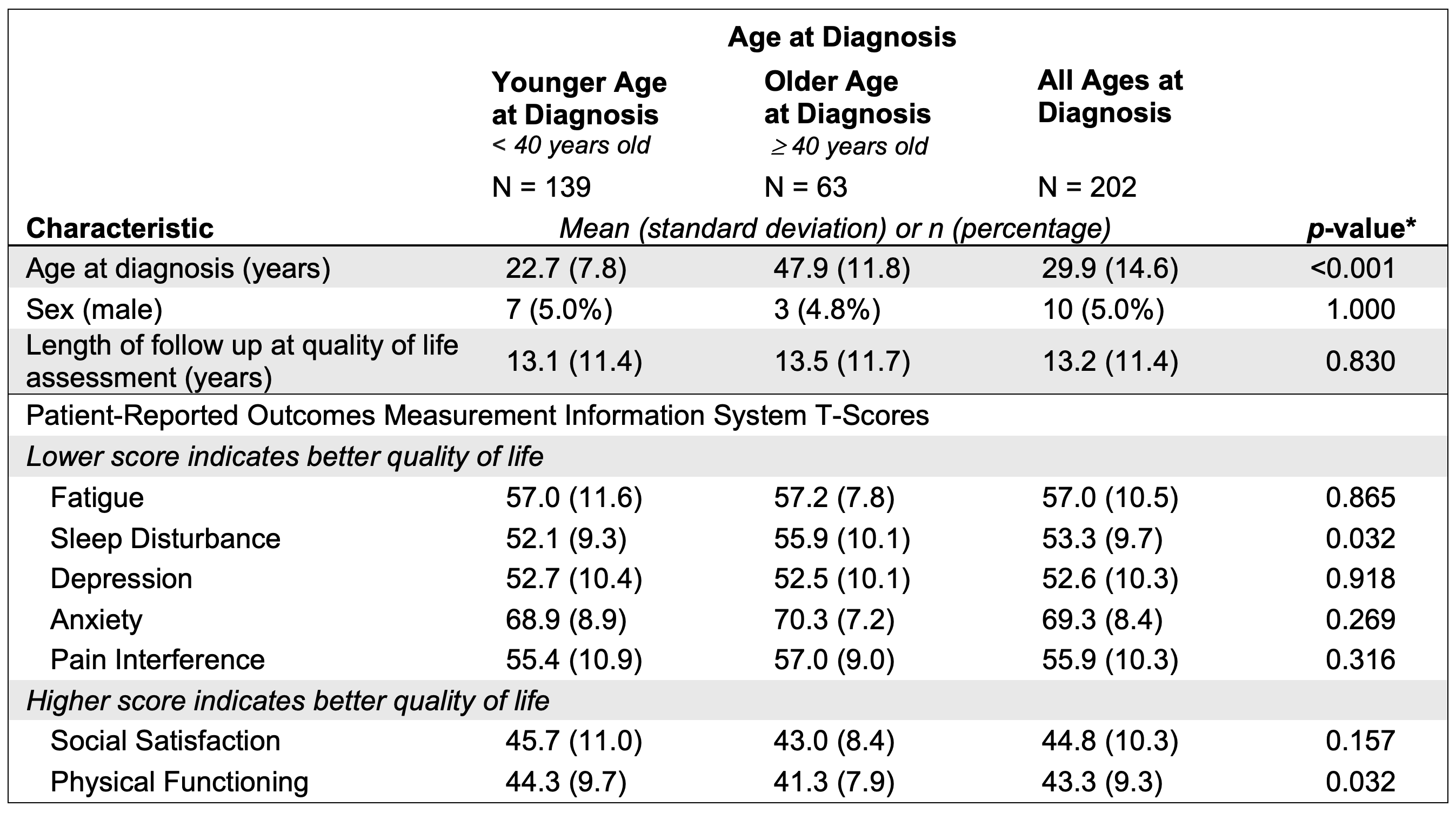 Unknown or missing responses for each score were not included. *Statistical significance was set at 0.05.
Table 2. Multivariable analysis of differences in Patient-Reported Outcomes Measurement Information System scores based on age at diagnosis.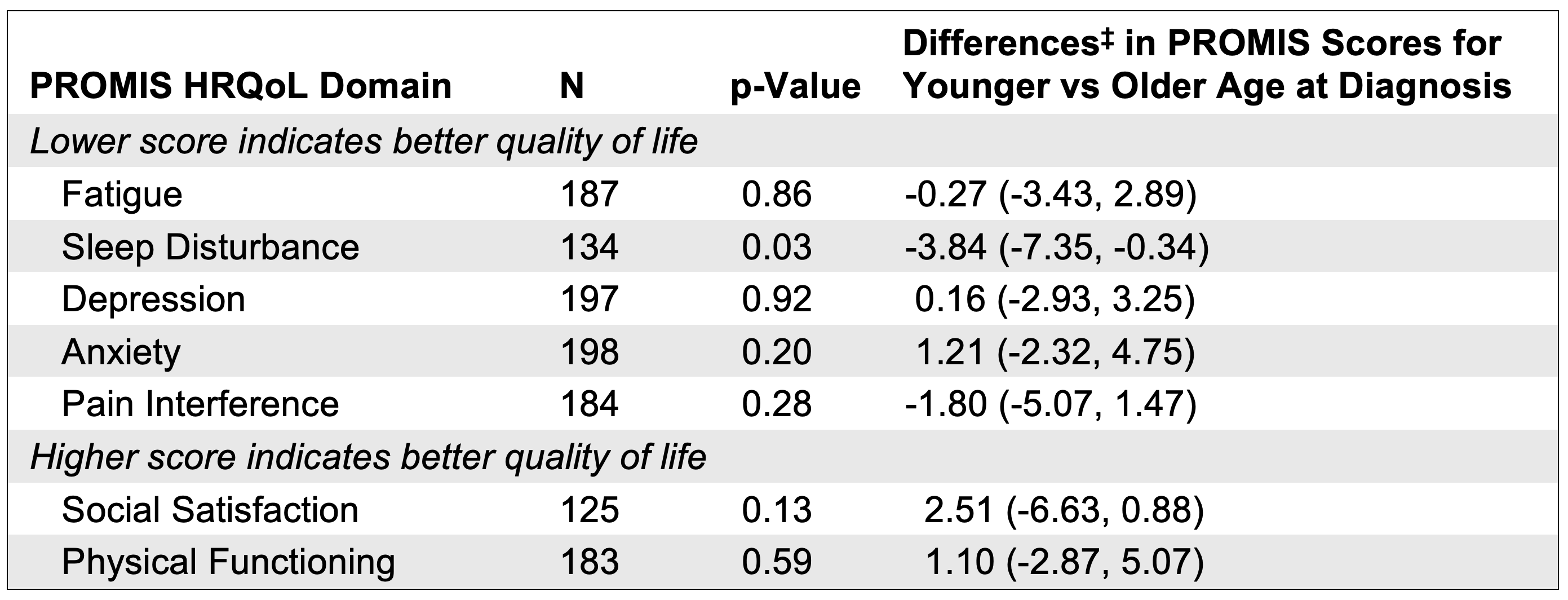 PROMIS, Patient-Reported Outcomes Measurement Information System. HRQoL, health-related quality of life.
Unknown or missing responses for each score were not included. *Statistical significance was set at 0.05.
‡Differences in scores between age at diagnosis groups were assessed via multivariable linear regression adjusting for age at time of quality-of-life assessment and glucocorticoid use if significant in the univariable analysis at p < 0.05 level. Sex was left out of univariable model due to the majority of patients being female. If the confidence interval includes zero, the difference is not significant. A positive estimated difference in scores represents a higher score for younger age at diagnosis than older age at diagnosis, while a negative difference represents a lower score in younger age at diagnosis than older age at diagnosis.
To cite this abstract in AMA style:
Bloom J, Pickett-Nairne K, Silveira L, Burroughs C, Bargender K, Bolton A, Yeung C, Gordon J, Merkel P, James K. The Association Between Age at Diagnosis and Health-Related Quality of Life in Takayasu Arteritis [abstract]. Arthritis Rheumatol. 2026; 78 (suppl 3). https://acrabstracts.org/abstract/the-association-between-age-at-diagnosis-and-health-related-quality-of-life-in-takayasu-arteritis/. Accessed .« Back to 2026 Pediatric Rheumatology Symposium
ACR Meeting Abstracts - https://acrabstracts.org/abstract/the-association-between-age-at-diagnosis-and-health-related-quality-of-life-in-takayasu-arteritis/