
Session Information
Date: Sunday, October 26, 2025
Session Type: Abstract Session
Session Time: 3:30PM-3:45PM
Background/Purpose: The presence of serum anti-CCP-IgG antibodies can predict the future development of clinically evident RA. Neutrophil extracellular trap (NET) formation can be a source of extracellular citrullinated (cit) proteins that can be antigenic targets of anti-CCP. Our group previously reported increased NET formation of sputum neutrophils from the lungs of individuals with RA and at-risk for RA that correlated with sputum anti-CCP levels. The objective of this study was to evaluate the relationship between sputum anti-CCP, sputum NET-associated proteins, and the risk and timing of transitions from an ‘at-risk’ state of systemic autoimmunity to clinical RA.
Methods: We included 98 individuals who were serum anti-CCP-IgG(+) (CCP3, Werfen), without examination evidence of inflammatory arthritis (IA) at baseline, had at least one follow-up visit with a joint examination, and had a baseline induced sputum sample. Nineteen individuals (19.4%) met 2010 ACR/EULAR classification criteria for RA (Classified RA) and 71 (72.4%) did not develop RA after at least 12 months of follow-up. There were 8 individuals who developed unclassifiable IA and were excluded from this analysis. Baseline sputum cell-free supernatant was tested by ELISA for anti-CCP-IgG (CCP3) and anti-CCP-IgA (CCP3.1 plate with research modification to detect IgA only). In a subset with adequate sample remaining, sputum supernatant was tested by immunoassays for NET-associated proteins, including calprotectin (Werfen), extracellular DNA (exDNA, Invitrogen), extracellular neutrophil elastase (exNE, Invitrogen), nucleosomes (Nu.Q H3.1, Volition) and cit-nucleosomes (Nu.Q H3R8Cit, Volition).
Results: Baseline sputum anti-CCP levels were higher in individuals who later transitioned to Classified RA compared to those who did not develop RA (anti-CCP-IgA, p< 0.001; anti-CCP-IgG, p=0.003, Table 1, Figure 1A-B). Sputum nucleosome and cit-nucleosome levels were also higher in individuals who transitioned to RA (Table 1, Figure 1C-D), but were not independently associated after adjusting for sputum anti-CCP-IgA level. Within individuals who transitioned to RA, sputum calprotectin and exNE levels correlated with time to RA onset (Figure 2A-B), with lower levels in those who developed RA within 12 months (Figure 2C-D). Sputum anti-CCP-IgA, exDNA, nucleosome, and cit-nucleosome and plasma calprotectin levels did not correlate with time to RA onset (p >0.05).
Conclusion: We found that anti-CCP and NET-associated nucleosomes in the sputum are increased in serum anti-CCP3+ individuals who transitioned to Classified RA. Sputum NET-associated proteins calprotectin and exNE correlated with time to RA onset, though surprisingly were lower in the 12 months preceding RA onset. These data support an important role of lung immunobiology and NETosis in transitions from systemic autoimmunity to RA and identify sputum biomarkers that can enhance prediction and timing of RA. Longitudinal studies are needed to determine whether decreasing sputum calprotectin and exNE levels result from enhanced local clearance and whether this process plays a role in imminent RA onset.

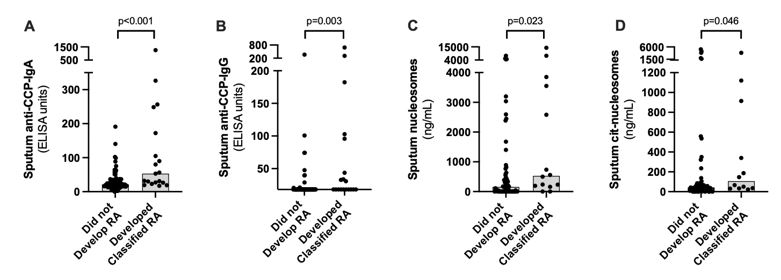 Figure 1. Sputum anti-CCP and nucleosome levels in individuals at-risk for RA. The figure depicts baseline sputum anti-CCP-IgA (Panel A), sputum anti-CCP-IgG, (Panel B), sputum nucleosome (Panel C) and sputum citrullinated nucleosome (cit-nucleosome, Panel D) in serum anti-CCP-IgG positive individuals who did vs. did not develop Classified RA during follow-up. P-values calculated by Wilcoxon rank sum test.
 Figure 2. Sputum calprotectin and extracellular neutrophil elastase (exNE) levels associated with timing of RA onset. In serum anti-CCP-IgG positive individuals who developed Classified RA within 36 months of follow-up, the figure depicts correlations between time to RA onset (in months from baseline visit) and baseline sputum calprotectin (Panels A) or sputum exNE (Panels B). P-values by Spearman’s correlation. Baseline sputum calprotectin (Panel C) and sputum exNE (Panel D) levels are compared between individuals who developed Classified RA in 0-12 months vs. 13-36 months after baseline sputum. P-values calculated by Wilcoxon rank sum test.
To cite this abstract in AMA style:
Wilson T, Lugo C, Feser M, Gillespie M, Torgerson T, Firestein G, Holers V, Deane K, Demoruelle K. Sputum Anti-CCP-IgA and NET-Associated Proteins Predict Risk and Timing of the Transition From Systemic Autoimmunity to Classified RA [abstract]. Arthritis Rheumatol. 2025; 77 (suppl 9). https://acrabstracts.org/abstract/sputum-anti-ccp-iga-and-net-associated-proteins-predict-risk-and-timing-of-the-transition-from-systemic-autoimmunity-to-classified-ra/. Accessed .ACR Meeting Abstracts - https://acrabstracts.org/abstract/sputum-anti-ccp-iga-and-net-associated-proteins-predict-risk-and-timing-of-the-transition-from-systemic-autoimmunity-to-classified-ra/