
Session Information
Session Time: 5:00PM-6:00PM
Background/Purpose: Nature-based interventions (NBIs) improve physical, mental, and social health, but their effect on the health and well-being of youth with rheumatic diseases is unknown. The objective of this study is to identify barriers and facilitators of nature engagement among adolescents with JIA, describe their perceptions of the relationship between nature and their health, and explore their perspectives on the feasibility, acceptability, and impact of established nature-based health interventions. Results will inform the future design of patient-centered NBIs for youth with rheumatic diseases.
Methods: We conducted a qualitative study using semi-structured interviews with JIA patients aged 14-21. We recruited participants from pediatric rheumatology clinics at a single tertiary children’s hospital and the 2025 Arthritis Foundation’s Juvenile Arthritis Family Summit. We used purposive sampling by JIA subtype, rurality, age, and state of residence to maximize diversity of experiences. Interviews, held virtually, were audio-recorded and automatically transcribed. We analyzed the data via modified grounded theory analysis with each transcript analyzed by two independent coders. Codebook creation and refinement occurred via serial coding review meetings. We reviewed memos, excerpts, and codes to synthesize themes.
Results: From 22 enrolled participants representing all JIA subtypes, we completed 20 interviews. Interviewed participants had a mean age of 16.6 years (SD 2.3), with 70% from urban/suburban communities, median household income of $125-150K, and 67% from Utah. Mean interview duration was 59 minutes (SD 6.5). We identified 4 preliminary themes:
1) Being in nature positively impacts participants’ mental health through a) increasing calm, joy, and presence/mindfulness and b) facilitating an emotional reset, which improves ability to cope.
2) Being in nature distracts from arthritis symptoms, especially pain, which improves pain; distraction occurs through a) sensory experiences and b) appreciation of nature’s beauty, feelings of awe/wonder, and sense of accomplishment.
3) Arthritis leads to unique barriers to engaging with nature, including a) weather and weather changes affect arthritis symptoms, b) physical limitations from arthritis affect nature engagement, and c) comparison with peers affects desire to engage in nature activities.
4) Identifying with nature positively impacts sense of self through a) facilitating self-acceptance, b) increasing feelings of resilience, c) enhancing empathy with non-human life, and d) creating a sense of self-connection through connection with nature.
Table 1 features exemplar quotes by theme.
Conclusion: Adolescents with JIA perceive that nature engagement positively impacts their health through increasing calm and joy while decreasing stress and worry, improving perceived pain, and facilitating connection, empathy, and a positive sense of self. NBIs may be promising, novel approaches to support the holistic health and wellbeing of youth with JIA and other rheumatic diseases. Future research directions include trialing NBIs among adolescents with JIA and exploring nature engagement among youth with other rheumatic diseases.
Table 1 (Page 1)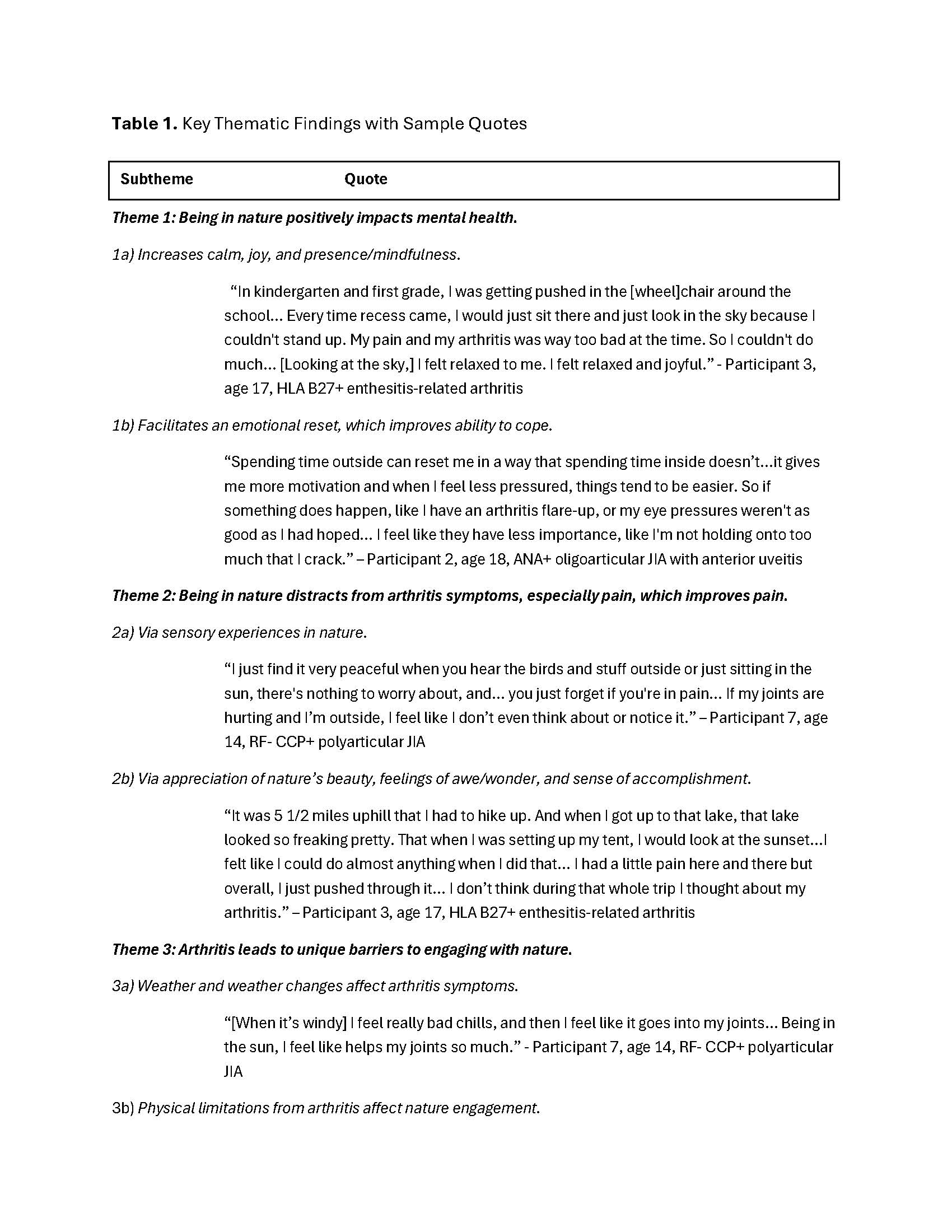 Key Thematic Findings with Sample Quotes (Page 1)
Table 1 (Page 2)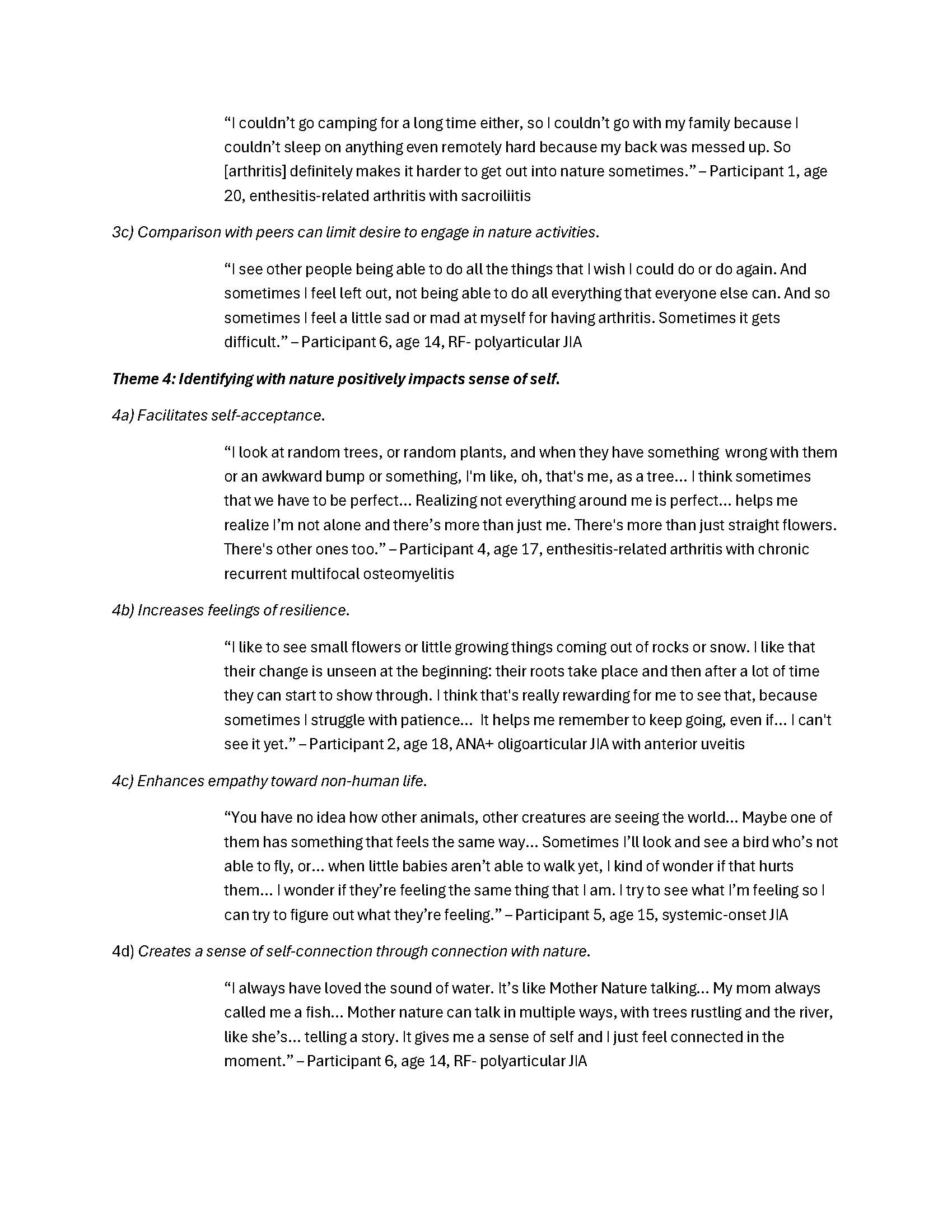 Key Thematic Findings with Sample Quotes (Page 2)
To cite this abstract in AMA style:
Saltzman H, Wallgren S, Hersh A, Chiraseveenuprapund P, Stern S, James K, Zhu A, Tuddenham L, Peckenpaugh C, Lin J. Setting the Stage for an Effective, Accessible, and Patient-Centered Nature-Based Intervention for Adolescents with Juvenile Idiopathic Arthritis (JIA) [abstract]. Arthritis Rheumatol. 2026; 78 (suppl 3). https://acrabstracts.org/abstract/setting-the-stage-for-an-effective-accessible-and-patient-centered-nature-based-intervention-for-adolescents-with-juvenile-idiopathic-arthritis-jia/. Accessed .« Back to 2026 Pediatric Rheumatology Symposium
ACR Meeting Abstracts - https://acrabstracts.org/abstract/setting-the-stage-for-an-effective-accessible-and-patient-centered-nature-based-intervention-for-adolescents-with-juvenile-idiopathic-arthritis-jia/