
Session Information
Session Time: 4:49PM-4:54PM
Background/Purpose: Musculoskeletal ultrasound (MSUS) is a diagnostic and interventional tool for juvenile idiopathic arthritis (JIA). Various workgroups (WG) have proposed MSUS scanning and scoring protocols to quantify JIA disease activity, including the Childhood Arthritis Rheumatology Research Alliance (CARRA) WG. The CARRA pediatric-specific scoring systems (PAUSS) has good-to-excellent interrater reliability for the knee, elbow, wrist, finger, and ankle. The knee- and ankle-PAUSS have excellent accuracy for synovitis detection when compared to contrast-enhanced MRI.
While previous work assessed the PAUSS reliability, there are no published studies on scanning protocol reliability. The objective of this study was to determine the reliability of the pediatric joint-specific scanning protocols proposed by the CARRA MSUS WG.
Methods: This IRB-approved study had 2 parts: scanning sessions and image scoring.
Scanning sessions. Sonographers included seven certified rheumatologist-sonographers, with post-training experience ranging from 1 to >10 years. Recruited patients with JIA were ≤ 18 years-old with at least 1 active joint based on recent physical examination by a rheumatologist. ILAR classification was used for JIA subtypes.
Sonographers reviewed the scanning protocols and were blinded to patient JIA subtype and disease activity. The same ultrasound machines were used, with standardized grayscale (B-mode) and power doppler (PD) mode settings. Sonographers obtained paired (B- and PD-mode) still images from each patient for 4-6 predetermined active and normal joints.
Image scoring. Eleven blinded rheumatologist-sonographers (raters) then scored the images using PAUSS. Using 117 paired images, a calibration exercise to assess inter-rater reliability was performed prior to formal scoring and showed excellent reliability [intra-class correlation (ICC) ≥0.80].
Statistical Analysis. The scanning protocol reliabilities were assessed by evaluating the ICC among raters for the same image/patient, defined as follows: 0.75 – 1.00 = excellent, 0.60 – 0.74 = good, 0.40 – 0.59 = fair, and < 0.4 = poor. The 95% confidence interval (CI) was included.
Results: Table 1 summarizes the demographics of the 10 JIA patients. A total of 365 joints were scanned; 1657 paired images acquired. The inter-rater reliability of the scoring protocol was excellent [ICC 0.88 (0.97 – 0.89)]. The scanning protocol reliability for all joints was excellent [ICC 0.89, 95% CI (0.89 – 0.90)] (Table 2). The knee and ankle joints had excellent ICC, while finger tendons had the lowest ICC. The ICC for each view was determined to further evaluate the reliability of the scanning protocol (Table 3).
Conclusion: To our knowledge, this is the first study evaluating the reliability of the CARRA MSUS scanning protocol, demonstrating good to excellent reliability for the knee, ankle, wrist, and finger joints. The findings highlight the opportunity to further standardize sonographic evaluation of the wrist and finger tendons. This study supports the use of the CARRA PAUSS as an instrument for the assessment of disease activity and potential JIA outcome measure.
Demographics of Patient Participants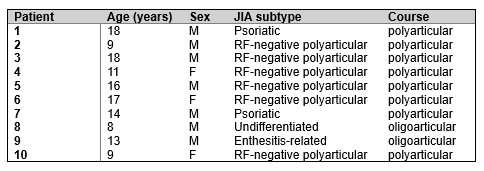 Demographics of participating patients. Patient ages ranged from 8 years-old to 18 years-old. Using the ILAR criteria, juvenile idiopathic arthritis (JIA) subtypes included psoriatic, RF-negative polyarticular, enthesitis-related, and undifferentiated
Scanning Protocol Reliability: ICC for Joints and Tendons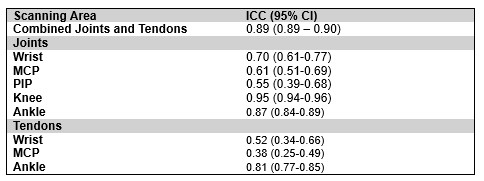 Evaluation of the scanning protocol reliability for all joints and each joint area using the ICC for the PAUSS scoring system. ICC = intra-class correlation: 0.75 – 1.00 = excellent, 0.60 – 0.74 = good, 0.40 – 0.59 = fair, and < 0.4 = poor.
Scanning Protocol Reliability: ICC for Specific Joint and Tendon Views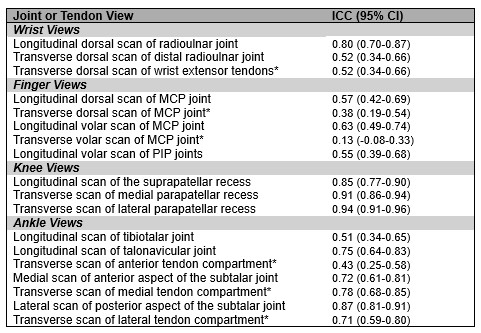 Evaluation of the scanning protocol and sonographer reliability specific joint views using the ICC for the PAUSS scoring system. ICC = intra-class correlation: 0.75 – 1.00 = excellent, 0.60 – 0.74 = good, 0.40 – 0.59 = fair, and < 0.4 = poor. *Refers to views use to evaluate for tendon pathology
To cite this abstract in AMA style:
Esteban Y, Avar-Aydin P, Rodriguez-Smith J, Proulx-Gauthier J, Benham H, Lin C, Clark M, DeRanieri D, Brunner E, oberle E, Henrickson M, Cassedy A, Ting T, Vega-Fernandez P. Reliability of Pediatric-Specific Musculoskeletal Ultrasound Scanning Protocol for the Detection of Arthritis [abstract]. Arthritis Rheumatol. 2026; 78 (suppl 3). https://acrabstracts.org/abstract/reliability-of-pediatric-specific-musculoskeletal-ultrasound-scanning-protocol-for-the-detection-of-arthritis/. Accessed .« Back to 2026 Pediatric Rheumatology Symposium
ACR Meeting Abstracts - https://acrabstracts.org/abstract/reliability-of-pediatric-specific-musculoskeletal-ultrasound-scanning-protocol-for-the-detection-of-arthritis/