
Session Information
Session Time: 5:00PM-6:00PM
Background/Purpose: The ACCORD clinic (adult center for childhood onset rheumatic disease) is an experimental rheumatology clinic focused on integrating Health Care Transition (HCT) to prepare adolescent and young adults who are transferring from pediatric to adult rheumatology. One aspect unique to ACCORD is that an adult rheumatologist is introduced in the pediatric rheumatology setting, facilitating a warm handoff. Our aim was to better understand patients’ experience in ACCORD, elucidate barriers to a successful transition, and clarify patients’ perspective on what signifies a successful transfer.
30-50% of pediatric rheumatology patients temporarily lose access to care when they fail to transfer to adult healthcare, contributing to an increase in morbidity and mortality. Patient-centered research that engages this target population is needed to understand the effect of current HCT efforts, and to increase the impact and acceptability of future HCT interventions.
Methods: This cross-sectional study included chart reviews and semi-structured interviews. Eligible interview participants were contacted over phone, email, or text message for a 45-minute semi-structured interview. The interview script incorporated tenants of the Got Transition framework, focusing on experiences with ACCORD, barriers to transition, and perspectives on successful transition. Interviews were recorded, transcribed, quality checked and qualitatively analyzed through a two-phase deductive content analysis. In phase one, data was deductively sorted by trained analysts according to Got Transition tenants. Coder consensus meetings occurred bi-weekly for two months to ensure reproducibility in the application of coding. A need to identify emergent thematic categories arose and overlapping or problematic codes were resolved. The codebook was developed and revised in an iterative process with data collection and input from all research team members. In phase two, two interviews were double coded independently (Kappa 0.78). The codebook was then applied to the remaining interviews.
Results: A total of 14 interviews were analyzed. Median age was 24 years. Most were female. Participants voiced overwhelmingly positive experiences with the ACCORD clinic; meeting the adult rheumatologist in the pediatric setting was unanimously a positive experience. Negative experiences were few, but lack of nursing support was noted, “…nurses in the clinics play such an important role, and I think that’s a part that’s crucially lacking.” The greatest perceived barrier to a successful transition was navigating a new physical environment in adult care settings (e.g. parking, finding the clinic, check-in process). Finally, there was no concordance on how to define a successful transition, but several participants noted the importance of clarity in communication, personalization of care, and a warm hand off.
Conclusion: The patient experience of the ACCORD clinic was overwhelmingly positive. Introducing an adult rheumatologist in the pediatric clinic is a well-received approach to improving HCT. The greatest perceived barriers, logistical uncertainty and lack or nursing support, are future targets of intervention.
Table 1. Demographics and diagnoses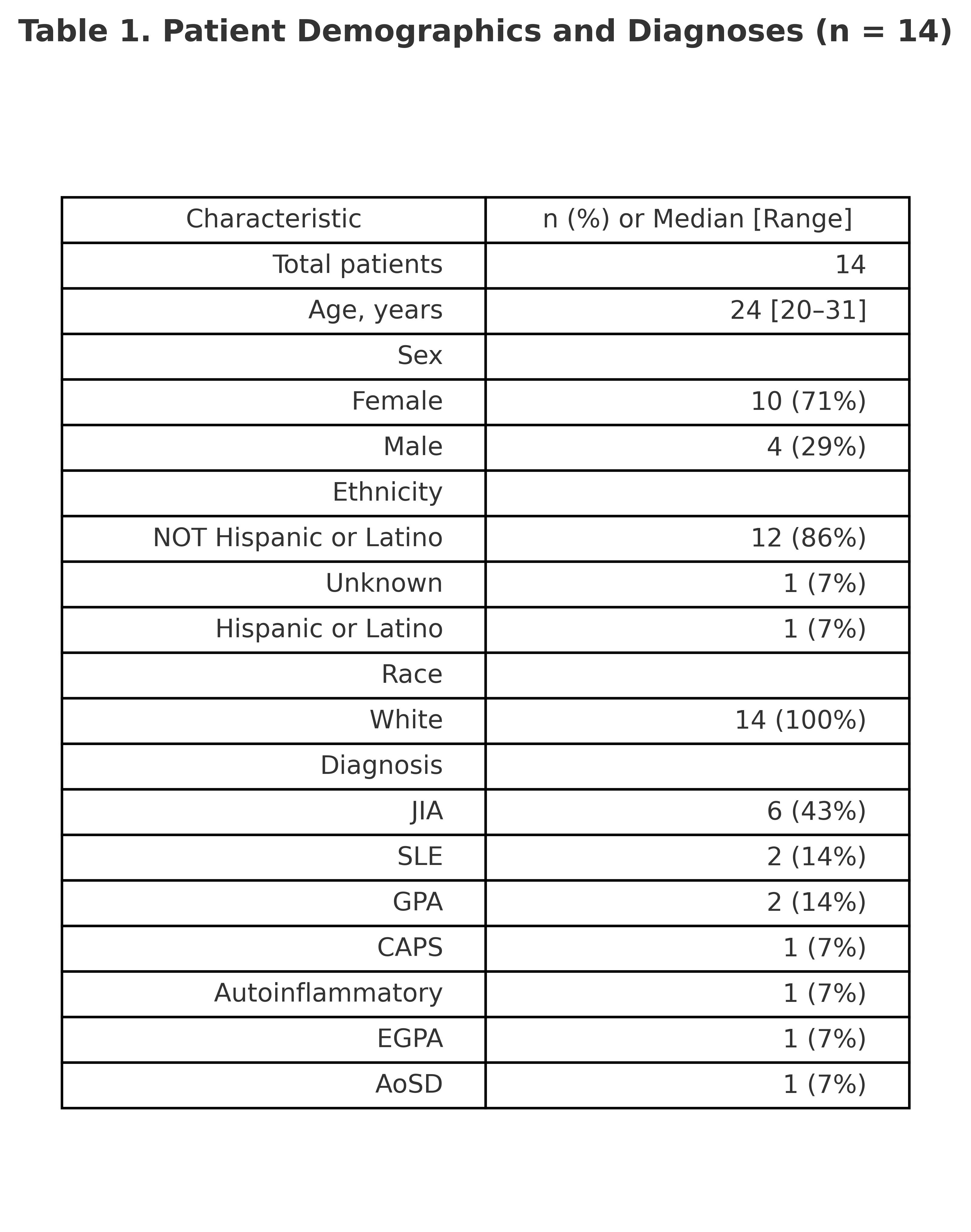
Figure 1. Word cloud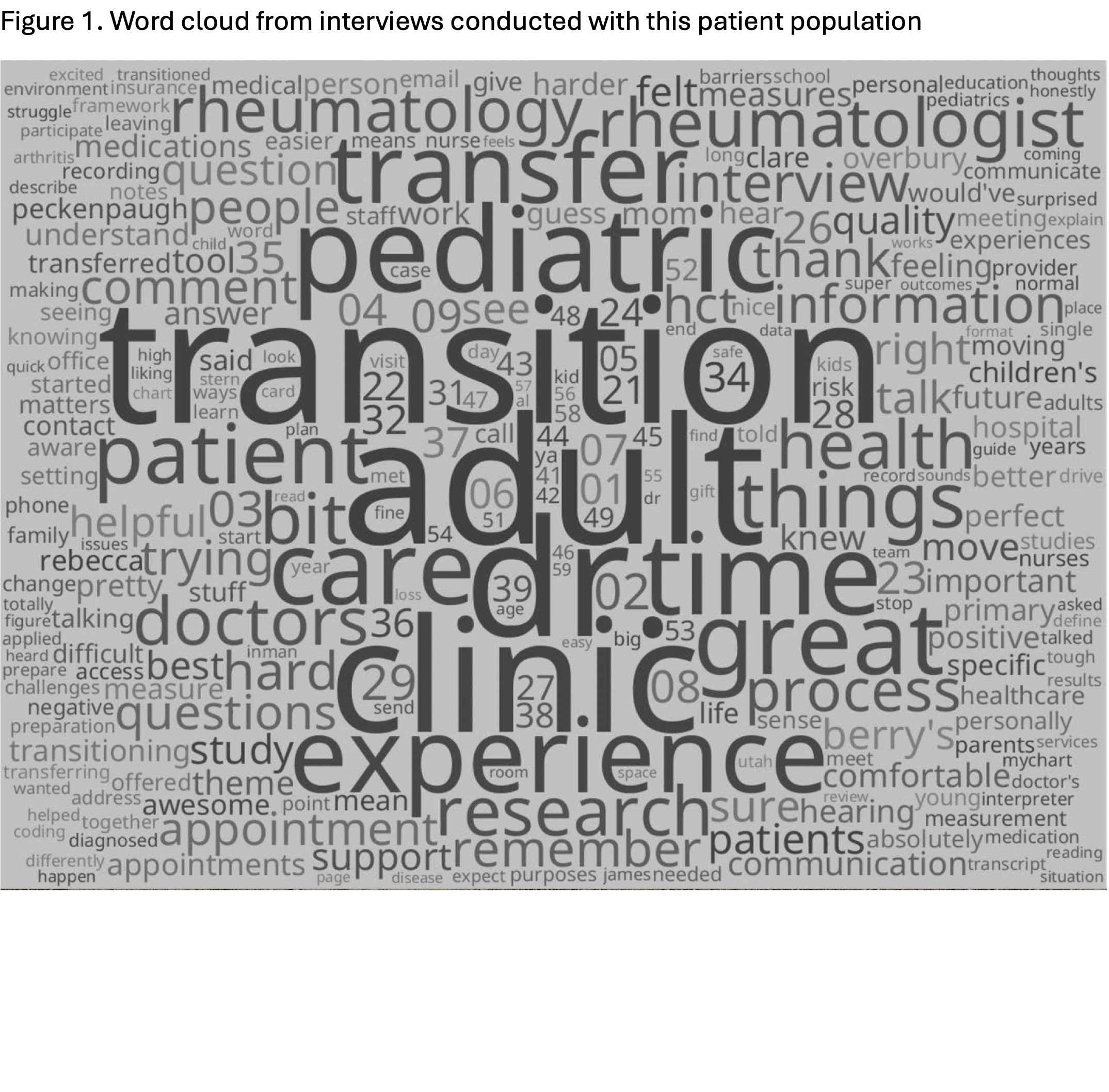
To cite this abstract in AMA style:
Peckenpaugh C, Warner E, Rollins T, Wallgren S, Richins S, Sward K, Hersh A, Overbury R. Patient perspectives, barriers, and next steps in a health care transition clinic for pediatric to adult rheumatology [abstract]. Arthritis Rheumatol. 2026; 78 (suppl 3). https://acrabstracts.org/abstract/patient-perspectives-barriers-and-next-steps-in-a-health-care-transition-clinic-for-pediatric-to-adult-rheumatology/. Accessed .« Back to 2026 Pediatric Rheumatology Symposium
ACR Meeting Abstracts - https://acrabstracts.org/abstract/patient-perspectives-barriers-and-next-steps-in-a-health-care-transition-clinic-for-pediatric-to-adult-rheumatology/