ACR Meeting Abstracts

ACR Meeting Abstracts

  • Meetings
    • 2026 ACR/ARP PRSYM
    • ACR Convergence 2025
    • ACR Convergence 2024
    • ACR Convergence 2023
    • 2023 ACR/ARP PRSYM
    • ACR Convergence 2022
    • ACR Convergence 2021
    • 2020-2009 Meetings
    • Download Abstracts
  • Keyword Index
  • Advanced Search
  • Your Favorites
    • Favorites
    • Login
    • View and print all favorites
    • Clear all your favorites
  • ACR Meetings

Abstract Number: 029

Oral vs Subcutaneous Methotrexate at High Dose for Pediatric Anterior Uveitis

Katie Choi1 and Melissa Lerman2, 1Perelman School of Medicine at the University of Pennsylvania, Philadelphia, PA, 2Children's Hospital of Philadelphia, Philadelphia, PA

Meeting: 2026 Pediatric Rheumatology Symposium

  • Tweet
  • Email a link to a friend (Opens in new window) Email
  • Print (Opens in new window) Print
Session Information

Date: Thursday, March 19, 2026

Title: Posters: Clinical and Therapeutic Aspects I

Session Time: 6:00PM-7:00PM

Background/Purpose: Methotrexate (MTX) is effective and steroid-sparing for pediatric non-infectious anterior uveitis, but whether subcutaneous (SC) achieves control faster than oral (PO) remains unclear. High-dose regimens have been linked to faster remission, though dose–route confounding limits inference. We sought to compare high-dose PO vs SC MTX.

Methods: Single-center retrospective cohort (2007–2024) of children < 18 years with active non-infectious anterior uveitis at MTX initiation. Active uveitis was defined as anterior chamber cells >0.5+, topical steroids >2 drops/day, and/or on systemic steroids. MTX episodes began with initiation or route switch; >180-day washouts separated opposite routes. Doses were aligned using PO-equivalence (1 mg PO = 0.65 mg SC). High dose was >0.5 mg/kg if < 25 kg or >12.5 mg if ≥25 kg. The primary outcome was time to sustained control, defined as two consecutive visits ≤60 days apart with inactive disease. Survival analysis was used to analyze time to sustained control.

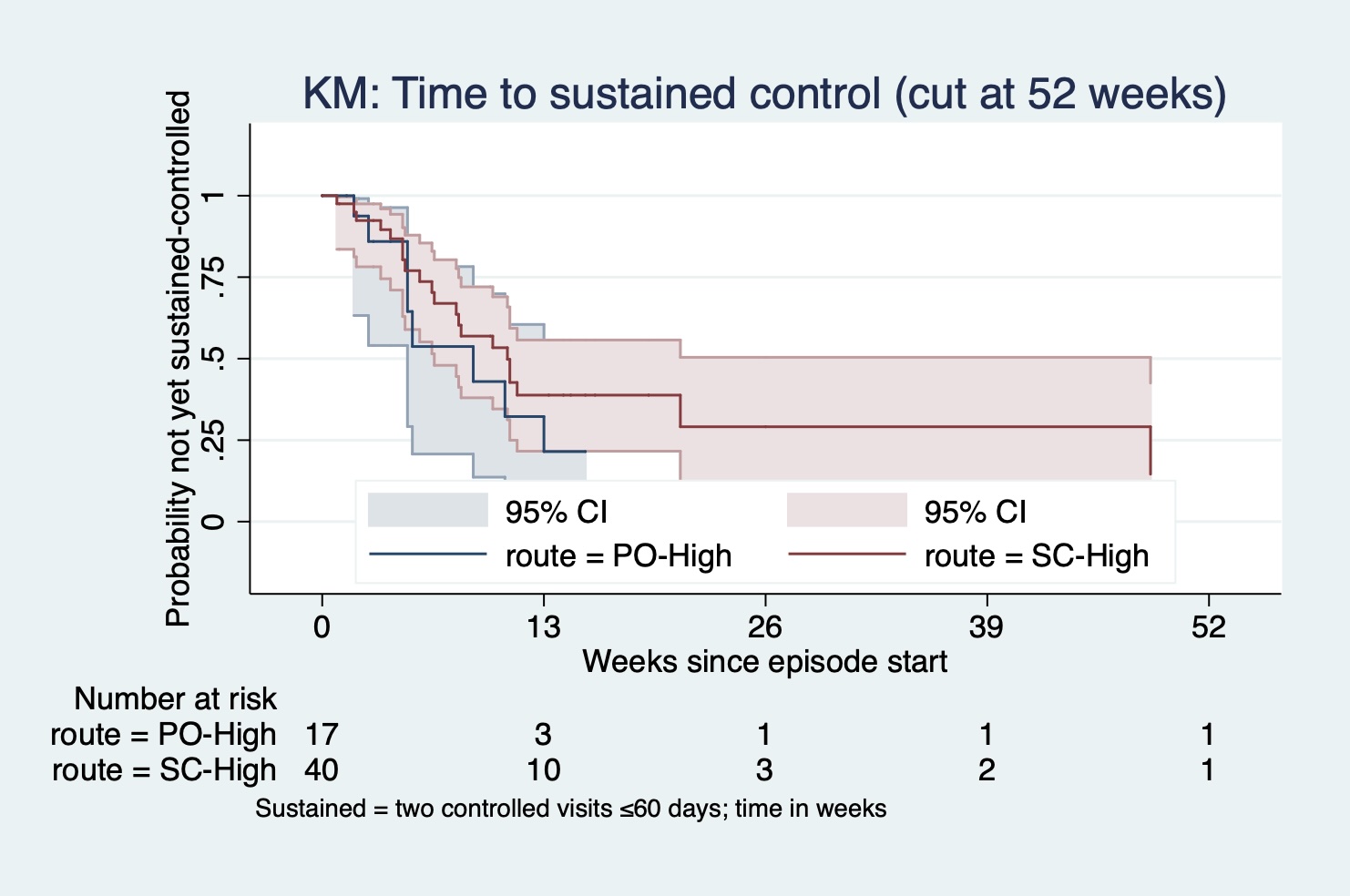
Results: Fifty-seven high-dose episodes (52 unique patients) were analyzed: 17 PO and 40 SC. Mean age at start was 7.9 ± 4.0 years (PO 8.0 ± 4.2; SC 7.9 ± 4.0). Kaplan–Meier curves overlapped through 52 weeks; numbers at risk at weeks 0/13/26/39/52 were 17/16/10/5/5 (PO) and 40/38/32/23/20 (SC). In a patient-clustered Cox model, SC vs PO had a hazard ratio of 0.78 (95% CI, 0.34–1.77; p=0.55).

Conclusion: In pediatric anterior uveitis treated with high-dose MTX, SC and PO achieved similar time to sustained control. Clinicians may consider prioritizing tolerance, adherence, and access when choosing route.

SC vs PO MTX for Anterior Uveitis: Kaplan–Meier Curve of Time to Sustained Control Supporting image 1

Disclosures: K. Choi: None; M. Lerman: None.

To cite this abstract in AMA style:

Choi K, Lerman M. Oral vs Subcutaneous Methotrexate at High Dose for Pediatric Anterior Uveitis [abstract]. Arthritis Rheumatol. 2026; 78 (suppl 3). https://acrabstracts.org/abstract/oral-vs-subcutaneous-methotrexate-at-high-dose-for-pediatric-anterior-uveitis/. Accessed .
  • Tweet
  • Email a link to a friend (Opens in new window) Email
  • Print (Opens in new window) Print

« Back to 2026 Pediatric Rheumatology Symposium

ACR Meeting Abstracts - https://acrabstracts.org/abstract/oral-vs-subcutaneous-methotrexate-at-high-dose-for-pediatric-anterior-uveitis/

Advanced Search

Your Favorites

You can save and print a list of your favorite abstracts during your browser session by clicking the “Favorite” button at the bottom of any abstract. View your favorites »

Embargo Policy

All abstracts accepted to PRYSM are under media embargo once the ACR has notified presenters of their abstract’s acceptance. They may be presented at other meetings or published as manuscripts after this time but should not be discussed in non-scholarly venues or outlets. The following embargo policies are strictly enforced by the ACR.

Accepted abstracts are made available to the public online in advance of the meeting and are published in a special online supplement of our scientific journal, Arthritis & Rheumatology. Information contained in those abstracts may not be released until the abstracts appear online. In an exception to the media embargo, academic institutions, private organizations, and companies with products whose value may be influenced by information contained in an abstract may issue a press release to coincide with the availability of an ACR abstract on the ACR website. However, the ACR continues to require that information that goes beyond that contained in the abstract (e.g., discussion of the abstract done as part of editorial news coverage) is under media embargo until 6:00 PM CT on March 18. Journalists with access to embargoed information cannot release articles or editorial news coverage before this time. Editorial news coverage is considered original articles/videos developed by employed journalists to report facts, commentary, and subject matter expert quotes in a narrative form using a variety of sources (e.g., research, announcements, press releases, events, etc.).

Violation of this policy may result in the abstract being withdrawn from the meeting and other measures deemed appropriate. Authors are responsible for notifying colleagues, institutions, communications firms, and all other stakeholders related to the development or promotion of the abstract about this policy. If you have questions about the ACR abstract embargo policy, please contact ACR abstracts staff at [email protected].

Wiley

  • Online Journal
  • Privacy Policy
  • Permissions Policies
  • Cookie Preferences

© Copyright 2026 American College of Rheumatology