
Session Information
Date: Thursday, March 19, 2026
Title: Abstracts: Imaging
Session Time: 5:23PM-5:28PM
Background/Purpose: The presentation of juvenile psoriatic arthritis (JPsA) in children with psoriasis can be insidious and poses a diagnostic challenge. Musculoskeletal ultrasound (MSUS) is a sensitive imaging modality to detect joint inflammation. Growing evidence has shown adult psoriasis patients without signs of arthritis have findings of subclinical joint pathology on MSUS. Longitudinal studies demonstrate that these patients with imaging abnormalities are more likely to develop active psoriatic arthritis. Similar investigations among the pediatric psoriatic and JPsA population are scarce. The aim of this study is to describe clinical and subclinical joint and nail abnormalities in children with psoriasis who have no known history of arthritis in comparison with healthy children.
Methods: Children with psoriasis not on systemic treatment and age and sex-matched healthy controls underwent ultrasound examination using a standard acquisition protocol. Images were obtained in both grey-scale (B) mode and power Doppler (PD) mode. The following sites were scanned bilaterally: a) joints/nails – fingernails, MCP, and IP joints of the second and third fingers, as well as any finger with psoriatic nail involvement, patella, tibiotalar and subtalar joints, b) entheses – quadriceps, proximal and distal patellar tendon, Achilles, and plantar fascia calcaneal insertion. Ultrasound images were assessed using an established pediatric-specific scoring system for the joints, with B-mode findings of grade 2 (moderate) and 3 (severe) considered positive for synovitis. Enthesitis was evaluated according to the OMERACT definition and scored on a dichotomous scale (0-negative,1-positive). Various nail parameters were measured, and nail plate structure was evaluated utilizing the Wortsman classification. A semi-quantitative scoring approach was utilized for nail PD-mode findings.
Results: Fifteen psoriasis patients and thirteen healthy controls were enrolled. While patients with psoriasis demonstrated subclinical synovitis in the finger, knee, and ankle joints more frequently than the control group (p=0.047), no statistically significant difference was observed in the comparison of each specific joint. PD positivity was detected at the entheses in two patients with psoriasis and at three entheseal sites of two healthy children. Nail ultrasound examination demonstrated significantly thicker nail beds (1.6 vs. 1.4 mm, p< 0.001) and more frequent abnormal nail structure (70% vs. 21.2%, p< 0.001) in the psoriasis group compared to control group while the thickness of the nail plate and nail matrix were similar. Type II nail morphology changes were the most frequently detected type according to the Wortsman classification. Positive PD-mode findings in the nail bed and nail matrix were more common in the control group (both p< 0.001). Among the psoriasis cohort, nails with abnormal exam findings had significantly thicker nail plate (0.4 vs. 0.35 mm, p=0.003) and nail bed (1.8 vs. 1.6 mm, p=0.006) measurements compared to nails with normal examination.
Conclusion: MSUS is a useful tool for evaluating inflammatory joint and nail findings that may help delineate subclinical joint inflammation in children with psoriasis.
Table 1. MSUS findings of the joints and entheses between the study groups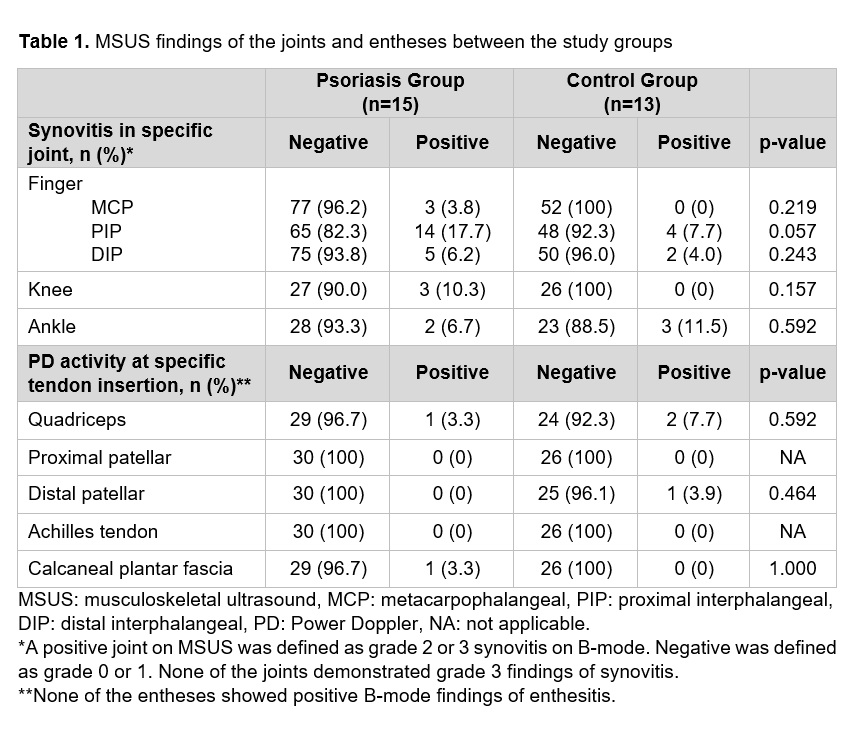
Table 2. Nail ultrasound findings of the study groups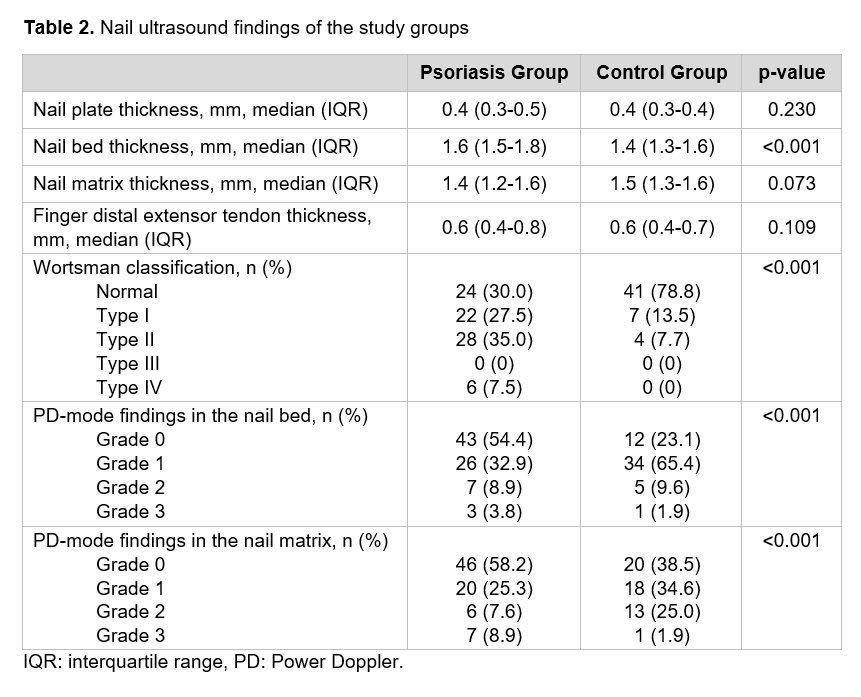
Table 3. Nail ultrasound findings of the psoriasis group according to clinical nail examination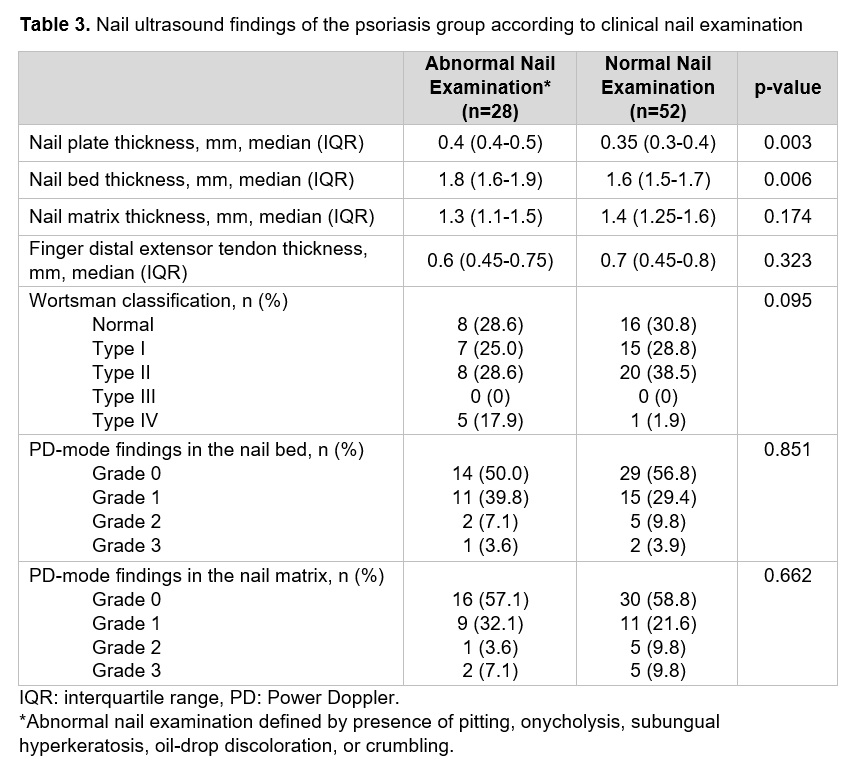
To cite this abstract in AMA style:
Nedorezov L, Avar-Aydin P, Ting T, Bayart C, Cassedy A, Vega-Fernandez P. Musculoskeletal and Nail Ultrasound Findings in Children with Psoriasis: A Case-Control Study [abstract]. Arthritis Rheumatol. 2026; 78 (suppl 3). https://acrabstracts.org/abstract/musculoskeletal-and-nail-ultrasound-findings-in-children-with-psoriasis-a-case-control-study/. Accessed .« Back to 2026 Pediatric Rheumatology Symposium
ACR Meeting Abstracts - https://acrabstracts.org/abstract/musculoskeletal-and-nail-ultrasound-findings-in-children-with-psoriasis-a-case-control-study/