ACR Meeting Abstracts

ACR Meeting Abstracts

  • Meetings
    • 2026 ACR/ARP PRSYM
    • ACR Convergence 2025
    • ACR Convergence 2024
    • ACR Convergence 2023
    • 2023 ACR/ARP PRSYM
    • ACR Convergence 2022
    • ACR Convergence 2021
    • 2020-2009 Meetings
    • Download Abstracts
  • Keyword Index
  • Advanced Search
  • Your Favorites
    • Favorites
    • Login
    • View and print all favorites
    • Clear all your favorites
  • ACR Meetings

Abstract Number: 032

Methotrexate Response in Systemic JIA: Real-World Evidence from a Tertiary-Care Cohort

Malavika Mittal1, Neha Rajpal2, manjari Agarwal3 and sujata Sawhney4, 1Sir Ganga Ram Hospital, DELHI, Delhi, India, 2Sir Ganga Ram Hospital, India, 3Sir Ganga Ram Hospital, NEW DELHI, Delhi, India, 4Sir Ganga Ram Hospital, Sector 37 noida, Uttar Pradesh, India

Meeting: 2026 Pediatric Rheumatology Symposium

  • Tweet
  • Email a link to a friend (Opens in new window) Email
  • Print (Opens in new window) Print
Session Information

Date: Thursday, March 19, 2026

Title: Posters: Clinical and Therapeutic Aspects I

Session Time: 6:00PM-7:00PM

Background/Purpose: Systemic juvenile idiopathic arthritis (SJIA) shows heterogeneous disease trajectories, and the subset of patients who achieve remission with methotrexate (MTX) monotherapy is not well defined. MTX remains widely used in resource-limited settings, yet most published data suggest limited durability as monotherapy. This study aimed to characterize clinical, laboratory, and longitudinal features associated with MTX-only versus MTX-plus treatment courses in a large tertiary-care cohort.

Methods: A retrospective analysis was conducted (July 2001 – September 2025) on patients diagnosed with SJIA (ILAR 2001 criteria) before age 18 with ≥2 years of follow-up. Clinical features and laboratory investigations, at presentation, and disease variables (age at onset, time to diagnosis, time to remission, flares, MAS events) were extracted from clinical records. Outcomes included remission on drugs, remission off drugs, active disease, and disease course patterns (monocyclic, polycyclic, persistent). Corticosteroid exposure (oral, IV), intra-articular steroids, and all DMARD use were recorded. All patients received MTX and were stratified as MTX-only or MTX-plus (additional DMARDs/biologics), and compared.

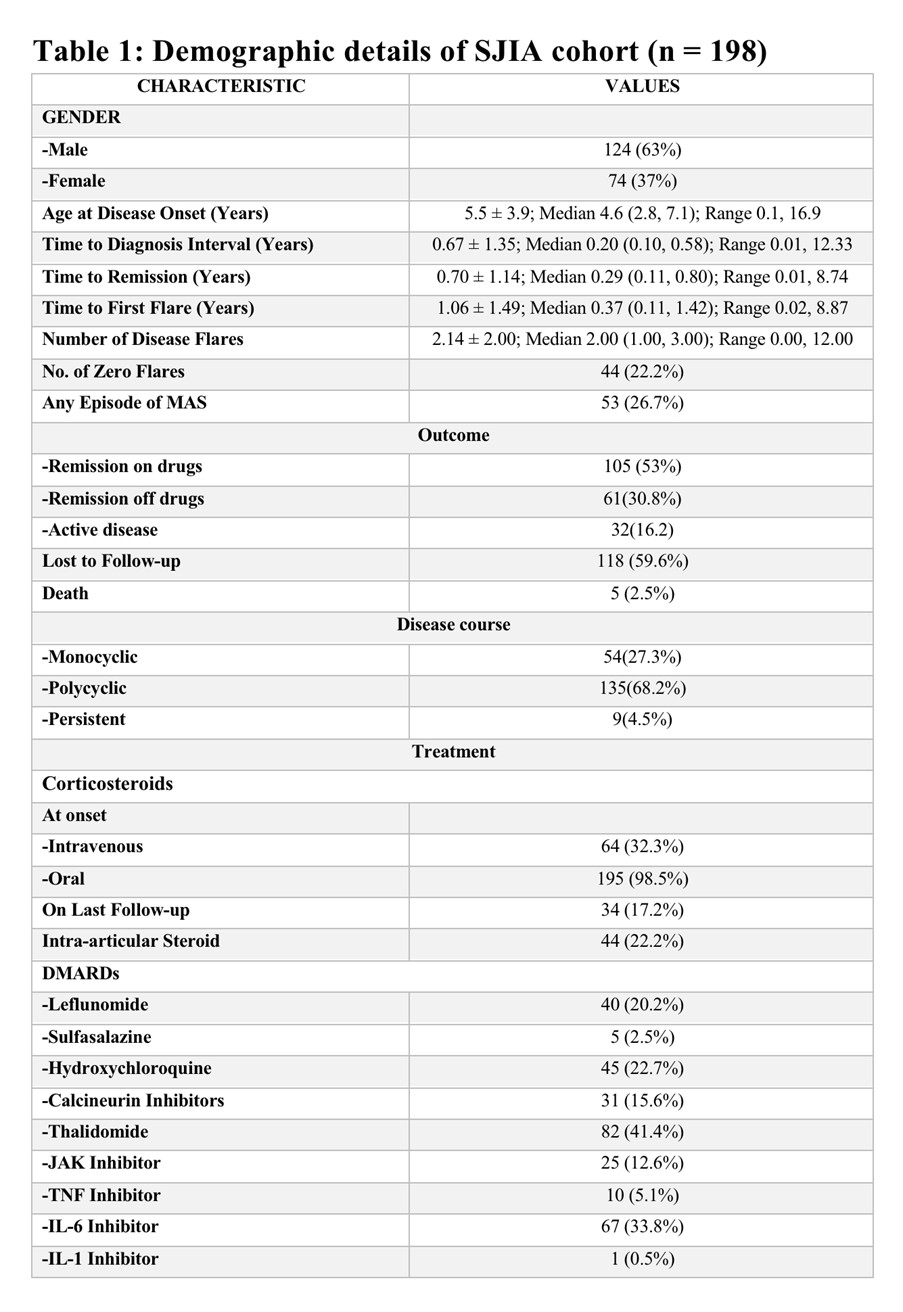
Results: Among 198 patients (mean onset age 5.8 ± 3.8 yrs; median follow-up 5.5 [3.5, 8.7] yrs; 63% male), key onset features were fever (100%), arthritis (98%), rash (69%), lymphadenopathy (35%), hepatomegaly (20%), splenomegaly (14%), and serositis (4%), with MAS in 26.7%; with 5 deaths. All received steroids (32.3% IV, 98.4% oral), and at last follow-up remission off/on drugs and active disease were 30.8%, 53%, and 16.2%, respectively (see Table 1).
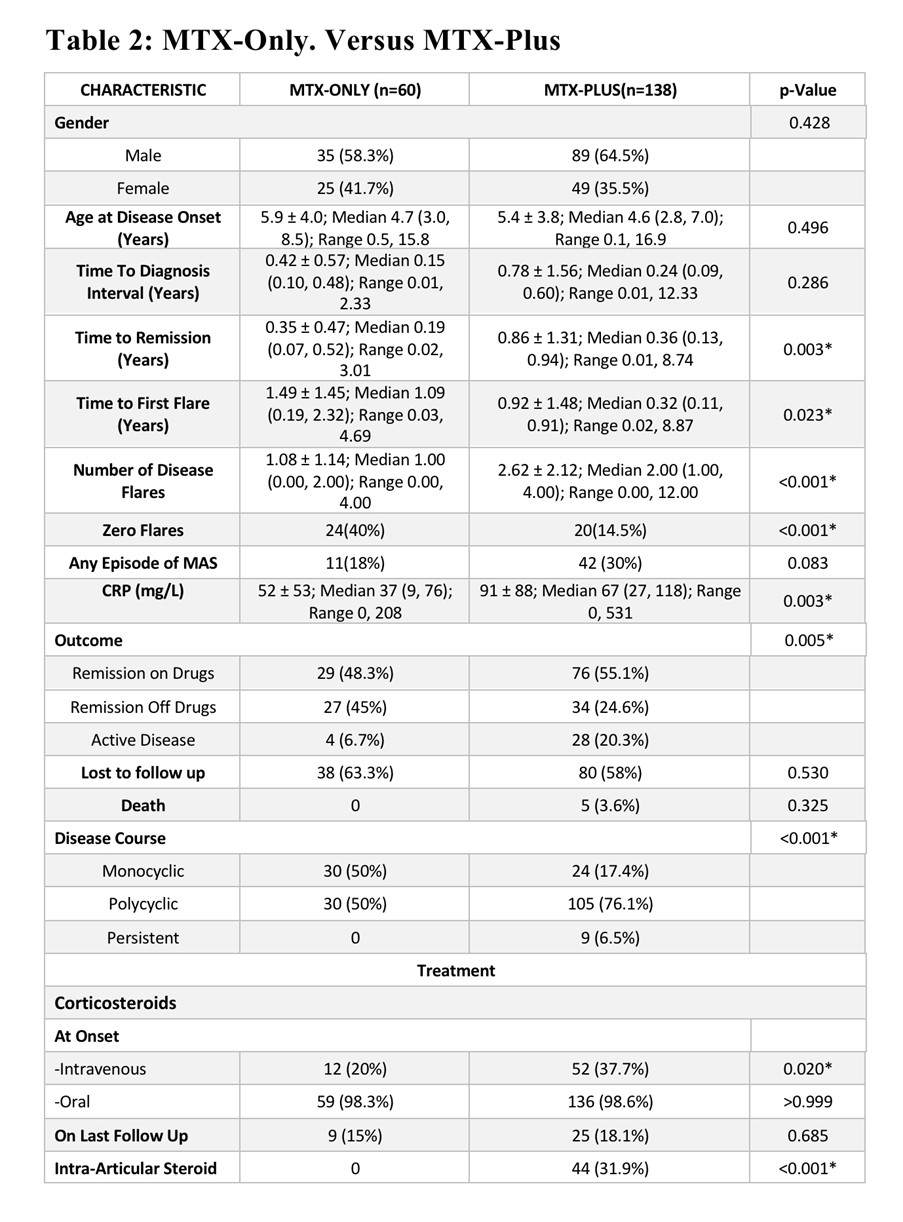
MTX-only (n=60) and MTX-plus (n=138) groups differed, with MTX-plus showing longer follow-up (7.2 vs 4.8 yrs), time to remission (0.86 vs 0.35 yrs), earlier first flare (0.32 vs 1.09 yrs), and longer MTX duration (6.4 vs 3.9 yrs), but similar peak dose (0.75 vs 0.72 mg/kg/week); remission patterns, disease courses, and flare frequency differed significantly, with zero-flare disease more frequent in MTX-only (40% vs 14.5%) (see Table 2).

Conclusion: In this tertiary-care cohort, about 1/3rd of patients sustained remission with MTX monotherapy, demonstrating a distinct MTX-responsive phenotype, despite prevailing literature favoring early biologic escalation. MTX-only patients had faster remission, fewer flares, more monocyclic disease, and better long-term drug-free remission rates compared with MTX-plus patients, who experienced more flares and prolonged disease activity despite similar MTX dosing. These findings highlight clinically recognizable divergence in SJIA disease trajectories and support data-driven stratification of MTX use in real-world settings.
Supporting image 1

Supporting image 2


Disclosures: M. Mittal: None; N. Rajpal: None; m. Agarwal: None; s. Sawhney: None.

To cite this abstract in AMA style:

Mittal M, Rajpal N, Agarwal m, Sawhney s. Methotrexate Response in Systemic JIA: Real-World Evidence from a Tertiary-Care Cohort [abstract]. Arthritis Rheumatol. 2026; 78 (suppl 3). https://acrabstracts.org/abstract/methotrexate-response-in-systemic-jia-real-world-evidence-from-a-tertiary-care-cohort/. Accessed .
  • Tweet
  • Email a link to a friend (Opens in new window) Email
  • Print (Opens in new window) Print

« Back to 2026 Pediatric Rheumatology Symposium

ACR Meeting Abstracts - https://acrabstracts.org/abstract/methotrexate-response-in-systemic-jia-real-world-evidence-from-a-tertiary-care-cohort/

Advanced Search

Your Favorites

You can save and print a list of your favorite abstracts during your browser session by clicking the “Favorite” button at the bottom of any abstract. View your favorites »

Embargo Policy

All abstracts accepted to PRYSM are under media embargo once the ACR has notified presenters of their abstract’s acceptance. They may be presented at other meetings or published as manuscripts after this time but should not be discussed in non-scholarly venues or outlets. The following embargo policies are strictly enforced by the ACR.

Accepted abstracts are made available to the public online in advance of the meeting and are published in a special online supplement of our scientific journal, Arthritis & Rheumatology. Information contained in those abstracts may not be released until the abstracts appear online. In an exception to the media embargo, academic institutions, private organizations, and companies with products whose value may be influenced by information contained in an abstract may issue a press release to coincide with the availability of an ACR abstract on the ACR website. However, the ACR continues to require that information that goes beyond that contained in the abstract (e.g., discussion of the abstract done as part of editorial news coverage) is under media embargo until 6:00 PM CT on March 18. Journalists with access to embargoed information cannot release articles or editorial news coverage before this time. Editorial news coverage is considered original articles/videos developed by employed journalists to report facts, commentary, and subject matter expert quotes in a narrative form using a variety of sources (e.g., research, announcements, press releases, events, etc.).

Violation of this policy may result in the abstract being withdrawn from the meeting and other measures deemed appropriate. Authors are responsible for notifying colleagues, institutions, communications firms, and all other stakeholders related to the development or promotion of the abstract about this policy. If you have questions about the ACR abstract embargo policy, please contact ACR abstracts staff at [email protected].

Wiley

  • Online Journal
  • Privacy Policy
  • Permissions Policies
  • Cookie Preferences

© Copyright 2026 American College of Rheumatology