
Session Information
Session Time: 6:00PM-7:00PM
Background/Purpose: Musculoskeletal (MSK) manifestations are amongst the most common extraintestinal manifestations (EIMs) in pediatric Crohn’s disease (CD). MSK EIMs contribute to reduced quality of life and morbidity and are associated with increased severity of bowel disease activity in pediatric IBD (Derfalvi B et al., 2022). Despite this, there is a relative paucity of literature describing MSK EIMs, and specifically, asymptomatic sacroiliitis (SI) is even less commonly described. One prior pediatric study identified asymptomatic SI in 15% of patients (5/34) (Giani T et al., 2020). We aimed to determine the prevalence of asymptomatic SI detected on magnetic resonance enterography (MRE) and explore its association with clinical, laboratory, and disease characteristics over time.
Methods: In this single-center, retrospective cohort study, pediatric patients diagnosed with CD (< 1 year) who underwent MRE at a children’s hospital over four years (2019-2023) were included. Patients with inadequate sacroiliac joint imaging or known spondyloarthritis were excluded. MRE sacroiliac joint images including coronal T1, axial T2, and coronal T2W sequences with fat suppression were evaluated by a fellowship-trained adult MSK radiologist, with a secondary read by a fellowship-trained pediatric MSK radiologist to establish inter-rater reliability. Patient follow-up data were collected over a 2-year time frame. Descriptive statistics were used to describe baseline characteristics and group comparisons. Trends over time for continuous and dichotomous outcomes were examined using linear and generalized logistic regression mixed models, respectively.
Results: Among 133 patients with CD (mean age 13.3 ± 3.0 years; 41% female), 9% (12/133) demonstrated SI on MRE: 5 acute, 4 chronic, and 3 acute-on-chronic [Table 1]. Inter-rater reliability demonstrated substantial agreement (Cohen’s kappa 0.78). Except for painful joints (p=0.016), baseline clinical and laboratory parameters, including CRP, ESR and wPCDAI, did not differ significantly between groups. Over two years, patients with SI demonstrated fewer hospital admissions (p=0.044), greater decreases in ESR (p=0.032), and greater decreases in WBC counts (p=0.042). Notably, only one third (4/12) of patients with SI on MRE had a rheumatology assessment during follow-up.
Conclusion: Asymptomatic SI was detected in nearly one in ten pediatric CD patients through routine MRE, highlighting a potential role for enterography as an opportunistic screening tool for axial disease. These findings underscore the need for systematic rheumatology assessment of these patients and prospective studies to clarify the clinical significance of subclinical SI in pediatric IBD.
Table 1: Clinical characteristics of pediatric Crohn’s disease patients with magnetic resonance enterography imaging.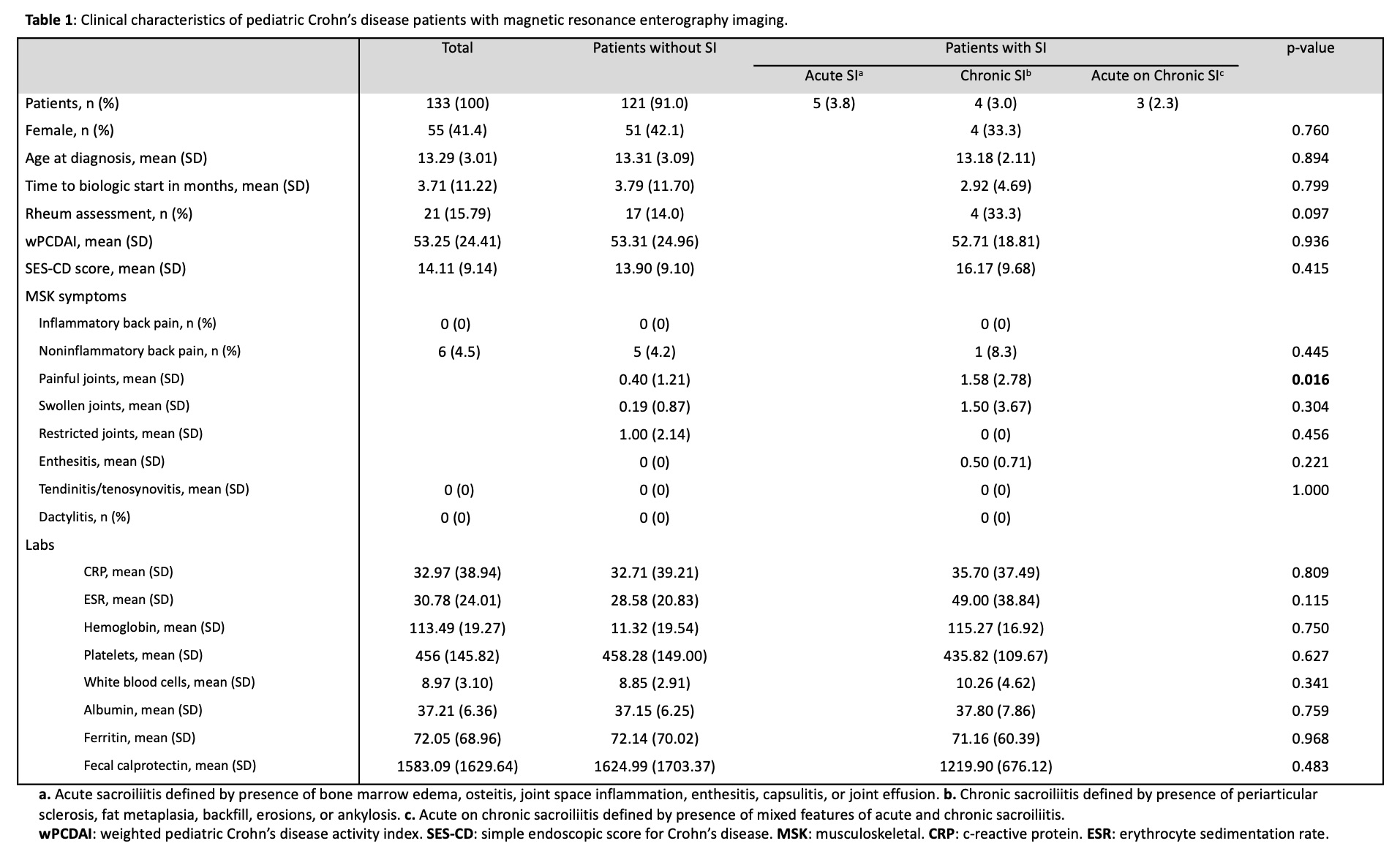 a. Acute sacroiliitis defined by presence of bone marrow edema, osteitis, joint space inflammation, enthesitis, capsulitis, or joint effusion. b. Chronic sacroiliitis defined by presence of periarticular sclerosis, fat metaplasia, backfill, erosions, or ankylosis. c. Acute on chronic sacroiliitis defined by presence of mixed features of acute and chronic sacroilittis.
WPCDAI: weighted pediatric Crohn’s disease activity index. SES-CD: simple endoscopic score for Crohn’s disease. MSK: musculoskeletal. CRP: c-reactive protein. ESR: erythrocyte sedimentation rate.
To cite this abstract in AMA style:
Ali A, Kalia V, Ross I, Daichendt L, Sawicka J, Miller M, Wells S, Crowley E, Berard R. Magnetic Resonance Enterography Detected Sacroiliitis in Pediatric Crohn’s Disease: A Retrospective Cohort Study [abstract]. Arthritis Rheumatol. 2026; 78 (suppl 3). https://acrabstracts.org/abstract/magnetic-resonance-enterography-detected-sacroiliitis-in-pediatric-crohns-disease-a-retrospective-cohort-study/. Accessed .« Back to 2026 Pediatric Rheumatology Symposium
ACR Meeting Abstracts - https://acrabstracts.org/abstract/magnetic-resonance-enterography-detected-sacroiliitis-in-pediatric-crohns-disease-a-retrospective-cohort-study/