
Session Information
Date: Friday, March 20, 2026
Title: Abstracts: Technology
Session Time: 4:43PM-4:48PM
Background/Purpose: Juvenile idiopathic arthritis (JIA) can lead to cumulative, permanent disability from chronic inflammation without early intervention and effective treatment. It is primarily a clinical diagnosis and a diagnosis of exclusion. Highly sensitive imaging modalities, such as musculoskeletal ultrasonography and MRI, are helpful for diagnosis but have several limitations, including time constraints, cost, and the need for sedation in young children. Given the shortage of pediatric rheumatologists, which limits access to care and makes it difficult to establish regular follow-up, it is necessary to develop objective, convenient, and affordable biomarkers.
Previous studies have shown joint acoustic emissions (JAEs) as a promising biomarker for knee articular health in JIA. However, most JAEs are collected using a wired benchtop system, making monitoring outside of the clinic setting difficult. In this work, we present our low-cost, small-form-factor wearable (KneeMS) previously validated against the benchtop (Dytran (Type 3225F7) system in healthy adults, now in the JIA population during a flexion/extension (FE) activity.
Methods: We placed both the Dytran (wired) and the KneeMS (wireless) on the medial and lateral sides of the patellar tendon on each knee to record JAEs for 22 participants (44 knees). Signals from each device were band-pass filtered between 5 and 500 Hz. Since the acoustical signals appear as ‘spike-like clicks’ during a shorter period of time, we chose 30-ms windows with a 20-ms overlap to calculate the root mean square (RMS) feature. The RMS feature was then averaged over all 30-ms windows to get one RMS value per FE cycle. For each RMS value for the Dytran, we have a corresponding value for KneeMS. These pairwise values from each FE cycle across all subjects were then used to calculate the Spearman Correlation Coefficient.
Results: We observed a high correlation between the RMS values of the Dytran and KneeMS FE cycles. We calculated the Spearman’s correlation coefficient separately for the medial and lateral sides of the knee, since the lateral side has a more impeded route than the medial. For the medial side, the Spearman Correlation coefficient was 0.936 (n = 442 FE cycles), whereas for the lateral side, it was 0.825 (n = 388 FE cycles). Both these values show a significantly (p–value < 0.001) high correlation between the two devices for the JIA population.
Conclusion: JAE obtained by the KneeMS and Dytran are highly correlated, making KneeMS a viable and low-cost (25 times cheaper) alternative to Dytran. Given that KneeMS is a low-cost, wireless wearable device, it has the potential to expand access to rheumatological care and improve management of JIA by establishing remote, JAE-based longitudinal monitoring.
Figure 1: Methodology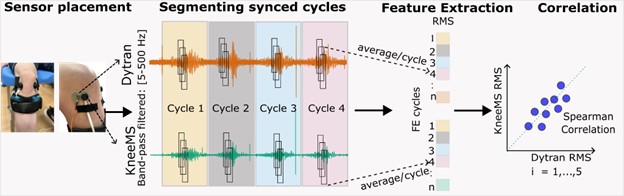 Extracting the RMS feature from filtered signals of Dytran and KneeMS for Spearman Correlation Coefficient.
Figure 2: Scatter plots for correlation and Bland-Altman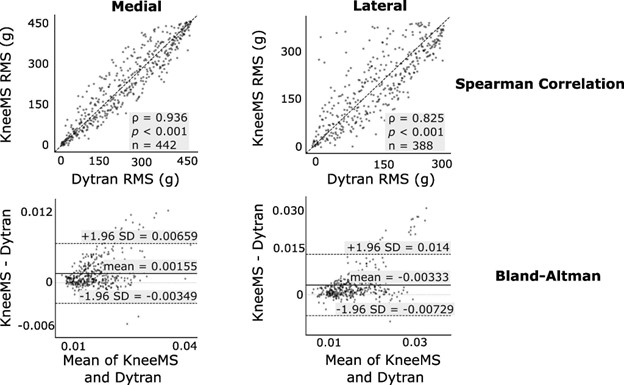 Shows high and significant (p-value < 0.001) correlation between devices for both medial and lateral sides of the patellar tendon
To cite this abstract in AMA style:
Mishra R, Yang C, Goossens Q, Nichols C, Emirdagi A, Chen C, Kilic O, Garretson C, Nikbakht M, Bindra P, Ponder L, Inan O, Prahalad S. KneeMS for Juvenile Idiopathic Arthritis [abstract]. Arthritis Rheumatol. 2026; 78 (suppl 3). https://acrabstracts.org/abstract/kneems-for-juvenile-idiopathic-arthritis/. Accessed .« Back to 2026 Pediatric Rheumatology Symposium
ACR Meeting Abstracts - https://acrabstracts.org/abstract/kneems-for-juvenile-idiopathic-arthritis/