ACR Meeting Abstracts

ACR Meeting Abstracts

  • Meeting Abstracts
    • All Meetings
    • PRSYM 2026
    • ACR Convergence 2025
    • Download Abstract Supplements
  • Keyword Index
  • Search
  • My Favorites
    • View and print all favorites
    • Clear all favorites

Abstract Number: L06

Interferon-gamma (IFN-γ) Neutralization with Emapalumab and Time to Response in Patients with Macrophage Activation Syndrome (MAS) Complicating Systemic Juvenile Idiopathic Arthritis (s-JIA) who failed High-Dose Glucocorticoids

Fabrizio De Benedetti1, Paul Brogan 2, Alexei A. Grom 3, Pierre Quartier 4, Rayfel Schneider 5, Jordi Antón 6, Claudia Bracaglia 7, Manuela Pardeo 8, Giulia Marucci 8, Emanuela Sacco 9, Despina Eleftheriou 10, Charalampia Papadopoulou 11, Philippe Jacqmin 12, maria ballabio 13 and Cristina de Min 13, 1Bambino Gesù Children's Hospital, Rome, Italy, 2Great Ormond Street Hospital for Children NHS Foundation Trust, London, United Kingdom, 3Division of Rheumatology, Cincinnati Children's Hospital Medical Center, Cincinnati, OH, 4Necker Hospital, Paris, France, 5Hospital for Sick Children, Toronto, ON, Canada, 6Hospital Sant Joan de Déu, Barcelona, Spain, 7Division of Rheumatology, IRCCS Ospedale Pediatrico Bambino Gesù, Rome, Italy, 8Division of Rheumatology, IRCCS Ospedale Pediatrico Bambino Gesù, Rome, Italy, Rome, Italy, 9Division of Rheumatology, IRCCS Ospedale Pediatrico Bambino Gesù, Rome, Italy, Rome, 10UCL Institute of Child Health, and Great Ormond Street Hospital NHS Foundation Trust, Infection, Immunology, and Rheumatology section,, london, United Kingdom, 11UCL Institute of Child Health, and Great Ormond Street Hospital NHS Foundation Trust, Infection, Immunology, and Rheumatology section, london, United Kingdom, 12MnS, Dinant, Belgium, 13Sobi AG, basel, Switzerland

Meeting: ACR/ARP Annual Meeting 2019

Date of first publication: October 23, 2019

Keywords: interferons, Late-Breaking 2019, Still's disease, Systemic JIA

  • Tweet
  • Email a link to a friend (Opens in new window) Email
  • Print (Opens in new window) Print
Session Information

Date: Tuesday, November 12, 2019

Title: Late-Breaking Abstracts ePoster

Session Type: Late-Breaking Abstract Poster Session

Session Time: 9:00AM-11:00AM

Background/Purpose: MAS is a severe complication of rheumatic diseases, most frequently sJIA and adult-onset Still’s disease. It is characterized by fever, hepatosplenomegaly, liver dysfunction, cytopenias, coagulation abnormalities and hyperferritinemia, potentially progressing to multiple organ failure and death. MAS is classified among the secondary forms of HLH. Overproduction of IFNγ is a major driver of hyperinflammation/hypercytokinemia in several MAS and HLH murine models. We assessed efficacy, safety and timing of response of clinical and laboratory parameters of the neutralizing IFNg monoclonal antibody emapalumab in patients with MAS.

Methods: In a pilot open-label single-arm international study (NCT03311854), patients with MAS (defined according to the 2016 criteria), on a background of sJIA and inadequate response to high-dose glucocorticoids, received emapalumab (first dose: 6 mg/kg; subsequent doses: 3 mg/kg twice weekly) for a total of 4 weeks or less upon achievement of complete response (CR). Serum concentrations of the IFNg-induced chemokine CXCL9 and of sIL2R were measured. Safety assessments included adverse events and laboratory abnormalities. CR (week 8) was defined as absence of MAS clinical signs AND white blood cell and platelet counts above lower limit of normal, LDH, AST/ ALT< 1.5 x upper limit of normal, fibrinogen >100 mg/dL, and ferritin decreased by >80% or to < 2000 ng/mL, whichever was lower. Twin protocols (minimum 5 patients each) are in place in Europe and North America. We report on the first 6 patients recruited in Europe; subsequently 2 additional patients recruited in the US and 1 in Europe.

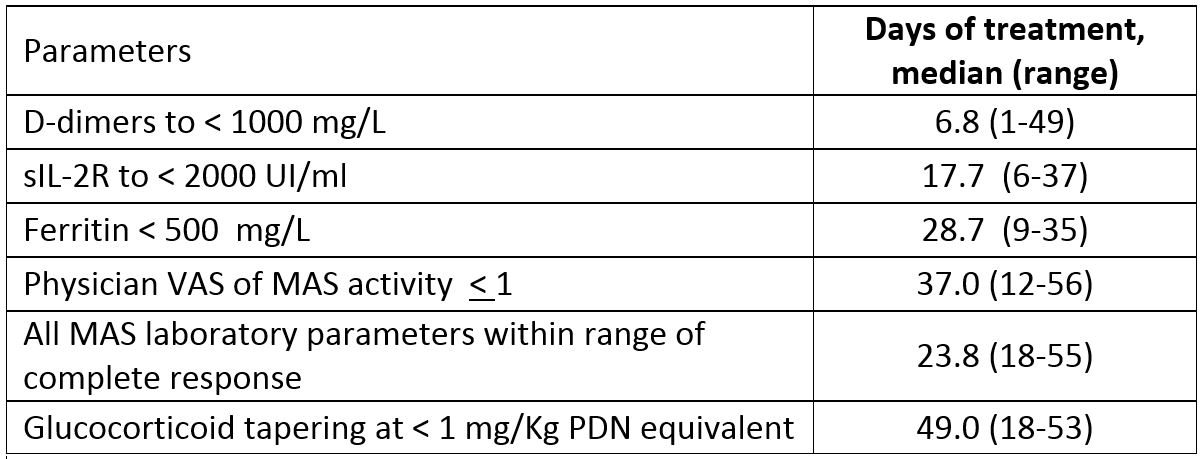
Results: Six patients (4 females, median age 11 years, range: 2-25 years), who had failed methylprednisolone (in 2 patients plus cyclosporine A (CsA) and in 2 patients plus CsA and anakinra) received emapalumab (Table 1). CXCL9 showed initial substantial decrease between day 2 and 5, showing rapid IFNg neutralization (Table 2). In all patients but one (who presented a single measurement of 37.6 at SD 21) fever resolved (< 37.5) within 3 days. These effects were followed by progressive improvement in all MAS clinical and laboratory parameters (Table 3). CR was achieved in all patients after a median of 23.8 (18-55) days. Glucocorticoids were tapered in all patients (median % tapering -92%, range -45-98% at week 8). Emapalumab was well tolerated; no patient discontinued emapalumab. A CMV reactivation, reported as a serious event possibly related to emapalumab, resolved with treatment.

Conclusion: All 6 patients receiving emapalumab achieved CR. Progressive improvement and subsequent normalization of all clinical and laboratory parameters occurred following rapid and sustained CXCL9 decrease.
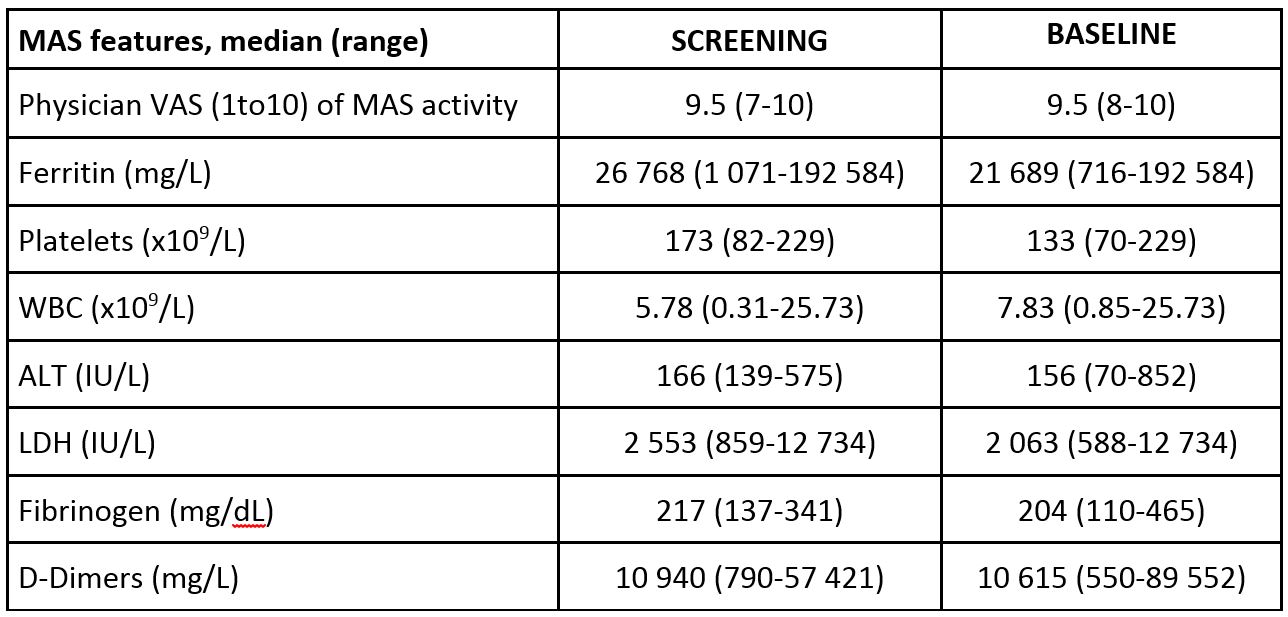
Table 1: Baseline and screening disease parameters

Table 2. Serum CXCL9 levels at baseline and during the first 7 days of treatments with emapalumab

Table 3: Time (days of treatment) of D-dimers to < 1000, sIL-2 receptor (sIL-2R) to < 2000 UI/ml, ferritin < 500 mg/L, physician VAS < 1, all MAS laboratory parameters within range of complete response and glucocorticoid tapering at < 1 mg/Kg PDN equivalent


Disclosure: F. De Benedetti, AbbVie, 2, BMS, 2, Novartis, 2, Novartis, Novimmune, Hoffmann- La Roche, SOBI, AbbVie, Pfizer, 2, Novimmune, 2, Pfizer, 2, Roche, 2, Sanofi, 2, Sobi, 2, Swedish Orphan Biovitrum, 2, UCB, 2; P. Brogan, None; A. Grom, AB2 Bio Ltd, 2, 5, AB2Bio, 2, 5, Children's Hospital Medical Center, 3, Novartis, 2, 5, Novartis Pharmaceuticals Corporation, 2, 5, Novartis Pharmaceuticals Corporations, 5, NovImmune, 2, 5, Novimmune, 2, 5; P. Quartier, AbbVie, 5, 8, Bristol-Myers Squibb, 5, 8, Chugai-Roche, 5, 8, Lilly, 5, Novartis, 5, 8, Novimmune, 5, Pfizer, 5, 8, Sanofi, 9, Swedish Orphan Biovitrum, 5, 8; R. Schneider, Novimmune, 5, Sobi, 5, Novartis, 5; J. Antón, AbbVie, 2, Bristol-Myers Squibb, 2, Gebro, 2, GlaxoSmithKline, 2, Novartis, 2, Novimmune, 2, Pfizer, 2, Roche, 2, Sobi, 2; C. Bracaglia, None; M. Pardeo, None; G. Marucci, None; E. Sacco, None; D. Eleftheriou, roche, 1, sobi, 1, Pfizer, 1; C. Papadopoulou, None; P. Jacqmin, SOBI AG, 1; m. ballabio, SOBI AG, 1; C. de Min, SOBI AG, 1.

To cite this abstract in AMA style:

De Benedetti F, Brogan P, Grom A, Quartier P, Schneider R, Antón J, Bracaglia C, Pardeo M, Marucci G, Sacco E, Eleftheriou D, Papadopoulou C, Jacqmin P, ballabio m, de Min C. Interferon-gamma (IFN-γ) Neutralization with Emapalumab and Time to Response in Patients with Macrophage Activation Syndrome (MAS) Complicating Systemic Juvenile Idiopathic Arthritis (s-JIA) who failed High-Dose Glucocorticoids [abstract]. Arthritis Rheumatol. 2019; 71 (suppl 10). https://acrabstracts.org/abstract/interferon-gamma-ifn-%ce%b3-neutralization-with-emapalumab-and-time-to-response-in-patients-with-macrophage-activation-syndrome-mas-complicating-systemic-juvenile-idiopathic-arthritis-s-jia-who/. Accessed .
  • Tweet
  • Email a link to a friend (Opens in new window) Email
  • Print (Opens in new window) Print

« Back to ACR/ARP Annual Meeting 2019

ACR Meeting Abstracts - https://acrabstracts.org/abstract/interferon-gamma-ifn-%ce%b3-neutralization-with-emapalumab-and-time-to-response-in-patients-with-macrophage-activation-syndrome-mas-complicating-systemic-juvenile-idiopathic-arthritis-s-jia-who/

Advanced Search

My Favorites

Save and print abstracts during your browser session by clicking the “Favorite” button at the bottom of any abstract (must have cookies enabled in browser). See saved favorites.

Abstract Policies

  • ACR Convergence Abstract Embargo Policies
  • ACR Convergence Abstract Permissions & Reprints
  • PRSYM Abstract Policies

ACR Convergence. Where Rheumatology Meets

ACR Convergence 2026

Join us November 6-11 in Orlando, Florida.
See Registration Information

  • Contact ACR
  • Privacy Policy
  • ACR Policies
  • Cookie Preferences

© Copyright 2026 American College of Rheumatology