ACR Meeting Abstracts

ACR Meeting Abstracts

  • Meetings
    • 2026 ACR/ARP PRSYM
    • ACR Convergence 2025
    • ACR Convergence 2024
    • ACR Convergence 2023
    • 2023 ACR/ARP PRSYM
    • ACR Convergence 2022
    • ACR Convergence 2021
    • 2020-2009 Meetings
    • Download Abstracts
  • Keyword Index
  • Advanced Search
  • Your Favorites
    • Favorites
    • Login
    • View and print all favorites
    • Clear all your favorites
  • ACR Meetings

Abstract Number: 114

Incidence of Inflammatory Arthritis Before and After Inflammatory Bowel Disease Diagnosis: A Population-Based Cohort Study

Roberta A Berard1, Ellen Kuenzig2, Jessica Widdifield3, Eric Benchimol4, Melody Lam5, Vipul Jairath6, Sherry Rohekar7, Laura Targownik4, Melanie Watson8 and Eileen Crowley9, 1London Health Sciences Centre, London, ON, Canada, 2Schulich- University of Western Ontario, ON, Canada, 3Sunnybrook Research Institute, Toronto, ON, Canada, 4University of Toronto, ON, Canada, 5ICES, ON, Canada, 6Western University, London, ON, Canada, 7University of Western Ontario - London, London, ON, Canada, 8Western University, ON, Canada, 9London Children's Hospital, ON, Canada

Meeting: 2026 Pediatric Rheumatology Symposium

  • Tweet
  • Email a link to a friend (Opens in new window) Email
  • Print (Opens in new window) Print
Session Information

Date: Friday, March 20, 2026

Title: Abstracts: Pediatric Rheumatology Potpourri

Session Time: 4:43PM-4:48PM

Background/Purpose: Arthropathies are a common extra-intestinal manifestation of IBD, yet population-level data on the risk of inflammatory arthritis (IA) among individuals newly diagnosed with inflammatory bowel disease (IBD) is lacking. Describe the incidence of IA among incident IBD cases.

Methods: We used population-based health administrative data from Ontario, Canada to identify all incident IBD cases diagnosed between April 1, 2003 and March 31, 2020 using previously validated age-specific algorithms. Among individuals in this inception cohort of IBD patients, we identified individuals diagnosed with IA either before or after their IBD diagnosis. IA diagnosis (rheumatoid arthritis, axial spondylitis, other seronegative spondyloarthropathies, synovitis) required ≥1 hospitalization or emergency department visit or ≥2 physician claims with an IA diagnosis code, with ≥1 claim made by a rheumatologist (adult or pediatric), internal medicine physician, pediatrician, or gastroenterologist. IA diagnoses could occur at any point during data availability (1991-2024). We calculated the time between the diagnoses of IA and IBD, categorizing time into the intervals (>3 years pre-IBD diagnosis to >10-15 years post-IBD diagnosis). Age- and sex-standardized IA incidence rates were calculated within each interval. Analyses were stratified by IBD type, age at IBD diagnosis (< 18y, 18 to 64y, ≥65y), and sex.

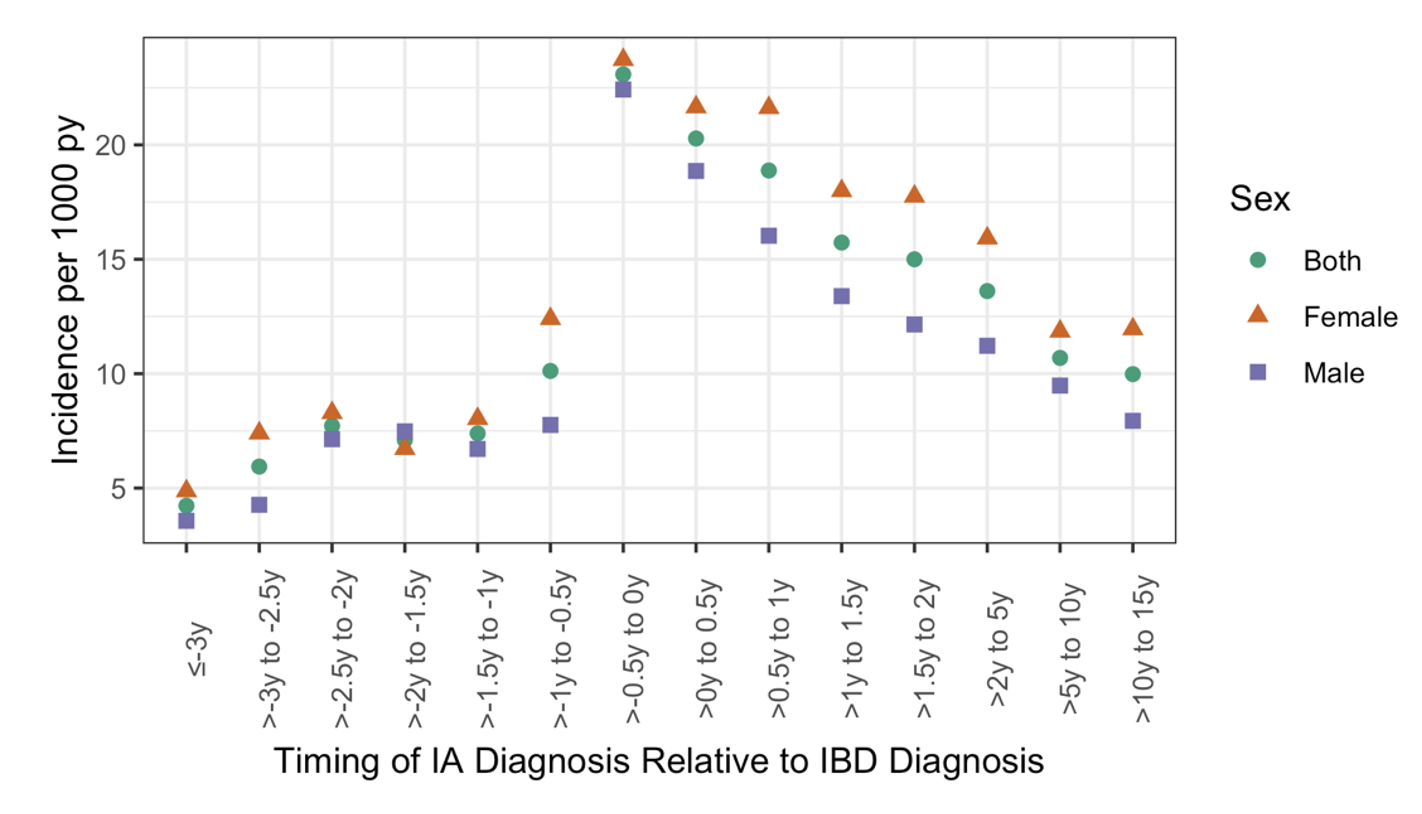
Results: We identified 56,776 individuals with incident IBD; 11,814 (20.8%) had an IA diagnosis. The incidence of IA peaked in the 6 months prior to IBD diagnosis (23.1 (95% CI 18.6 to 28.4) per 1000 person-years), then gradually decreased in the time following IBD diagnosis (Figure). This pattern was consistent in all subgroups.

Conclusion: This is the first population-based study to describe the incidence of IA in an inception cohort of people with IBD. The peak in IA diagnosis around the time of IBD diagnosis indicates a need for integrated interprofessional care models to facilitate patient access to both gastroenterology and rheumatology care. Future research will investigate the implications of these co-occurring diagnoses on health services utilization and expenditures.

Figure. Incidence of IA among incident IBD cases, stratified by sexSupporting image 1

Disclosures: R. Berard: AbbVie/Abbott, 1, Celltrion, 12, advisory board; E. Kuenzig: None; J. Widdifield: None; E. Benchimol: None; M. Lam: None; V. Jairath: AbbVie, 2, 6, Amgen, 2, Anaptys Bio, 2, Asahi Kasei, 2, Asieris, 2, AstraZeneca, 2, Attovia, 2, Biomebank, 2, Biosciences, 2, Blackbird Labs, 2, Boehringer-Ingelheim, 2, Bristol-Myers Squibb(BMS), 2, Caldera, 2, Calluna, 2, Catalytic Health, 2, Celltrion, 2, Eli Lilly, 2, Ensho, 2, Enthera, 2, Exeliome, 2, Ferring, 2, Fresenius Kabi, 2, Gilead, 2, GlaxoSmithKlein(GSK), 2, Granite Bio, 2, Janssen, 2, Merck/MSD, 2, Mountainfield, 2, MRM Health, 2, Nxera, 2, Organon, 2, OSE Immounotherapeautics, 2, OSE Immunotherapeutics, 2, Pendopharm, 2, 2, Pfizer, 2, Pioneering Medicine, 2, Prometheus, 2, Roche/Genentech, 2, Sandofi, 2, SCOPE, 2, Shattuck Labs, 2, Sorriso, 2, Spyre, 2, Synedgen, 2, Takeda, 2, Teva, 2, Tillotts, 2, Union Therapeutics, 2, Ventus, 2, Ventyx, 2, Vividion, 2, Xencor, 2, Zealand Pharma, 2; S. Rohekar: AbbVie/Abbott, 1, 6, Celltrion, 1, 6, Eli Lilly, 1, 6, Fresenius Kabi, 1, 6, Janssen, 1, 6, Novartis, 1, 6, Pfizer, 1, 6, Roche, 1, 6, Sun, 6, UCB, 1, 5, 6, Viatris, 1, 6; L. Targownik: Amgen, 2, Eli Lilly, 2, Janssen, 2, 5, 6, Merck/MSD, 2, Pfizer, 1, 2, 6; M. Watson: AbbVie/Abbott, 2, Amgen, 6, Pfizer, 2; E. Crowley: Abbvie, 5, Alimentiv Inc., 2, Pfizer, 5, Sanofi, 2.

To cite this abstract in AMA style:

Berard R, Kuenzig E, Widdifield J, Benchimol E, Lam M, Jairath V, Rohekar S, Targownik L, Watson M, Crowley E. Incidence of Inflammatory Arthritis Before and After Inflammatory Bowel Disease Diagnosis: A Population-Based Cohort Study [abstract]. Arthritis Rheumatol. 2026; 78 (suppl 3). https://acrabstracts.org/abstract/incidence-of-inflammatory-arthritis-before-and-after-inflammatory-bowel-disease-diagnosis-a-population-based-cohort-study/. Accessed .
  • Tweet
  • Email a link to a friend (Opens in new window) Email
  • Print (Opens in new window) Print

« Back to 2026 Pediatric Rheumatology Symposium

ACR Meeting Abstracts - https://acrabstracts.org/abstract/incidence-of-inflammatory-arthritis-before-and-after-inflammatory-bowel-disease-diagnosis-a-population-based-cohort-study/

Advanced Search

Your Favorites

You can save and print a list of your favorite abstracts during your browser session by clicking the “Favorite” button at the bottom of any abstract. View your favorites »

Embargo Policy

All abstracts accepted to PRYSM are under media embargo once the ACR has notified presenters of their abstract’s acceptance. They may be presented at other meetings or published as manuscripts after this time but should not be discussed in non-scholarly venues or outlets. The following embargo policies are strictly enforced by the ACR.

Accepted abstracts are made available to the public online in advance of the meeting and are published in a special online supplement of our scientific journal, Arthritis & Rheumatology. Information contained in those abstracts may not be released until the abstracts appear online. In an exception to the media embargo, academic institutions, private organizations, and companies with products whose value may be influenced by information contained in an abstract may issue a press release to coincide with the availability of an ACR abstract on the ACR website. However, the ACR continues to require that information that goes beyond that contained in the abstract (e.g., discussion of the abstract done as part of editorial news coverage) is under media embargo until 6:00 PM CT on March 18. Journalists with access to embargoed information cannot release articles or editorial news coverage before this time. Editorial news coverage is considered original articles/videos developed by employed journalists to report facts, commentary, and subject matter expert quotes in a narrative form using a variety of sources (e.g., research, announcements, press releases, events, etc.).

Violation of this policy may result in the abstract being withdrawn from the meeting and other measures deemed appropriate. Authors are responsible for notifying colleagues, institutions, communications firms, and all other stakeholders related to the development or promotion of the abstract about this policy. If you have questions about the ACR abstract embargo policy, please contact ACR abstracts staff at [email protected].

Wiley

  • Online Journal
  • Privacy Policy
  • Permissions Policies
  • Cookie Preferences

© Copyright 2026 American College of Rheumatology