ACR Meeting Abstracts

ACR Meeting Abstracts

  • Meetings
    • 2026 ACR/ARP PRSYM
    • ACR Convergence 2025
    • ACR Convergence 2024
    • ACR Convergence 2023
    • 2023 ACR/ARP PRSYM
    • ACR Convergence 2022
    • ACR Convergence 2021
    • 2020-2009 Meetings
    • Download Abstracts
  • Keyword Index
  • Advanced Search
  • Your Favorites
    • Favorites
    • Login
    • View and print all favorites
    • Clear all your favorites
  • ACR Meetings

Abstract Number: 101

Identifying Intervention Targets to Reduce Emotional Distress and Improve Physical Activity in Juvenile Lupus and Dermatomyositis Patients: Longitudinal Analysis of Lupus Erythematosus and Dermatomyositis Stress and Cardiovascular Health Study Patient-Reported Resiliency Data

Kaveh Ardalan1, Wenshan Yu2, Hwanhee Hong2, Angel Davalos2, Bryce Reeve2, Christoph Hornik2, M. Anthony Moody2, Donald Lloyd-Jones3, Rebecca Sadun1, Jeffrey Dvergsten2, Lauren Covert2, Ann Reed2, Eveline Wu4, Laura Cannon5, Leonard Kovalick6, Caitlan Pinotti6, Aliese Sarkissian6, Audrey Ward7, Simisola Gbadegesin8, Mark Connelly9 and Laura Schanberg10, 1Duke University School of Medicine, Durham, NC, 2Duke University School of Medicine, 3Boston University Chobanian & Avedisian School of Medicine, 4UNC Chapel Hill, Chapel Hill, NC, 5University of North Carolina at Chapel Hill, Chapel Hill, NC, 6University of North Carolina School of Medicine, 7Children's National Hospital, 8Wake Forest University School of Medicine, 9Children’s Mercy Kansas City/University of Missouri-Kansas City School of Medicine, Kansas City, MO, 10Duke University Medical Center, DURHAM, NC

Meeting: 2026 Pediatric Rheumatology Symposium

  • Tweet
  • Email a link to a friend (Opens in new window) Email
  • Print (Opens in new window) Print
Session Information

Date: Friday, March 20, 2026

Title: Abstracts: Pediatric Rheumatology Potpourri

Session Time: 4:37PM-4:42PM

Background/Purpose: Emotional distress is prevalent among patients with juvenile lupus and dermatomyositis (JSLE/JDM). We previously showed that JSLE/JDM patients following high emotional distress trajectories tended to have poorer cardiovascular health (CVH), defined as protective factors against cardiovascular disease (CVD). Diet and physical activity were suboptimal in >95% of JSLE/JDM patients. To inform intervention development, we evaluated associations of patient-reported resiliency factors, emotional distress, and diet/physical activity.

Methods: The LEADS-CV cohort has been described previously (https://duke.is/y/cx66). Participants with complete data were included (n=76). Emotional distress was assessed using self-report PROMIS Pediatric Psychological Stress Experiences, Depressive Symptoms, and Anxiety (PROMIS-Stress/-Depr/-Anx) measures. Resiliency factors evaluated include PROMIS Positive Affect and Emotional Regulation Questionnaire for Children and Adolescents, which assesses adaptive (cognitive reappraisal, ERQ-CR) and maladaptive (emotion suppression, ERQ-ES) emotion regulation strategies. Self-report measures of diet quality (FLASHE screener) and physical activity (PROMIS Physical Activity) were administered. Longitudinal analyses included: 1) growth mixture models (GMM) to identify latent trajectories of resiliency factors; 2) linear mixed-effects models (LMM) to assess associations among resiliency factors, emotional distress, and diet/physical activity.

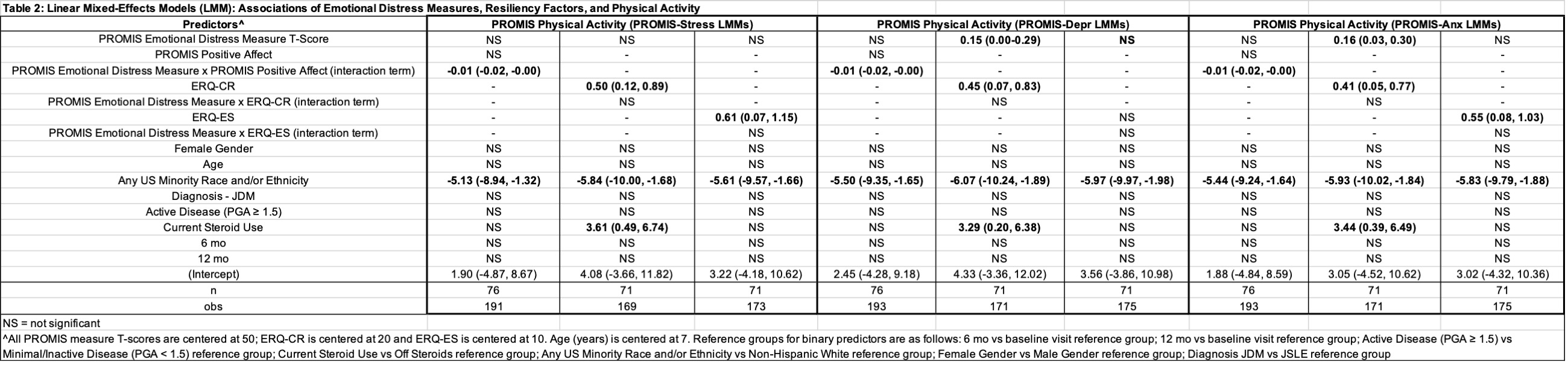
Results: GMMs identified latent trajectories for PROMIS Positive Affect and ERQ-ES (good, fair, poor) and for ERQ-CR (good, poor) (Figure 1). Poor resiliency trajectories were common (21-50%) and remained stable over time. LMMs showed significant associations of PROMIS Positive Affect and ERQ-ES with all emotional distress measures (β range |0.49–0.96| in expected directions, Table 1). Female gender was significantly associated with higher emotional distress across most models (β range 4.92–8.49, table 1). Higher ERQ-CR was associated with better PROMIS Physical Activity (β range 0.16–0.50), and unexpectedly, higher ERQ-ES was also associated with better PROMIS Physical Activity in most models (β range 0.51–0.61) (Table 2). Minority race/ethnicity was associated with worse PROMIS Physical Activity (β range −5.13 to −6.07), even after adjusting for confounders including diagnosis (Table 2). Emotional distress and resiliency factors were not significantly associated with diet quality (not shown).

Conclusion: Interventions that enhance positive affect and strengthen emotion regulation may help reduce emotional distress in JSLE/JDM patients. The finding that both cognitive reappraisal and emotion suppression were associated with greater physical activity suggests complex, potentially bidirectional relationships where some youth use cognitive reappraisal to facilitate physical activity, while others use physical activity as a coping strategy when other emotion regulation strategies are less developed. Gender and racial/ethnic differences should be considered when developing behavioral interventions for JSLE/JDM patients.

Figure 1: Resiliency Factor Latent TrajectoriesSupporting image 1
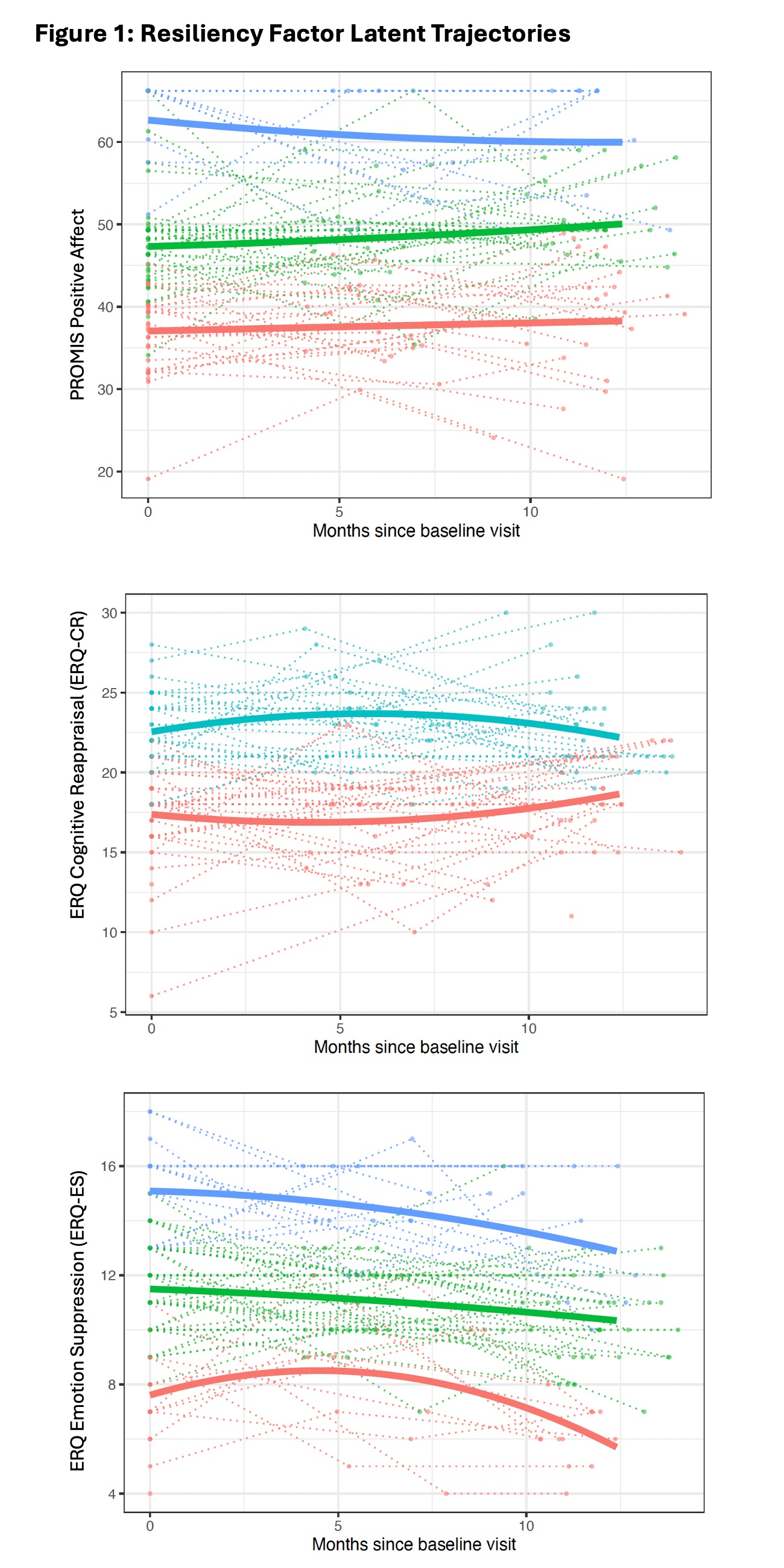
Table 1: Linear Mixed-Effects Models (LMM): Associations of Resiliency Factors & Emotional Distress MeasuresSupporting image 2
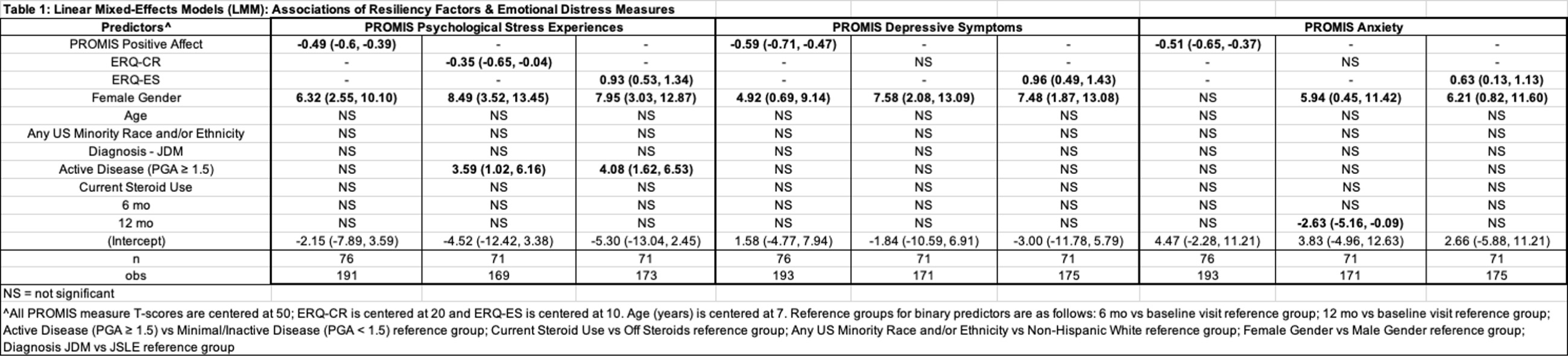
Table 2: Linear Mixed-Effects Models (LMM): Associations of Emotional Distress Measures, Resiliency Factors, and Physical ActivitySupporting image 3

Disclosures: K. Ardalan: Cabaletta Bio, 1, 2, 5, Cartesian Therapeutics, 2, SingHealth, 6, 11; W. Yu: None; H. Hong: None; A. Davalos: None; B. Reeve: Daiichi Sankyo, 2, Dartmouth University, 2, Johns Hopkins University, 2, University of North Carolina at Chapel Hill, 2, Vertex Pharmaceuticals, 2; C. Hornik: Cytokinetics, 1, Emmes Corporation, 12, DSMB, Tellus, 2; M. Moody: Grid Therapeutics, LLC., 8; D. Lloyd-Jones: None; R. Sadun: None; J. Dvergsten: Rare Disease Research, 2; L. Covert: None; A. Reed: None; E. Wu: Pharming Healthcare, Inc, 2, 6, Sumitomo Pharma America, 1; L. Cannon: None; L. Kovalick: None; C. Pinotti: None; A. Sarkissian: None; A. Ward: None; S. Gbadegesin: None; M. Connelly: None; L. Schanberg: AbbVie, 5, Amgen, 5, Bristol-Myers Squibb(BMS), 5, Frenesius Kabi, 5, Pfizer, 5, Sanofi, 12, DSMB.

To cite this abstract in AMA style:

Ardalan K, Yu W, Hong H, Davalos A, Reeve B, Hornik C, Moody M, Lloyd-Jones D, Sadun R, Dvergsten J, Covert L, Reed A, Wu E, Cannon L, Kovalick L, Pinotti C, Sarkissian A, Ward A, Gbadegesin S, Connelly M, Schanberg L. Identifying Intervention Targets to Reduce Emotional Distress and Improve Physical Activity in Juvenile Lupus and Dermatomyositis Patients: Longitudinal Analysis of Lupus Erythematosus and Dermatomyositis Stress and Cardiovascular Health Study Patient-Reported Resiliency Data [abstract]. Arthritis Rheumatol. 2026; 78 (suppl 3). https://acrabstracts.org/abstract/identifying-intervention-targets-to-reduce-emotional-distress-and-improve-physical-activity-in-juvenile-lupus-and-dermatomyositis-patients-longitudinal-analysis-of-lupus-erythematosus-and-dermatomyos/. Accessed .
  • Tweet
  • Email a link to a friend (Opens in new window) Email
  • Print (Opens in new window) Print

« Back to 2026 Pediatric Rheumatology Symposium

ACR Meeting Abstracts - https://acrabstracts.org/abstract/identifying-intervention-targets-to-reduce-emotional-distress-and-improve-physical-activity-in-juvenile-lupus-and-dermatomyositis-patients-longitudinal-analysis-of-lupus-erythematosus-and-dermatomyos/

Advanced Search

Your Favorites

You can save and print a list of your favorite abstracts during your browser session by clicking the “Favorite” button at the bottom of any abstract. View your favorites »

Embargo Policy

All abstracts accepted to PRYSM are under media embargo once the ACR has notified presenters of their abstract’s acceptance. They may be presented at other meetings or published as manuscripts after this time but should not be discussed in non-scholarly venues or outlets. The following embargo policies are strictly enforced by the ACR.

Accepted abstracts are made available to the public online in advance of the meeting and are published in a special online supplement of our scientific journal, Arthritis & Rheumatology. Information contained in those abstracts may not be released until the abstracts appear online. In an exception to the media embargo, academic institutions, private organizations, and companies with products whose value may be influenced by information contained in an abstract may issue a press release to coincide with the availability of an ACR abstract on the ACR website. However, the ACR continues to require that information that goes beyond that contained in the abstract (e.g., discussion of the abstract done as part of editorial news coverage) is under media embargo until 6:00 PM CT on March 18. Journalists with access to embargoed information cannot release articles or editorial news coverage before this time. Editorial news coverage is considered original articles/videos developed by employed journalists to report facts, commentary, and subject matter expert quotes in a narrative form using a variety of sources (e.g., research, announcements, press releases, events, etc.).

Violation of this policy may result in the abstract being withdrawn from the meeting and other measures deemed appropriate. Authors are responsible for notifying colleagues, institutions, communications firms, and all other stakeholders related to the development or promotion of the abstract about this policy. If you have questions about the ACR abstract embargo policy, please contact ACR abstracts staff at [email protected].

Wiley

  • Online Journal
  • Privacy Policy
  • Permissions Policies
  • Cookie Preferences

© Copyright 2026 American College of Rheumatology