
Session Information
Session Time: 5:00PM-6:00PM
Background/Purpose: Guidance statements published in 2025 by the American College of Rheumatology stress the importance of addressing mental health concerns in children with rheumatic diseases. Previous work done in our division has shown that anxiety and depression screening in patients with lupus can occur successfully by utilizing the electronic health record (EHR) and ensuring access to psychological services within an outpatient rheumatology clinic. Building off this work, our goal for this project was to expand the diagnoses for electronically-based screening in an outpatient rheumatology clinic, and to assess percentage completion for mental health screeners.
Methods: Mental health screeners, including the Patient Health Questionnaire 8 (PHQ-8), Generalized Anxiety Disorder-7 (GAD-7), and Ask Suicide-Screening Questions (ASQ), were assigned at outpatient rheumatology visits for patients in 2023 and expanded to a wide range of rheumatic diseases in December 2024. Data on screener completion and follow-up activities for positive screens were collected. Using QI methodology, several plan-do-study-act cycles were completed to implement interventions to increase patient-level accessibility of screeners and to expand our screened population. Screening results were incorporated into the clinic note and high score alerts were issued to psychology and social work using informatics tools.
Results: Electronically administering mental health screeners to an expanded list of patients with rheumatologic diagnoses increased the number of screeners that were assigned from a mean of 20.5 screeners per month at the start of data collection in 2023, to 50 screeners per month over the 9-month period in which screening diagnoses were expanded. This expansion had little impact on clinic flow based on qualitative reports; however, completion rates for PHQ and GAD7 screeners decreased over that nine-month period, from 75.1% to 69.3% (figure 1), and from 79% to 76.1% (figure 2), respectively. 6.2% of patients screened positive for suicide risk on the ASQ and required further risk assessment and safety planning.
Conclusion: Our results suggest that expansion of mental health screening to a wide range of rheumatologic diagnoses is feasible and an effective way to increase identification of anxiety and depressive symptoms among pediatric patients with rheumatic diseases. Future efforts will focus on an expansion to universal mental health screening in rheumatology follow up visits and measurement of timeliness and establishment of linkage with behavioral health services after positive screens.
PHQ-8 Depression Screener Completion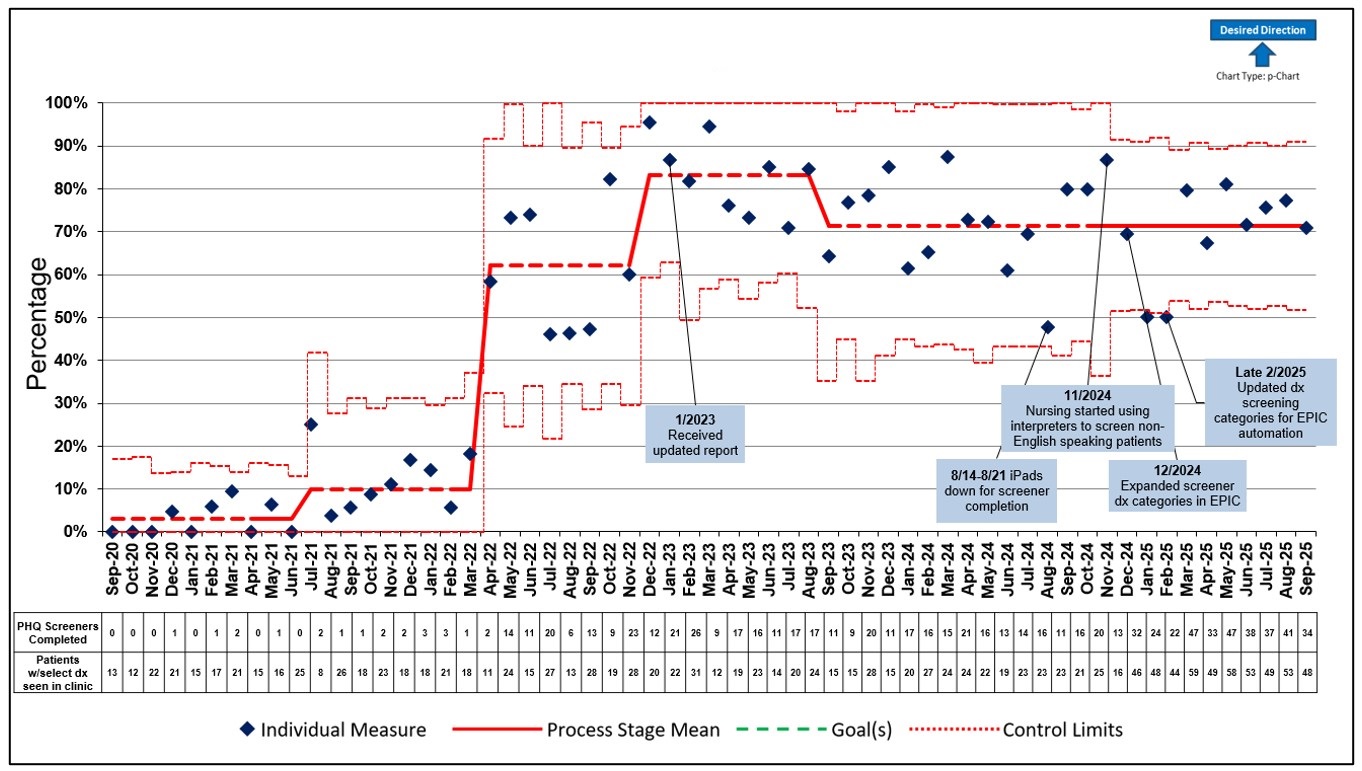 The number of PHQ-8 screeners assigned and completed in clinic by month.
GAD-7 Anxiety Screener Completion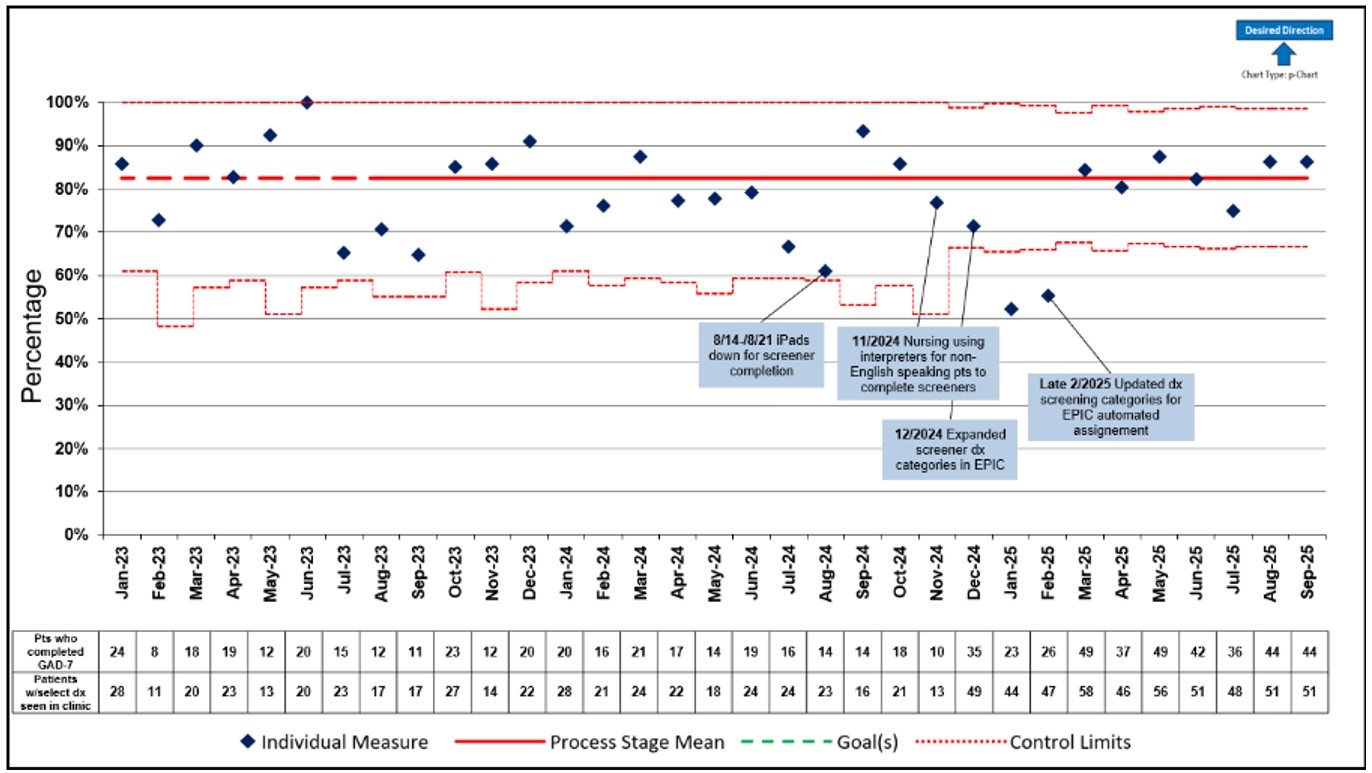 The number of GAD-7 screeners assigned and completed in clinic by month.
To cite this abstract in AMA style:
Brittain A, Sivaraman V, Leone A, McDaniel E, Hughes J, Taxter A, Driest K, Leever A. Expansion of Mental Health Screening to Patients with Diverse Rheumatologic Diagnoses in an Outpatient Pediatric Rheumatology Clinic [abstract]. Arthritis Rheumatol. 2026; 78 (suppl 3). https://acrabstracts.org/abstract/expansion-of-mental-health-screening-to-patients-with-diverse-rheumatologic-diagnoses-in-an-outpatient-pediatric-rheumatology-clinic/. Accessed .« Back to 2026 Pediatric Rheumatology Symposium
ACR Meeting Abstracts - https://acrabstracts.org/abstract/expansion-of-mental-health-screening-to-patients-with-diverse-rheumatologic-diagnoses-in-an-outpatient-pediatric-rheumatology-clinic/