
Session Information
Date: Tuesday, October 28, 2025
Title: (2547–2566) ARP Posters I
Session Type: Poster Session C
Session Time: 10:30AM-12:30PM
Background/Purpose: Hand osteoarthritis (OA) is a prevalent disease that significantly impacts hand function and quality of life. The Kellgren-Lawrence (KL) grading system is widely used for classifying radiographic OA severity, with KL3 and KL4 representing severe cases. However, the automated classification of KL3 and KL4 remains challenging due to the limited availability of high-quality training data (e.g., only 2% of interphalangeal joints are KL3 and KL4 in the Osteoarthritis Initiative). For example, traditional convolutional neural networks struggle to achieve high classification accuracy in KL3 and KL4 cases. This study explores augmenting the training dataset and improving classification accuracy by using CycleGAN to generate synthetic KL3 and KL4 images. By leveraging the abundance of KL0 images and transforming them into synthetic KL3 and KL4 cases, we aim to enhance the accuracy of KL3 and KL4 classification as well as the model’s overall performance while maintaining morphological realism and textural consistency in the synthetic images.
Methods: We selected 3,557 hand X-ray images from the Osteoarthritis Initiative (OAI) dataset and extracted 10,845 Distal interphalangeal joints (DIP) at the index finger, which include 6,845 KL0, 1,574 KL1, 2,142 KL2, 151 KL3, and 133 KL4 joints. The dataset was split into training, validation, and testing in a 75%:10%:15% ratio. We employed a CycleGAN model to generate synthetic KL3 and KL4 images to address the class imbalance using the more abundant KL0 and KL1 images. The generated synthetic images were then incorporated into the training dataset only. We trained an EfficientNetB7 model to evaluate the effect of synthetic data augmentation. Different configurations were tested, including varying the source domain (KL0 or KL1) and the target domain (KL3 or KL4) in CycleGAN training and mixing synthetic images with real data at different ratios. The classification performance was assessed based on accuracy improvements, particularly for KL3 and KL4 cases.
Results: The proposed CycleGAN pipeline successfully generated high-quality KL3 and KL4 images (Figure 1), enriching the dataset and boosting classification accuracy. We repeated the experiments 15 times to better evaluate our method and calculated the average improvement. The best EfficientNetB7 model showed a 6% improvement in KL3 accuracy (from 36.3% to 42.3%) and a 3.1% improvement in KL4 accuracy (from 74.2% to 77.3%) by adding 30% synthetic data into the training set (Table 1). The overall classification accuracy has slightly increased, indicating that the introduction of synthetic data has a minimal impact on KL0, KL1, and KL2 accuracy
Conclusion: Our study demonstrates the potential of generative AI in improving hand OA classification, particularly for the severe radiographic OA (KL3 and KL4). The proposed approach effectively implemented morphological changes to generate OA cases from healthy cases while keeping textural consistency, which leads to improved classification performance.
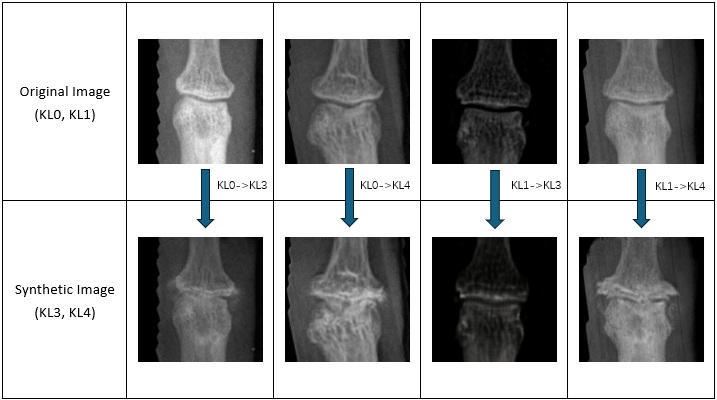 Figure 1: Examples of Synthetic KL3 and KL4 Image generated from KL0 and KL1
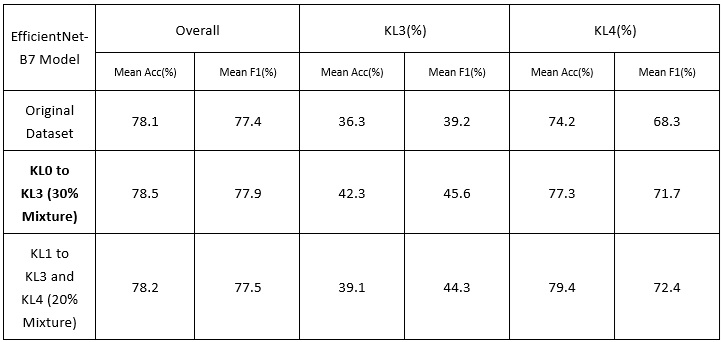 Table 1: Classification results of the EfficientNetB7 model on the original dataset and two synthetic data mixtures: 30% KL3 synthetic data from KL0 and 20% KL3 and KL4 synthetic data from KL1
Disclosures: Z. Cao: None; J. Shan: None; X. Jiang: None; Q. Wang: None; T. McAlindon: Anika, 2, Grunenthal, 2, Kiniksk, 2, Kolon TissueGene, Inc., 2, Medipost, 2, Novan, 2, Organogenesis, 2, Regeneron, 2, Remedium-Bio, 2, Samumed, 2, Sanofi, 2, Scarcell, 2, Visor, 2; J. Driban: None; M. Zhang: None.
To cite this abstract in AMA style:
Cao Z, Shan J, Jiang X, Wang Q, McAlindon T, Driban J, Zhang M. Enhancing Hand Osteoarthritis Classification with Generative AI: A CycleGAN and EfficientNetB7 Approach [abstract]. Arthritis Rheumatol. 2025; 77 (suppl 9). https://acrabstracts.org/abstract/enhancing-hand-osteoarthritis-classification-with-generative-ai-a-cyclegan-and-efficientnetb7-approach/. Accessed .ACR Meeting Abstracts - https://acrabstracts.org/abstract/enhancing-hand-osteoarthritis-classification-with-generative-ai-a-cyclegan-and-efficientnetb7-approach/