
Session Information
Date: Sunday, October 26, 2025
Session Type: Poster Session A
Session Time: 10:30AM-12:30PM
Background/Purpose: Semi-quantitative and semi-automated quantitative measurements of effusion-synovitis (ES) are prognostic for knee OA progression. Changes in these metrics relate to changes in knee pain. However, these traditional methods require readers to review or measure MRIs, leading to reader variability and significant time demands. An automated approach could enable quantitative ES volume measurements that can be rapidly deployed on large datasets without variations between readers. Hence, we evaluated the prognostic and construct validity of an automated quantitative measurement of ES volume by comparing its relationship to knee OA progression against that of a well-established semi-automated ES volume.
Methods: We conducted knee-based analyses among participants in the Osteoarthritis Initiative with bilateral knee MRIs and at least one knee with Kellgren-Lawrence (KL) grade ≥ 1 and a WOMAC pain score ≥ 10/100. We included participants with ES measurements at the 12- and 36-month OAI visits. A trained reader measured whole-knee ES volume on MRIs using our semi-automated software. To develop an automated measurement, we implemented a deep neural network approach based on the 3D U-Net architecture developed with the Medical Open Network for Artificial Intelligence (MONAI) framework. The model was trained using a different dataset with data augmentation techniques, including random affine transformations, spatial flips, and intensity shifts to enhance robustness. We calculated Pearson Correlation Coefficients between the automated and semi-automated ES volumes (cross-sectionally and 2-year change) and created Bland-Altman plots. To assess prognostic validity, we examined how ES volumes at the 12-month visit related to changes in radiographic severity (KL and joint space narrowing [JSN] progression) over the subsequent 3 years. To assess construct validity, we examined concurrent change in ES volumes with 2-year progression in KL grade, JSN grade, or WOMAC knee pain scores (change > 10/100 points). We performed knee-based analyses using logistic regression with repeated measures to adjust for correlations between knees within each person.
Results: Among the 506 participants (1,011 knees), 56% were female with a mean (SD) age = 61 (9) years and BMI = 29.3 (4.3) kg/m2. The sample included 82 (8%) knees with KL progression, 103 (10%) with medial JSN progression, and 126 (12%) with knee pain worsening. Cross-sectionally, the automated method yielded smaller volumes than the semi-automated method (Figure 1B); however, these differences were attenuated when assessing longitudinal change (Figure 1D). Despite these differences, the automated ES volume strongly correlated with the semi-automated volume (r = 0.89; Figure 1A) and volume change (r = 0.84; Figure 1C). The table shows that the automated and semi-automated ES volumes had consistent statistically significant associations with every outcome.
Conclusion: The automated ES volume had strong prognostic and construct validity regarding radiographic and pain outcomes. The automated method offers an efficient strategy to quantify ES in studies with large sample sizes. It may provide a cost-effective approach to screen MRIs in future clinical trials.
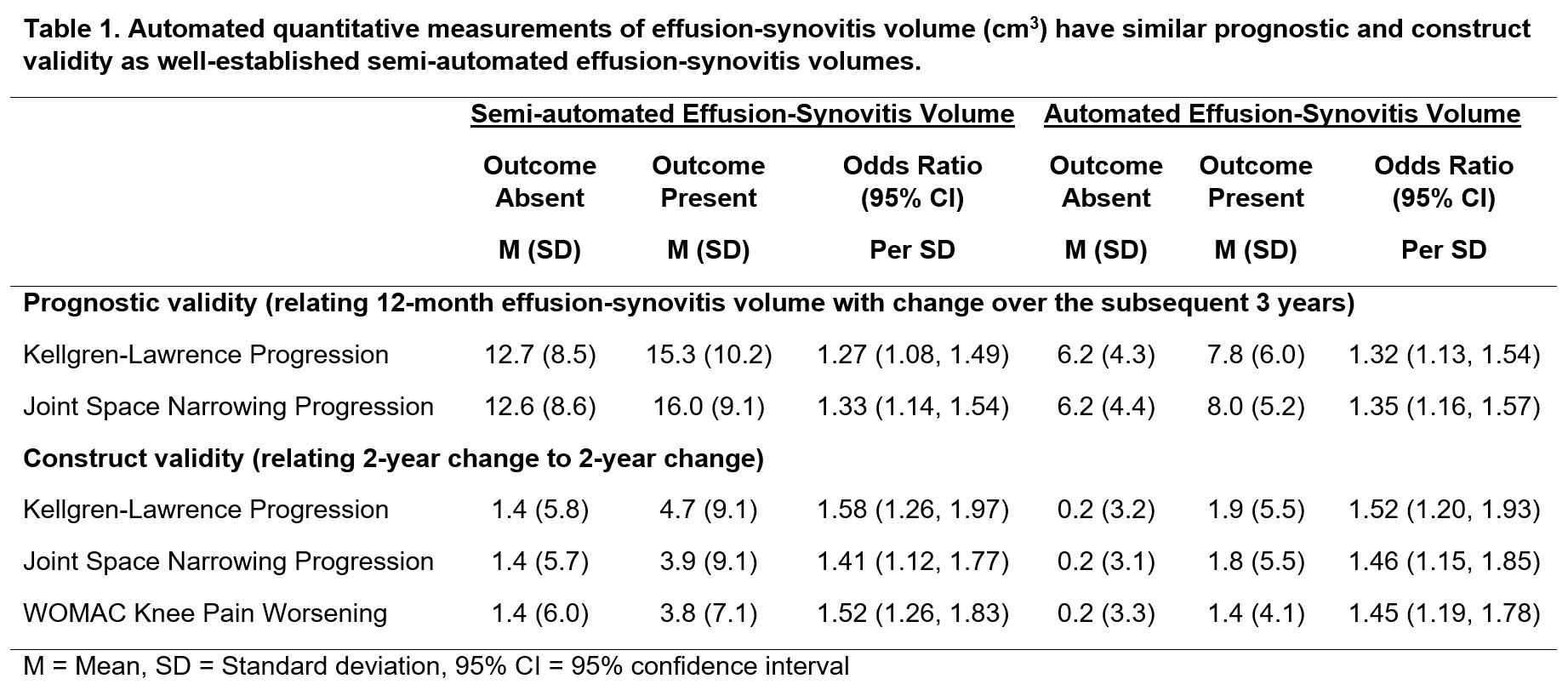 Table. Automated quantitative measurements of effusion-synovitis volume (cm3) have similar prognostic and construct validity as well-established semi-automated effusion-synovitis volumes.
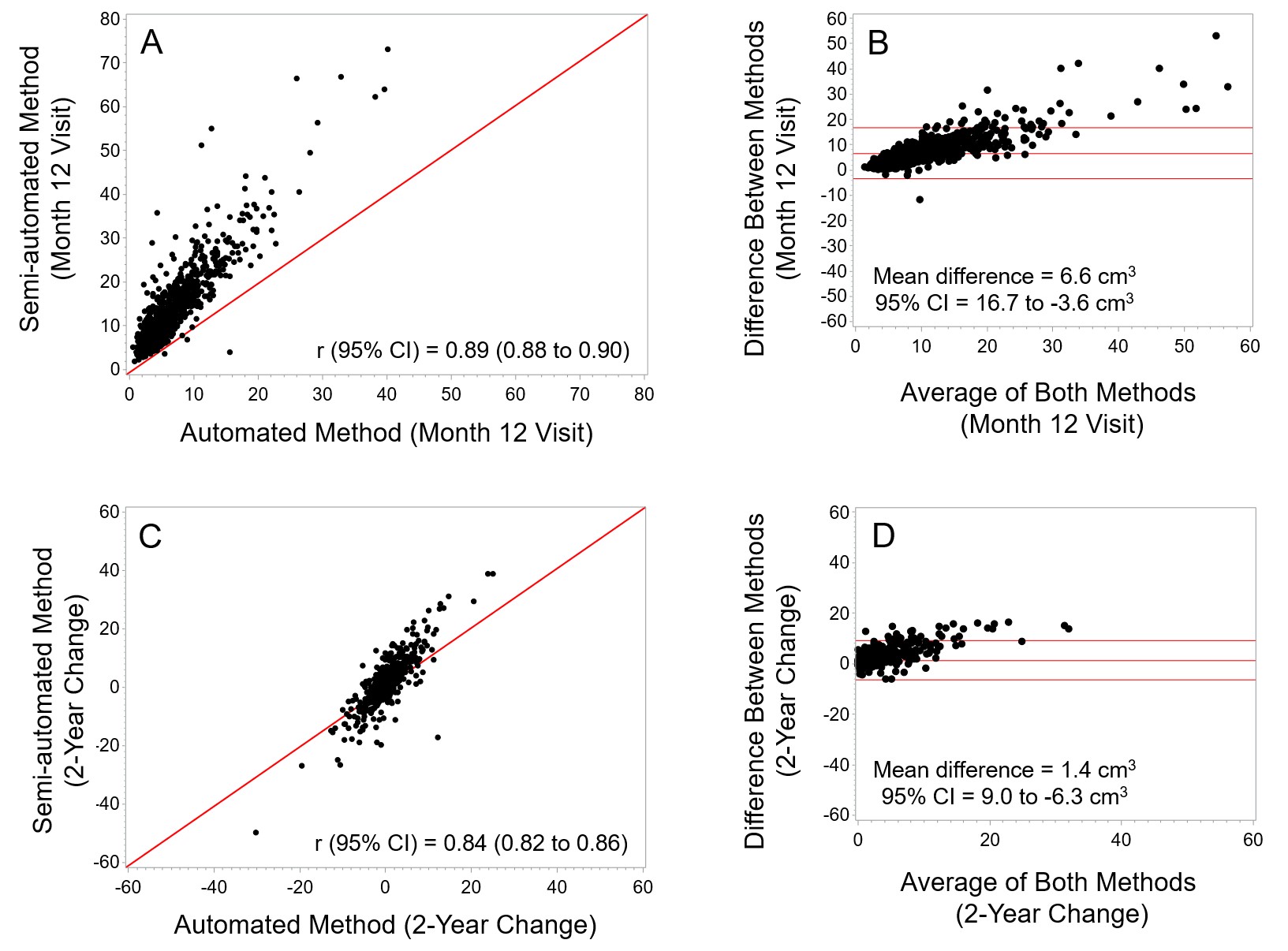 Figure 1. Cross-sectionally, the automated effusion-synovitis volumes (cm^3) are typically smaller than the semi-automated effusion-synovitis volumes (A [Scatter Plot], B [Bland-Altman Plot]); however, these differences are attenuated when examining the two-year change in both measures (C [Scatter Plot], D [Bland-Altman Plot]). In Figures A and C, the red line is the line of identity/equality, and correlations are reported with 95% confidence intervals (CI). In Figures B and D, the middle red line is the mean difference between the methods. The upper and lower red lines represent the upper and lower bounds of the 95% confidence interval, respectively.
Disclosures: J. Driban: None; K. Lapane: None; S. Liu: None; J. Baek: None; G. Lo: None; M. Harkey: None; C. Eaton: None; J. Mackay: AstraZeneca, 3, Blue Earth Diagnostics, 3; T. McAlindon: Anika, 2, Grunenthal, 2, Kiniksk, 2, Kolon TissueGene, Inc., 2, Medipost, 2, Novan, 2, Organogenesis, 2, Regeneron, 2, Remedium-Bio, 2, Samumed, 2, Sanofi, 2, Scarcell, 2, Visor, 2; M. Chowdhury: None; Z. Cao: None; J. Shan: None; M. Zhang: None.
To cite this abstract in AMA style:
Driban J, Lapane K, Liu S, Baek J, Lo G, Harkey M, Eaton C, Mackay J, McAlindon T, Chowdhury M, Cao Z, Shan J, Zhang M. Automated Effusion-Synovitis Volume is Prognostic and Responsive to Knee Osteoarthritis Progression: Data from the Osteoarthritis Initiative [abstract]. Arthritis Rheumatol. 2025; 77 (suppl 9). https://acrabstracts.org/abstract/automated-effusion-synovitis-volume-is-prognostic-and-responsive-to-knee-osteoarthritis-progression-data-from-the-osteoarthritis-initiative/. Accessed .ACR Meeting Abstracts - https://acrabstracts.org/abstract/automated-effusion-synovitis-volume-is-prognostic-and-responsive-to-knee-osteoarthritis-progression-data-from-the-osteoarthritis-initiative/