ACR Meeting Abstracts

ACR Meeting Abstracts

  • Meetings
    • 2026 ACR/ARP PRSYM
    • ACR Convergence 2025
    • ACR Convergence 2024
    • ACR Convergence 2023
    • 2023 ACR/ARP PRSYM
    • ACR Convergence 2022
    • ACR Convergence 2021
    • 2020-2009 Meetings
    • Download Abstracts
  • Keyword Index
  • Advanced Search
  • Your Favorites
    • Favorites
    • Login
    • View and print all favorites
    • Clear all your favorites
  • ACR Meetings

Abstract Number: 053

Association between Childhood Opportunity Index and Disparities in Health Care Access and Utilization in Childhood Onset Systemic Lupus Erythematosus

Abigale Jagger1, Elaine Yung2, Hermine Brunner2, Andrew Beck3, Eneida Mendonca3, Qing Duan4, Cole Brokamp4, Giya Harry5 and Jackeline Rodriguez-Smith2, 1Cincinnati Children's, Cincinnati, OH, 2Cincinnati Children's Hospital Medical Center, Cincinnati, OH, 3Cincinnati Children's Hospital Medical Center, University of Cincinnati College of Medicine, 4Cincinnati Children's Hospital Medical Center, 5Brenner Children's Hospital - Wake Forest Baptist Health, Winston-Salem, NC

Meeting: 2026 Pediatric Rheumatology Symposium

  • Tweet
  • Email a link to a friend (Opens in new window) Email
  • Print (Opens in new window) Print
Session Information

Date: Thursday, March 19, 2026

Title: Abstracts: Systemic Lupus Erythematosus

Session Time: 5:23PM-5:28PM

Background/Purpose: Disparities in pediatric health outcomes are well described. The role of social determinants of health (SDOH) in the persistence of such disparities is increasingly of interest across subspecialties, including pediatric rheumatology. Interrelationships between SDOH and childhood-onset systemic lupus erythematosus (cSLE) are poorly characterized. Here, we sought to characterize disparities in cSLE outcomes and assess links between such disparities and markers of the SDOH.

Methods: We conducted a retrospective longitudinal cohort study of patients with cSLE followed at a large, pediatric, tertiary center in the US between January 2012 and June 2024. Eligible patients had ≥3 pediatric rheumatology visits. Outcomes of interest included: timely attendance at rheumatology and infusion visits; and hospitalizations and emergency department (ED) encounters following initial cSLE diagnosis (index visit). Clinical data and sociodemographic data, including patient address, were obtained from the electronic health record. Addresses were geocoded and linked to the census tract-level Childhood Opportunity Index (COI), an area-level depiction of the SDOH. Unadjusted and adjusted regression models, accounting for baseline SLEDAI score and COI quintile, were used to study the relationship between racial disparities and cSLE outcomes.

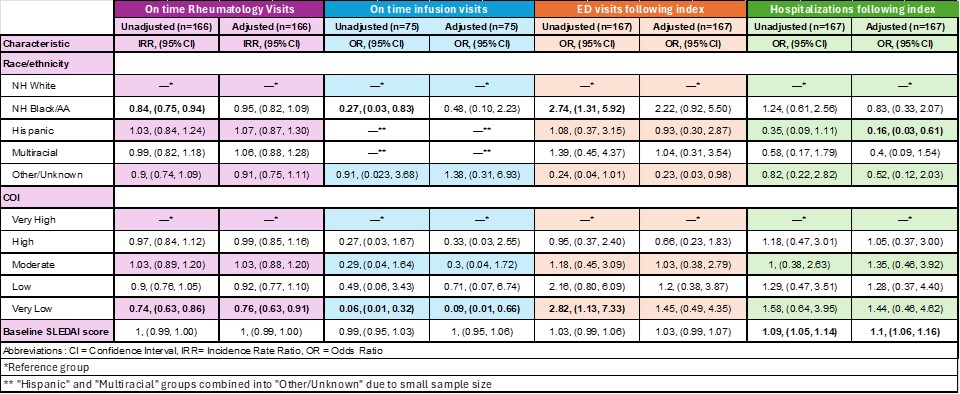
Results: A total of 170 patients met eligibility criteria. Within this population 53.5% had Medicaid, and 37.5% lived in low or very low COI tracts (15.5% and 22.0%, respectively) (Table 1). We observed a racial disparity in on time rheumatology visits (IRR for Black/AA vs. White: 0.84, CI 0.75-0.94), infusion visits (OR for Black/AA vs. White: 0.27, CI 0.08-0.83), and number of ED visits following the index encounter (OR for Black/AA vs White: 2.74, CI 1.31-5.92). After adjusting for COI and baseline disease severity, the racial disparity was not present for any of the aforementioned outcomes (Table 2). A statistical significance between Hispanics vs White for hospitalizations after index was observed. After adjusting for the follow up duration, the racial disparity was no longer present.

Conclusion: Racial disparities are observed in cSLE outcomes. As race is a social construct, accounting for SDOH via COI, eliminated racial disparities. Our findings suggest that structural inequities, such as living in areas of low childhood opportunity, are influential in shaping health care access and utilization experiences. Further investigation into such links will help define, develop, and evaluate interventions.  

Table 1. Demographics and clinical characteristics stratified by racial disparitiesSupporting image 1
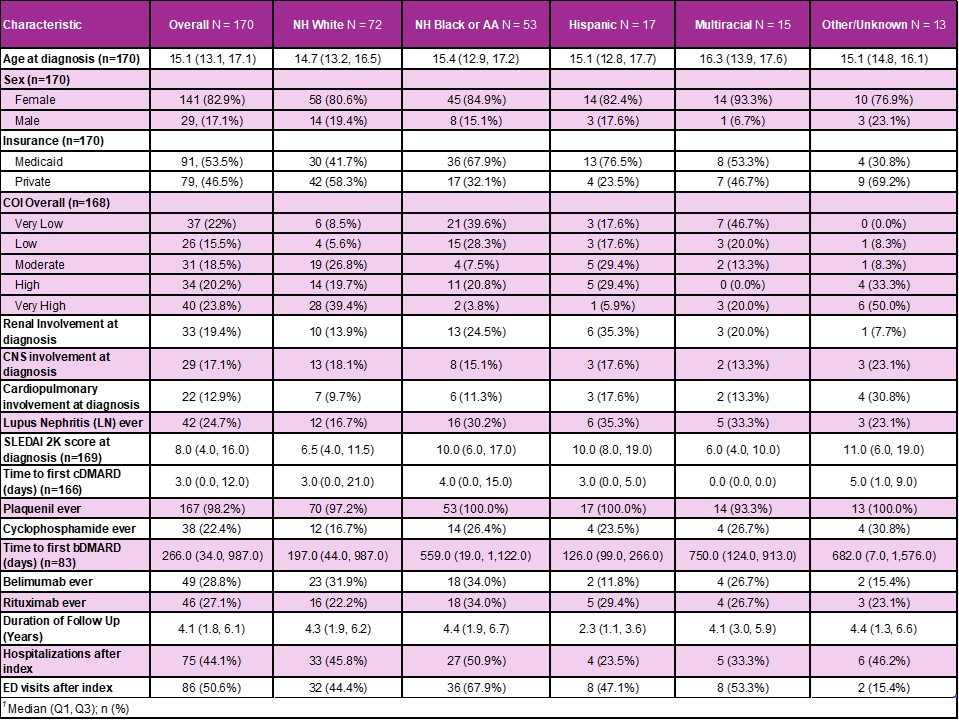
Table 2. Social determinants of health association with health care outcomesSupporting image 2

Disclosures: A. Jagger: None; E. Yung: None; H. Brunner: None; A. Beck: None; E. Mendonca: None; Q. Duan: None; C. Brokamp: None; G. Harry: None; J. Rodriguez-Smith: None.

To cite this abstract in AMA style:

Jagger A, Yung E, Brunner H, Beck A, Mendonca E, Duan Q, Brokamp C, Harry G, Rodriguez-Smith J. Association between Childhood Opportunity Index and Disparities in Health Care Access and Utilization in Childhood Onset Systemic Lupus Erythematosus [abstract]. Arthritis Rheumatol. 2026; 78 (suppl 3). https://acrabstracts.org/abstract/association-between-childhood-opportunity-index-and-disparities-in-health-care-access-and-utilization-in-childhood-onset-systemic-lupus-erythematosus/. Accessed .
  • Tweet
  • Email a link to a friend (Opens in new window) Email
  • Print (Opens in new window) Print

« Back to 2026 Pediatric Rheumatology Symposium

ACR Meeting Abstracts - https://acrabstracts.org/abstract/association-between-childhood-opportunity-index-and-disparities-in-health-care-access-and-utilization-in-childhood-onset-systemic-lupus-erythematosus/

Advanced Search

Your Favorites

You can save and print a list of your favorite abstracts during your browser session by clicking the “Favorite” button at the bottom of any abstract. View your favorites »

Embargo Policy

All abstracts accepted to PRYSM are under media embargo once the ACR has notified presenters of their abstract’s acceptance. They may be presented at other meetings or published as manuscripts after this time but should not be discussed in non-scholarly venues or outlets. The following embargo policies are strictly enforced by the ACR.

Accepted abstracts are made available to the public online in advance of the meeting and are published in a special online supplement of our scientific journal, Arthritis & Rheumatology. Information contained in those abstracts may not be released until the abstracts appear online. In an exception to the media embargo, academic institutions, private organizations, and companies with products whose value may be influenced by information contained in an abstract may issue a press release to coincide with the availability of an ACR abstract on the ACR website. However, the ACR continues to require that information that goes beyond that contained in the abstract (e.g., discussion of the abstract done as part of editorial news coverage) is under media embargo until 6:00 PM CT on March 18. Journalists with access to embargoed information cannot release articles or editorial news coverage before this time. Editorial news coverage is considered original articles/videos developed by employed journalists to report facts, commentary, and subject matter expert quotes in a narrative form using a variety of sources (e.g., research, announcements, press releases, events, etc.).

Violation of this policy may result in the abstract being withdrawn from the meeting and other measures deemed appropriate. Authors are responsible for notifying colleagues, institutions, communications firms, and all other stakeholders related to the development or promotion of the abstract about this policy. If you have questions about the ACR abstract embargo policy, please contact ACR abstracts staff at [email protected].

Wiley

  • Online Journal
  • Privacy Policy
  • Permissions Policies
  • Cookie Preferences

© Copyright 2026 American College of Rheumatology