
Session Information
Date: Sunday, October 26, 2025
Session Type: Poster Session A
Session Time: 10:30AM-12:30PM
Background/Purpose: Cartilage defects are a hallmark of OA progression. We previously developed a composite MRI-based metric that combines cartilage damage from 6 anatomical regions throughout a knee. This cumulative damage metric relates to radiographic knee OA severity and reflects the accumulation of damage attributable to OA over the course of the disease. Cumulative damage is a sensitive biomarker for detecting cartilage changes; however, morphological cartilage changes typically occur later in the disease process. It remains unclear whether this composite score represents clinically meaningful pathways relevant to early stages of OA and can identify people before the onset of OA. We evaluated whether our cumulative damage composite metric is prognostic of incident symptomatic knee OA over the subsequent three years.
Methods: We analyzed a convenience sample within the Osteoarthritis Initiative of participants without symptomatic knee OA. Pain assessments and radiographs were collected annually. Using Magnetic resonance images from the initial visit, we combined 6 regional cartilage damage index measures (intra-reader ICC ≥ 0.84) to calculate a composite score, referred to as the cumulative damage metric. A cumulative damage metric of 0 approximated the average value for a reference sample (n=197, 53% had moderate-severe radiographic knee OA, average [SD] WOMAC pain score = 5.0 [3.6]); lower (negative) values indicate milder disease, while greater values indicate worse disease. The outcome was incident symptomatic knee OA (the combined state of frequent knee pain and radiographic OA [Kellgren-Lawrence Grade ≥ 2]) within three years after the cumulative damage measurement. We used logistic regression with repeated measures to assess the association between cumulative damage (continuous measure and tertiles) and incident symptomatic knee OA, adjusting for gender, age, and body mass index.
Results: Among 913 knees (n=572 participants), most were female (56%), white (82%), and had a mean age of 61 (SD=9) and body mass index of 29.4 (SD=4.5) kg/m2. Cumulative damage ranged from -9.4 to 13.3 (higher values = worse cartilage damage). Knees that developed incident symptomatic OA had greater cumulative damage (2.0 [3.4] vs. 0.6 [3.3]); the adjusted relative risk per 1 unit increase was 1.09 (95% confidence interval: 1.06-1.13; Table). More specifically, the tertile with the worst cumulative damage – analogous to damage typically observed among knees with radiographic OA (Table) – was associated with a greater risk for incident symptomatic knee OA.
Conclusion: Greater cumulative damage, especially severe damage typical of knees with radiographic OA, is associated with a higher risk of incident symptomatic OA.
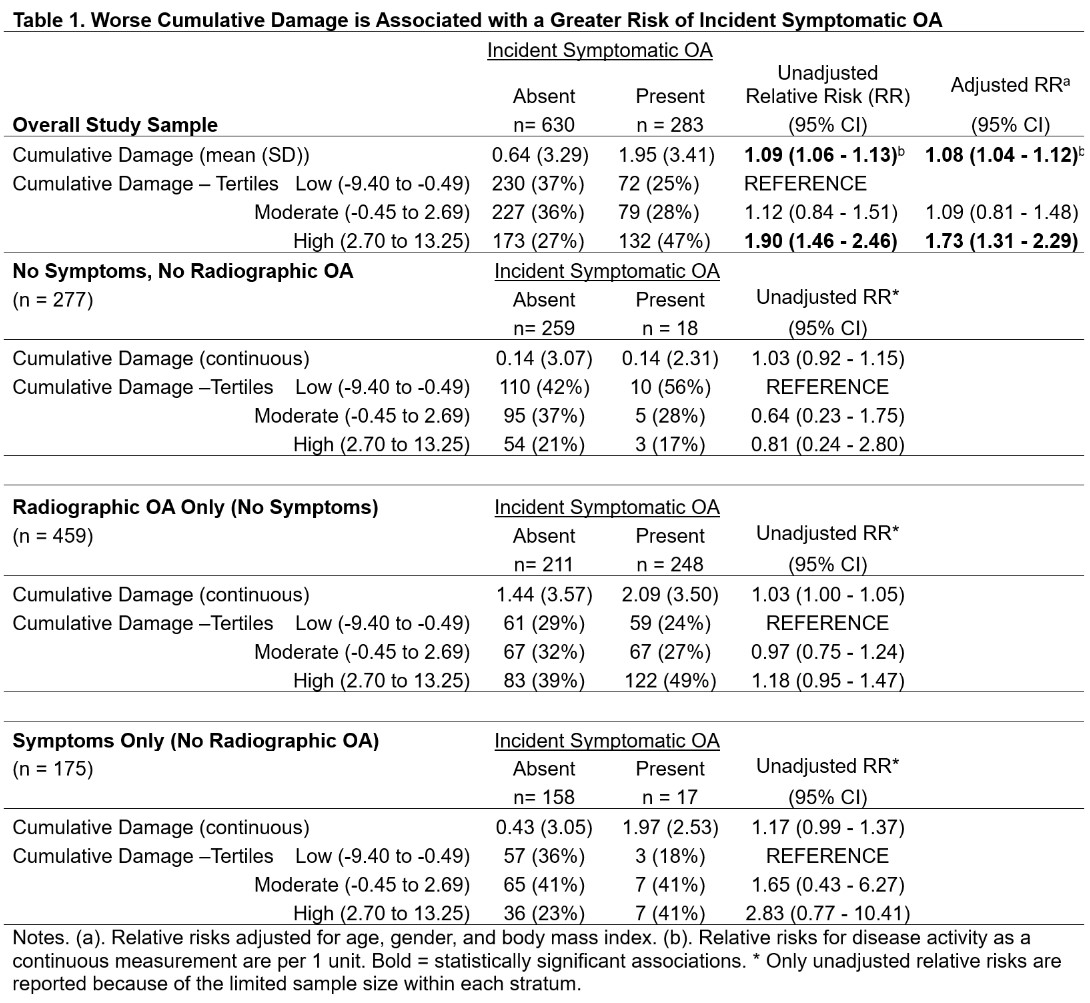 Table 1. Worse Cumulative Damage is Associated with a Greater Risk of Incident Symptomatic OA
Disclosures: J. Patarini: None; T. McAlindon: Anika, 2, Grunenthal, 2, Kiniksk, 2, Kolon TissueGene, Inc., 2, Medipost, 2, Novan, 2, Organogenesis, 2, Regeneron, 2, Remedium-Bio, 2, Samumed, 2, Sanofi, 2, Scarcell, 2, Visor, 2; J. Baek: None; E. Kirillov: None; N. Vo: None; M. Richard: None; M. Zhang: None; M. Harkey: None; G. Lo: None; S. Liu: None; K. Lapane: None; C. Eaton: None; J. Mackay: AstraZeneca, 3, Blue Earth Diagnostics, 3; J. Driban: None.
To cite this abstract in AMA style:
Patarini J, McAlindon T, Baek J, Kirillov E, Vo N, Richard M, Zhang M, Harkey M, Lo G, Liu S, Lapane K, Eaton C, Mackay J, Driban J. A Composite Cumulative Cartilage Damage Metric Predicts Incident Symptomatic Knee OA: Data from the Osteoarthritis Initiative [abstract]. Arthritis Rheumatol. 2025; 77 (suppl 9). https://acrabstracts.org/abstract/a-composite-cumulative-cartilage-damage-metric-predicts-incident-symptomatic-knee-oa-data-from-the-osteoarthritis-initiative/. Accessed .ACR Meeting Abstracts - https://acrabstracts.org/abstract/a-composite-cumulative-cartilage-damage-metric-predicts-incident-symptomatic-knee-oa-data-from-the-osteoarthritis-initiative/