
Session Information
Session Time: 5:00PM-6:00PM
Background/Purpose: : Medicaid is critical for uninterrupted access to high value care. Considering recent and ongoing changes in Medicaid federal policy, it is critical to understand trends in enrollment churn. There is limited knowledge about these trends among children with rheumatic disease. In this study, we examined trends in Medicaid enrollment churn among children with chronic disease and investigated the association between juvenile rheumatic disease and churn.
Methods: We used the Medicaid Merative MarketScan Research Databases to conduct a serial cross-sectional study of children aged 2-18 years enrolled in Medicaid between 2018-2023. Primary exposure: presence of ≥1 rheumatic disease ICD-10 code. Covariates of interest: race/ethnicity, age, chronic disease status (chronic disease and complex chronic disease classified by ICD-10 code groups), and year. Primary outcome: enrollment churn, a coverage gap of ≥1 month followed by re-enrollment within the same calendar year. We used multivariable logistic regression modeling to estimate the association between rheumatic disease and enrollment churn.
Results: The analysis included 3.66 – 6.25 million children enrolled in Medicaid per year. The rate of churn in the general population of Medicaid enrollees decreased from a peak in 2019 (3.7%) to a low in 2021 (0.4%). The proportion of children with rheumatic disease in the general Medicaid population ranged from 1.5% -2% (70 K – 110 K children). Their churn rate also peaked in 2019 at 2.7% and troughed at 0.4% in 2021. Children with juvenile rheumatic disease had lower odds of enrollment churn vs. those without (AOR = 0.84, 95% CI 0.82, 0.86). Children with non-rheumatic chronic disease (AOR 0.79, 95% CI 0.79-0.80) or complex chronic disease (AOR 0.59, 95% CI 0.59-0.60) had even lower odds of enrollment churn vs. those without chronic disease.
Conclusion: Trends in enrollment churn in the general Medicaid population and children with rheumatic disease decreased 7 to 9 fold between 2019 and 2021. In 2021, differences in the rate of churn among disease groups were nearly eliminated. Children with complex chronic diseases had 41% lower odds of churn vs. those without chronic disease; however, children with a diagnosis of rheumatic disease had only 16% lower odds. The cohort with rheumatic disease represents a small but potentially high-cost faction among Medicaid beneficiaries. Cost analyses are needed to better understand differences in the economic impact of churn among those with and with rheumatic or complex chronic disease.
Table 1. Association Between Demographic Characteristics and Enrollment Churn in Individuals with and without Rheumatic Disease Codes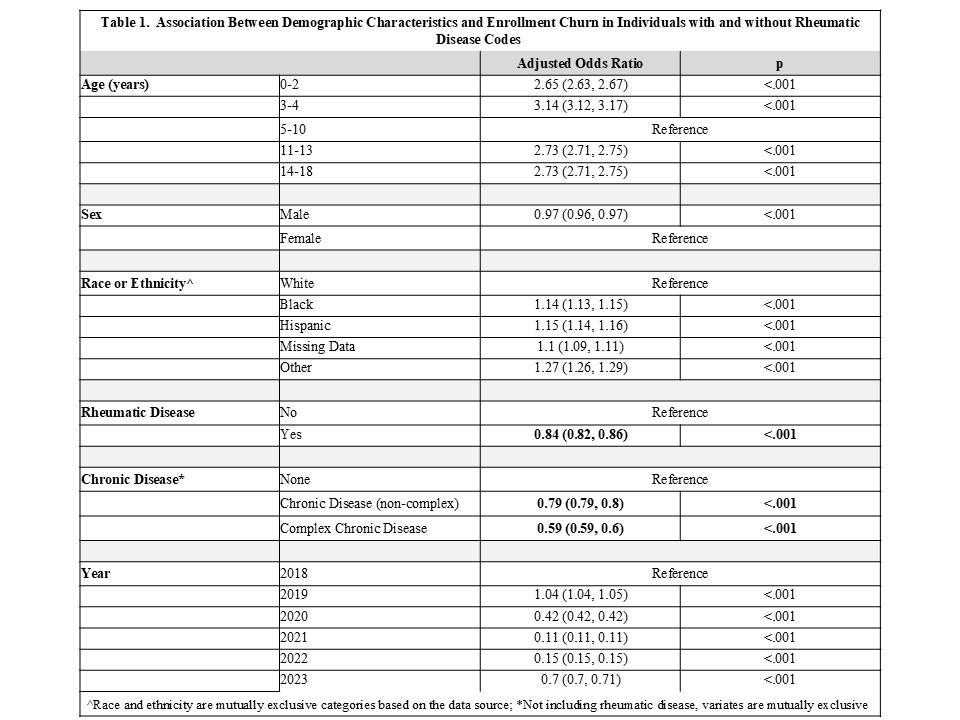 Table showing the odds ratios of a multivariable logistic regression model that estimates the association of factors of interest and the outcome of Medicaid enrollment churn
Figure 1. Trends in Medicaid Enrollment Churn Among Children with and without Chronic Disease or Rheumatic Disease, 2018-2023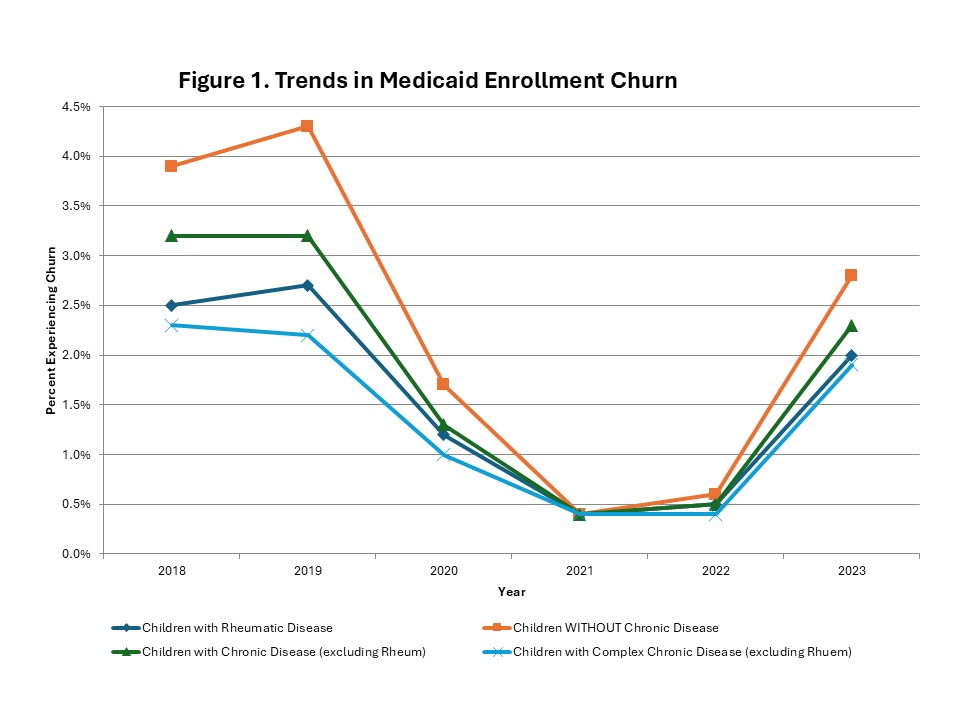 Line graph with markers depicting changes in the percentage of children experiencing Medicaid enrollment churn each year from 2018-2023
To cite this abstract in AMA style:
Chandler M, Hall M, Berry J, Ferrer Valencia V, Lo M, Son M, Ward V. Trends in Medicaid Enrollment Churn Among Children with Rheumatic Disease Diagnoses, 2018-2023 [abstract]. Arthritis Rheumatol. 2026; 78 (suppl 3). https://acrabstracts.org/abstract/trends-in-medicaid-enrollment-churn-among-children-with-rheumatic-disease-diagnoses-2018-2023/. Accessed .« Back to 2026 Pediatric Rheumatology Symposium
ACR Meeting Abstracts - https://acrabstracts.org/abstract/trends-in-medicaid-enrollment-churn-among-children-with-rheumatic-disease-diagnoses-2018-2023/