ACR Meeting Abstracts

ACR Meeting Abstracts

  • Meetings
    • 2026 ACR/ARP PRSYM
    • ACR Convergence 2025
    • ACR Convergence 2024
    • ACR Convergence 2023
    • 2023 ACR/ARP PRSYM
    • ACR Convergence 2022
    • ACR Convergence 2021
    • 2020-2009 Meetings
    • Download Abstracts
  • Keyword Index
  • Advanced Search
  • Your Favorites
    • Favorites
    • Login
    • View and print all favorites
    • Clear all your favorites
  • ACR Meetings

Abstract Number: 113

Risk Assessment for Pediatric Rheumatic Diseases in Children with a History of Kawasaki Disease: A Long-Term Retrospective Comparative Big Data Cohort Study

Rim Kasem Ali Sliman1 and Mohamad Hamad Saied2, 12 Rappaport Faculty of Medicine, Technion-Israel Institute of Technology, Haifa 3109601, Israel., Hefa, Israel, 2Carmel medical centre, Haifa, Israel

Meeting: 2026 Pediatric Rheumatology Symposium

  • Tweet
  • Email a link to a friend (Opens in new window) Email
  • Print (Opens in new window) Print
Session Information

Date: Friday, March 20, 2026

Title: Posters: Clinical and Therapeutic Aspects II

Session Time: 5:00PM-6:00PM

Background/Purpose: Kawasaki disease (KD) is an acute systemic vasculitis predominantly affecting children under 5 years old. Although primarily known for its cardiac complications, the long-term immune-related outcomes remain poorly understood. Recent evidence suggests a potential link between KD and subsequent development of autoimmune conditions, possibly due to immune dysregulation and Th1/Th2 cytokine imbalance. The aim is to assess the long-term risk of pediatric rheumatic diseases in children with a history of KD compared to the general pediatric population.
 

Methods: This comprehensive 20-year retrospective cohort cohort study analyzed Clalit Health Services data in Israel between 2002-2022. KD patients (N&#3f2126) were compared with matched controls (N&#3f10630) with follow-up assessments conducted at multiple intervals (2, 5, 10, 15, and 20 years). Primary outcomes included juvenile idiopathic arthritis (JIA), systemic lupus erythematosus (SLE), and Henoch-Schönlein purpura (HSP) development.

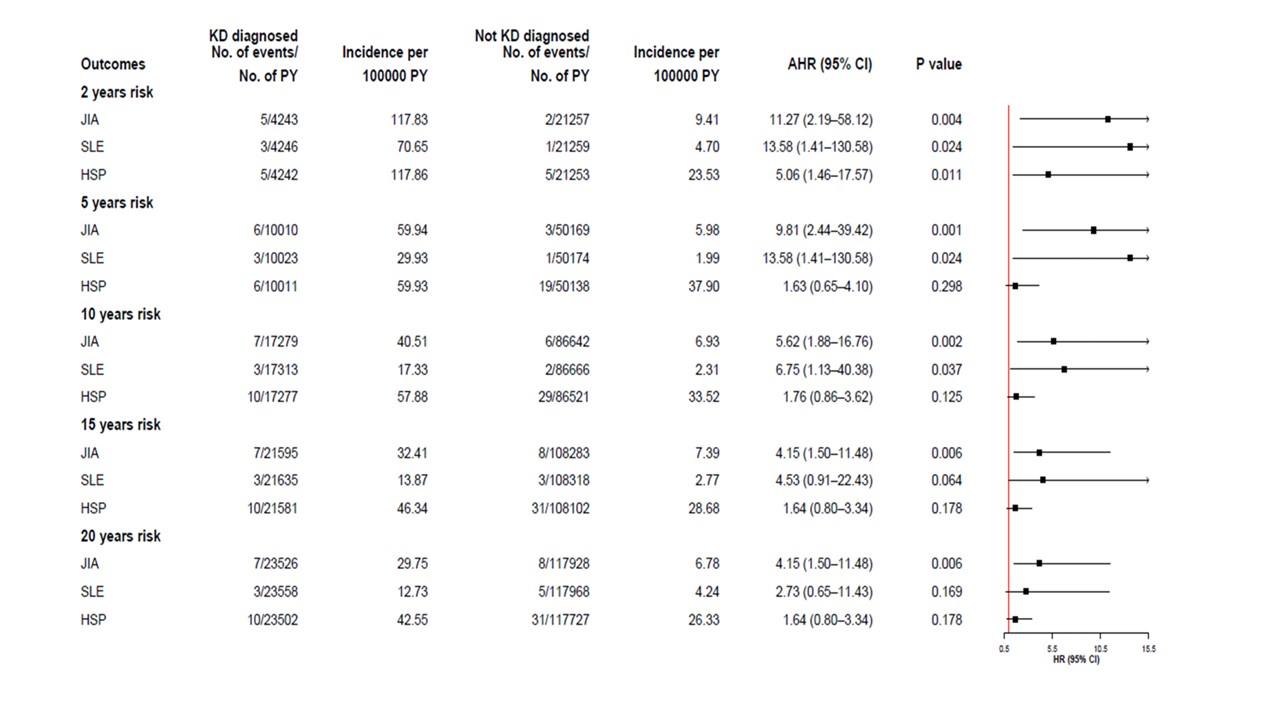
Results: Children with KD demonstrated a significantly higher risk of developing pediatric rheumatic diseases compared to controls. JIA incidence was markedly elevated at 2 years (117.83 vs. 9.41 per 100,000 person-years; HR 12.51, 95% CI: 2.43-64.50, P=0.003), with this significance persisting throughout the 20-year follow-up (HR 4.38, 95% CI: 1.59-12.09, P=0.004). SLE showed consistently significantly higher incidence from early follow-up (HR 15.01, 95% CI: 1.56-144.30, P=0.019) at 2 years, through 15 years (HR 5.01, 95% CI: 1.01-24.80, P=0.049), though not at 20-years. HSP risk was elevated at 2 years (HR 5.01, 95% CI: 1.45-17.30, P=0.011), with an approximately two-fold increased risk thereafter, without statistical significance.
 

Conclusion: Our findings reveal a crucial message for clinicians caring for children with KD: the battle doesn’t end when the fever subsides. These children face significantly higher risks of developing pediatric rheumatic diseases, with JIA risk up to 12.5 times higher at 2 years post-diagnosis and consistently

Forest PlotSupporting image 1

Disclosures: R. Kasem Ali Sliman: None; M. Hamad Saied: None.

To cite this abstract in AMA style:

Kasem Ali Sliman R, Hamad Saied M. Risk Assessment for Pediatric Rheumatic Diseases in Children with a History of Kawasaki Disease: A Long-Term Retrospective Comparative Big Data Cohort Study [abstract]. Arthritis Rheumatol. 2026; 78 (suppl 3). https://acrabstracts.org/abstract/risk-assessment-for-pediatric-rheumatic-diseases-in-children-with-a-history-of-kawasaki-disease-a-long-term-retrospective-comparative-big-data-cohort-study/. Accessed .
  • Tweet
  • Email a link to a friend (Opens in new window) Email
  • Print (Opens in new window) Print

« Back to 2026 Pediatric Rheumatology Symposium

ACR Meeting Abstracts - https://acrabstracts.org/abstract/risk-assessment-for-pediatric-rheumatic-diseases-in-children-with-a-history-of-kawasaki-disease-a-long-term-retrospective-comparative-big-data-cohort-study/

Advanced Search

Your Favorites

You can save and print a list of your favorite abstracts during your browser session by clicking the “Favorite” button at the bottom of any abstract. View your favorites »

Embargo Policy

All abstracts accepted to PRYSM are under media embargo once the ACR has notified presenters of their abstract’s acceptance. They may be presented at other meetings or published as manuscripts after this time but should not be discussed in non-scholarly venues or outlets. The following embargo policies are strictly enforced by the ACR.

Accepted abstracts are made available to the public online in advance of the meeting and are published in a special online supplement of our scientific journal, Arthritis & Rheumatology. Information contained in those abstracts may not be released until the abstracts appear online. In an exception to the media embargo, academic institutions, private organizations, and companies with products whose value may be influenced by information contained in an abstract may issue a press release to coincide with the availability of an ACR abstract on the ACR website. However, the ACR continues to require that information that goes beyond that contained in the abstract (e.g., discussion of the abstract done as part of editorial news coverage) is under media embargo until 6:00 PM CT on March 18. Journalists with access to embargoed information cannot release articles or editorial news coverage before this time. Editorial news coverage is considered original articles/videos developed by employed journalists to report facts, commentary, and subject matter expert quotes in a narrative form using a variety of sources (e.g., research, announcements, press releases, events, etc.).

Violation of this policy may result in the abstract being withdrawn from the meeting and other measures deemed appropriate. Authors are responsible for notifying colleagues, institutions, communications firms, and all other stakeholders related to the development or promotion of the abstract about this policy. If you have questions about the ACR abstract embargo policy, please contact ACR abstracts staff at [email protected].

Wiley

  • Online Journal
  • Privacy Policy
  • Permissions Policies
  • Cookie Preferences

© Copyright 2026 American College of Rheumatology