
Session Information
Session Time: 4:37PM-4:42PM
Background/Purpose: Emotional distress is prevalent among patients with juvenile lupus and dermatomyositis (JSLE/JDM). We previously showed that JSLE/JDM patients following high emotional distress trajectories tended to have poorer cardiovascular health (CVH), defined as protective factors against cardiovascular disease (CVD). Diet and physical activity were suboptimal in >95% of JSLE/JDM patients. To inform intervention development, we evaluated associations of patient-reported resiliency factors, emotional distress, and diet/physical activity.
Methods: The LEADS-CV cohort has been described previously (https://duke.is/y/cx66). Participants with complete data were included (n=76). Emotional distress was assessed using self-report PROMIS Pediatric Psychological Stress Experiences, Depressive Symptoms, and Anxiety (PROMIS-Stress/-Depr/-Anx) measures. Resiliency factors evaluated include PROMIS Positive Affect and Emotional Regulation Questionnaire for Children and Adolescents, which assesses adaptive (cognitive reappraisal, ERQ-CR) and maladaptive (emotion suppression, ERQ-ES) emotion regulation strategies. Self-report measures of diet quality (FLASHE screener) and physical activity (PROMIS Physical Activity) were administered. Longitudinal analyses included: 1) growth mixture models (GMM) to identify latent trajectories of resiliency factors; 2) linear mixed-effects models (LMM) to assess associations among resiliency factors, emotional distress, and diet/physical activity.
Results: GMMs identified latent trajectories for PROMIS Positive Affect and ERQ-ES (good, fair, poor) and for ERQ-CR (good, poor) (Figure 1). Poor resiliency trajectories were common (21-50%) and remained stable over time. LMMs showed significant associations of PROMIS Positive Affect and ERQ-ES with all emotional distress measures (β range |0.49–0.96| in expected directions, Table 1). Female gender was significantly associated with higher emotional distress across most models (β range 4.92–8.49, table 1). Higher ERQ-CR was associated with better PROMIS Physical Activity (β range 0.16–0.50), and unexpectedly, higher ERQ-ES was also associated with better PROMIS Physical Activity in most models (β range 0.51–0.61) (Table 2). Minority race/ethnicity was associated with worse PROMIS Physical Activity (β range −5.13 to −6.07), even after adjusting for confounders including diagnosis (Table 2). Emotional distress and resiliency factors were not significantly associated with diet quality (not shown).
Conclusion: Interventions that enhance positive affect and strengthen emotion regulation may help reduce emotional distress in JSLE/JDM patients. The finding that both cognitive reappraisal and emotion suppression were associated with greater physical activity suggests complex, potentially bidirectional relationships where some youth use cognitive reappraisal to facilitate physical activity, while others use physical activity as a coping strategy when other emotion regulation strategies are less developed. Gender and racial/ethnic differences should be considered when developing behavioral interventions for JSLE/JDM patients.
Figure 1: Resiliency Factor Latent Trajectories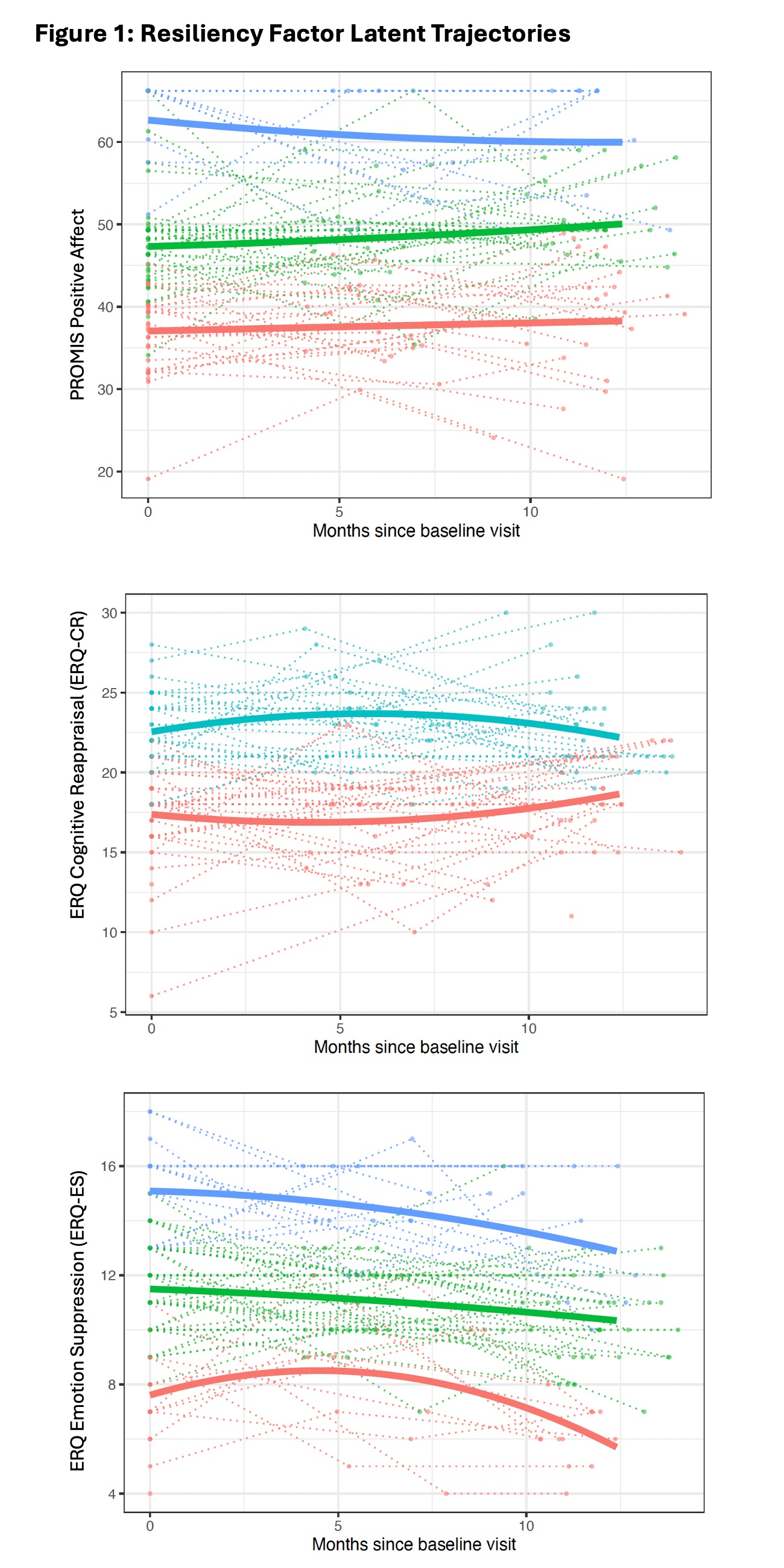
Table 1: Linear Mixed-Effects Models (LMM): Associations of Resiliency Factors & Emotional Distress Measures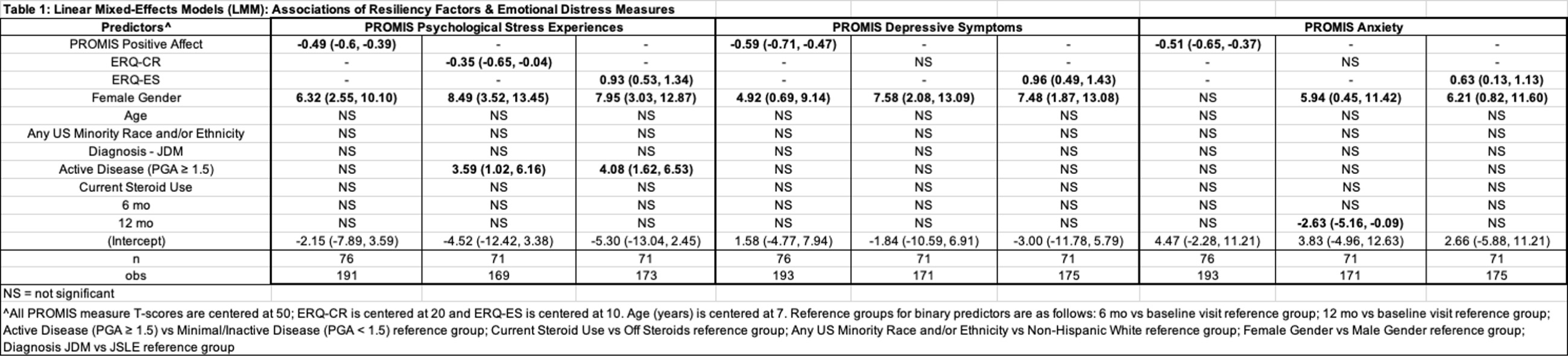
Table 2: Linear Mixed-Effects Models (LMM): Associations of Emotional Distress Measures, Resiliency Factors, and Physical Activity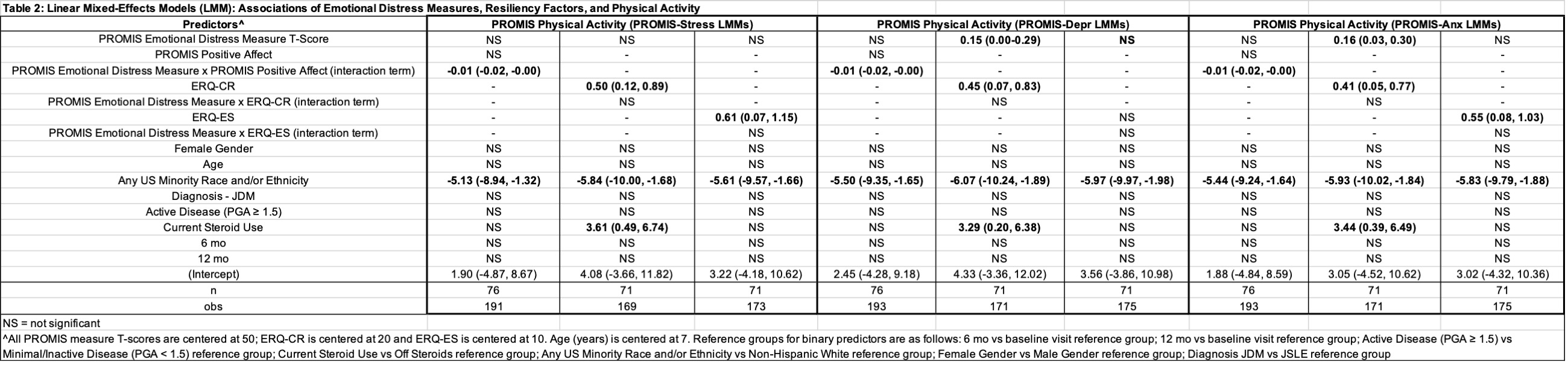
To cite this abstract in AMA style:
Ardalan K, Yu W, Hong H, Davalos A, Reeve B, Hornik C, Moody M, Lloyd-Jones D, Sadun R, Dvergsten J, Covert L, Reed A, Wu E, Cannon L, Kovalick L, Pinotti C, Sarkissian A, Ward A, Gbadegesin S, Connelly M, Schanberg L. Identifying Intervention Targets to Reduce Emotional Distress and Improve Physical Activity in Juvenile Lupus and Dermatomyositis Patients: Longitudinal Analysis of Lupus Erythematosus and Dermatomyositis Stress and Cardiovascular Health Study Patient-Reported Resiliency Data [abstract]. Arthritis Rheumatol. 2026; 78 (suppl 3). https://acrabstracts.org/abstract/identifying-intervention-targets-to-reduce-emotional-distress-and-improve-physical-activity-in-juvenile-lupus-and-dermatomyositis-patients-longitudinal-analysis-of-lupus-erythematosus-and-dermatomyos/. Accessed .« Back to 2026 Pediatric Rheumatology Symposium
ACR Meeting Abstracts - https://acrabstracts.org/abstract/identifying-intervention-targets-to-reduce-emotional-distress-and-improve-physical-activity-in-juvenile-lupus-and-dermatomyositis-patients-longitudinal-analysis-of-lupus-erythematosus-and-dermatomyos/