ACR Meeting Abstracts

ACR Meeting Abstracts

  • Meetings
    • 2026 ACR/ARP PRSYM
    • ACR Convergence 2025
    • ACR Convergence 2024
    • ACR Convergence 2023
    • 2023 ACR/ARP PRSYM
    • ACR Convergence 2022
    • ACR Convergence 2021
    • 2020-2009 Meetings
    • Download Abstracts
  • Keyword Index
  • Advanced Search
  • Your Favorites
    • Favorites
    • Login
    • View and print all favorites
    • Clear all your favorites
  • ACR Meetings

Abstract Number: 098

Investigating S100 Proteins as Biomarkers for Pediatric Localized Scleroderma

Jonathan Li1, Meagan Zulfer2, Brittany Ashe1, Alexandra Chop1, Terra Jackson2, Haley Havrilla1, Elena deRosas3 and Kathryn Torok3, 1Division of Rheumatology, Department of Pediatrics, UPMC Children's Hospital of Pittsburgh, Pittsburgh, PA, USA, Pittsburgh, PA, 2Division of Rheumatology, Department of Pediatrics, UPMC Children's Hospital of Pittsburgh, Pittsburgh, PA, USA, 3University of Pittsburgh, Pittsburgh, PA

Meeting: 2026 Pediatric Rheumatology Symposium

  • Tweet
  • Email a link to a friend (Opens in new window) Email
  • Print (Opens in new window) Print
Session Information

Date: Friday, March 20, 2026

Title: Abstracts: Pediatric Rheumatology Potpourri

Session Time: 4:55PM-5:00PM

Background/Purpose: Juvenile localized scleroderma (JLS) is a systemic inflammatory disease that primarily causes fibrosis of skin/subcutis resulting in pain, growth and joint restriction, and deformation. CNS inflammation can be seen in the craniofacial subtype. There are limited methods to monitor disease activity beyond clinical evaluation. S100A8/A9 (calprotectin) and S100A12 (EN-RAGE) proteins are emerging serum biomarkers in various skin and inflammatory diseases that are available for clinical use.

Methods: We measured serum concentrations of these proteins (hereon referred to collectively as S100 proteins) in a cohort of patients with JLS using a CLIA-certified immunodiagnostics lab (ELISA assay). We compared these results with cross-sectional clinical data to evaluate their potential use in JLS.

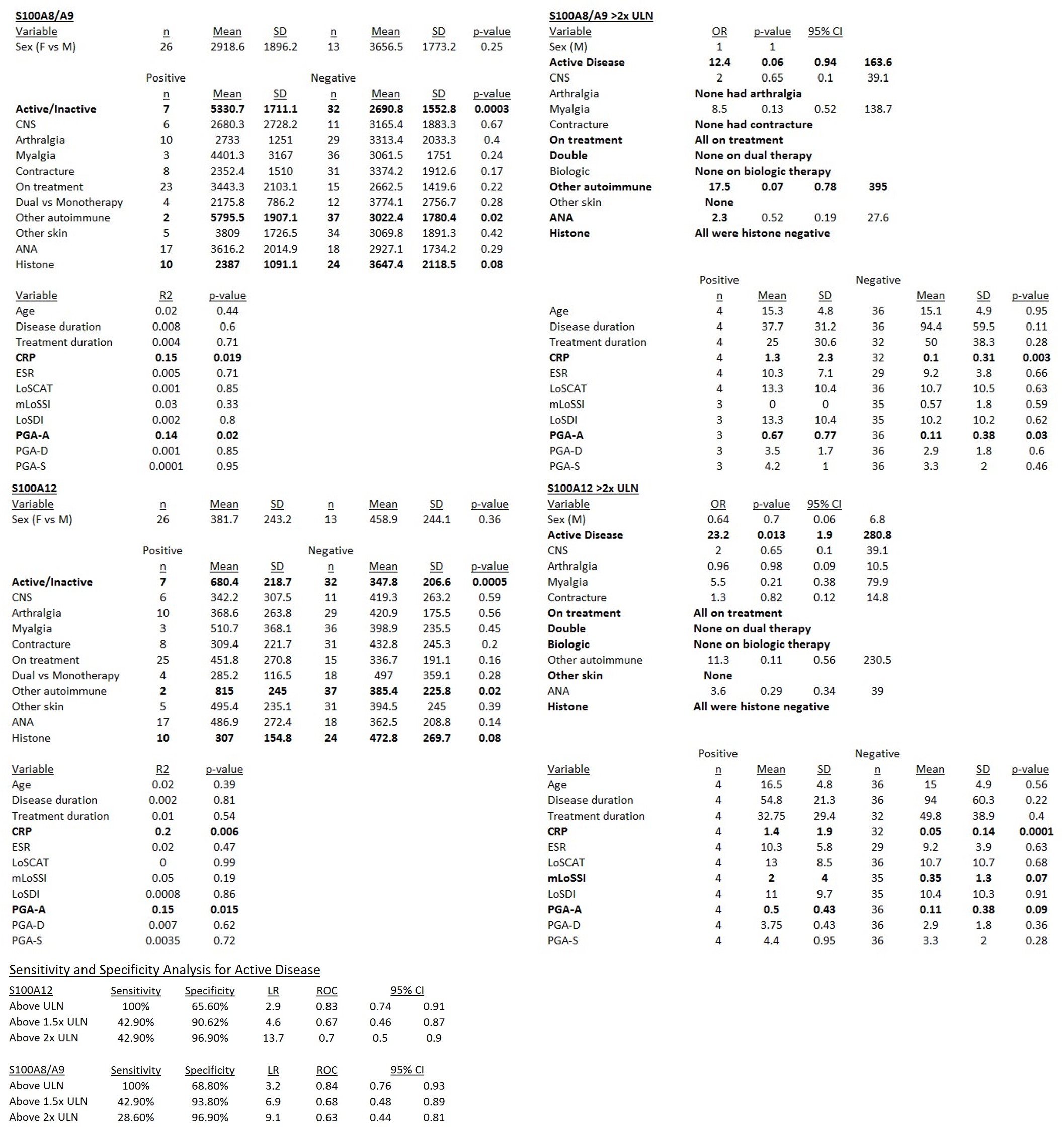
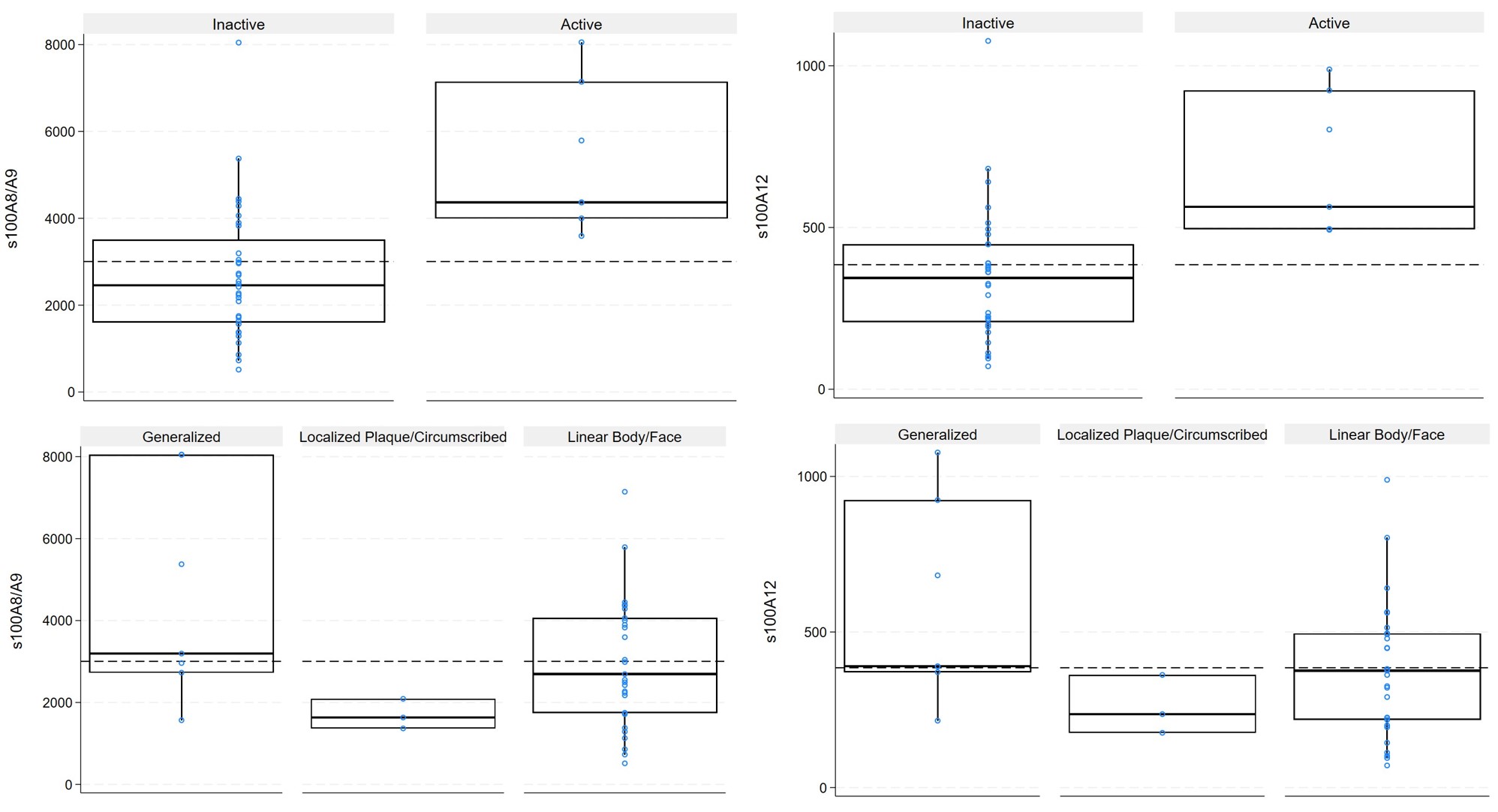
Results: Thirty nine patients were tested, mean age was 15 years (range 4-25). Most patients had a linear subtype (74%), were inactive (82%), and on treatment (60%). S100A8/A9 and S100A12 concentrations were closely correlated (R2 0.95, p< 0.001). Patients with active disease had a significantly higher concentration of S100 proteins. S100A8/A9 but not S100A12 was significantly higher in generalized and linear subtypes than plaque/circumscribed subtypes. Presence of another systemic autoimmune disease associated with elevated S100 protein levels; presence of other skin disease did not. There was signal in patients with anti-histone antibodies having lower levels of S100 proteins. S100 proteins showed significant linear correlation with CRP (R2 0.2, p< 0.01) and Physician Global Assessment of Activity (PGA-A) of R2 0.15 (p=0.02). The intrinsic cutoffs for each protein resulted in a 100% sensitivity and 66-69% specificity for active disease (LR 2.9-3.2). Use of a higher cutoff of 2x upper limit normal (ULN) resulted in a sensitivity of 29-43% and a specificity of 97% for both tests (LR 9.1-13.7). Having an S100 protein level greater than 2x ULN was associated with active disease, being on treatment but not dual therapy or a biologic, having another systemic autoimmune disease, not having another skin disease, having a negative anti-histone antibody, having a positive CRP, and having a higher PGA-A and mLoSSI. There was no association between sex, age, presence of CNS disease, arthralgia, myalgia, contracture, being on treatment, having other skin disease, being ANA positive, ESR, LoSCAT, LosDI, PGA of damage, or PGA of severity.

Conclusion: S100 proteins are potential serum biomarkers of activity but not damage in juvenile localized scleroderma that can discriminate between active and inactive disease. Further investigation is needed to determine utility in monitoring disease activity longitudinally, tapering/escalating therapy, prognosticating treatment response, determining flare risk and treatment resistance, and long term outcomes.

Association between S100 Proteins and Clinical ParametersSupporting image 1
Comparison of S100 Concentrations between Active/Inactive Disease Status and between DIsease SubtypesSupporting image 2

Disclosures: J. Li: None; M. Zulfer: None; B. Ashe: None; A. Chop: None; T. Jackson: None; H. Havrilla: None; E. deRosas: None; K. Torok: None.

To cite this abstract in AMA style:

Li J, Zulfer M, Ashe B, Chop A, Jackson T, Havrilla H, deRosas E, Torok K. Investigating S100 Proteins as Biomarkers for Pediatric Localized Scleroderma [abstract]. Arthritis Rheumatol. 2026; 78 (suppl 3). https://acrabstracts.org/abstract/investigating-s100-proteins-as-biomarkers-for-pediatric-localized-scleroderma/. Accessed .
  • Tweet
  • Email a link to a friend (Opens in new window) Email
  • Print (Opens in new window) Print

« Back to 2026 Pediatric Rheumatology Symposium

ACR Meeting Abstracts - https://acrabstracts.org/abstract/investigating-s100-proteins-as-biomarkers-for-pediatric-localized-scleroderma/

Advanced Search

Your Favorites

You can save and print a list of your favorite abstracts during your browser session by clicking the “Favorite” button at the bottom of any abstract. View your favorites »

Embargo Policy

All abstracts accepted to PRYSM are under media embargo once the ACR has notified presenters of their abstract’s acceptance. They may be presented at other meetings or published as manuscripts after this time but should not be discussed in non-scholarly venues or outlets. The following embargo policies are strictly enforced by the ACR.

Accepted abstracts are made available to the public online in advance of the meeting and are published in a special online supplement of our scientific journal, Arthritis & Rheumatology. Information contained in those abstracts may not be released until the abstracts appear online. In an exception to the media embargo, academic institutions, private organizations, and companies with products whose value may be influenced by information contained in an abstract may issue a press release to coincide with the availability of an ACR abstract on the ACR website. However, the ACR continues to require that information that goes beyond that contained in the abstract (e.g., discussion of the abstract done as part of editorial news coverage) is under media embargo until 6:00 PM CT on March 18. Journalists with access to embargoed information cannot release articles or editorial news coverage before this time. Editorial news coverage is considered original articles/videos developed by employed journalists to report facts, commentary, and subject matter expert quotes in a narrative form using a variety of sources (e.g., research, announcements, press releases, events, etc.).

Violation of this policy may result in the abstract being withdrawn from the meeting and other measures deemed appropriate. Authors are responsible for notifying colleagues, institutions, communications firms, and all other stakeholders related to the development or promotion of the abstract about this policy. If you have questions about the ACR abstract embargo policy, please contact ACR abstracts staff at [email protected].

Wiley

  • Online Journal
  • Privacy Policy
  • Permissions Policies
  • Cookie Preferences

© Copyright 2026 American College of Rheumatology