ACR Meeting Abstracts

ACR Meeting Abstracts

  • Meetings
    • 2026 ACR/ARP PRSYM
    • ACR Convergence 2025
    • ACR Convergence 2024
    • ACR Convergence 2023
    • 2023 ACR/ARP PRSYM
    • ACR Convergence 2022
    • ACR Convergence 2021
    • 2020-2009 Meetings
    • Download Abstracts
  • Keyword Index
  • Advanced Search
  • Your Favorites
    • Favorites
    • Login
    • View and print all favorites
    • Clear all your favorites
  • ACR Meetings

Abstract Number: 093

HOW DO WE HANDLE STILL’S DISEASE? REAL-LIFE CLINICIANS’ CHOICES FROM THE METAPHOR PROJECT WORLDWIDE SURVEY

Francesco Baldo1, Greta Rogani2, Claudia Bracaglia3, Dirk Foell4, Marco Gattorno5, Jordi Anton6, Marija Jelusic7, Paul Brogan8, Scott Canna9, Randy Cron10, Fabrizio De Benedetti11, Alexei Grom12, Merav Heshin Bekenstein13, AnnaCarin Horne14, Raju Khubchandani15, Mao Mizuta16, Seza zen17, Pierre Quartier Dit Maire18, Angelo Ravelli19, Nicolino Ruperto20, Masaki Shimizu21, Grant Schulert12, Rashmi Sinha22, Christiaan Scott23, Joost Swart24, Bruno Fautrel25, Sebastiaan Vastert2 and Francesca Minoia26, 1UOC Reuamtologia Pediatrica-ASST-Pini-CTO.it, Italy, 2University Medical Center Utrecht, Utrecht, Netherlands, 3Division of Rheumatology Ospedale Pediatrico Bambino Gesu' IRCCS, Roma, Italy, Rome, Rome, Italy, 4University Hospital Muenster, Muenster, Germany, 5Division of Rheumatology and Autoinflammatory Diseases, IRCCS Istituto Giannina Gaslini, Genoa, Italy, Genova, Italy, 6Hospital Sant Joan de Du. Universitat de Barcelona, Esplugues de Llobregat (Barcelona), Spain, 7University of Zagreb School of Medicine, University Hospital Centre Zagreb, Zagreb, Zagreb, Croatia, 8UCL Institute of Child Health and Great Ormond Street Hospital NHS Foundation Trust, London, United Kingdom, 9Children's Hospital of Philadelphia, Philadelphia, PA, 10University of Alabama at Birmingham, Birmingham, AL, 11Bambino Gesu Children's Hospital, Rome, Rome, Italy, 12Cincinnati Children's Hospital Medical Center, Cincinnati, OH, 13Tel Aviv Medical Center Israel, Binyamina, Israel, 14Karolinska University Hospital, Sollentuna, Sweden, 15SRCC Children's Hospital, Mumbai, India, India, 16Department of Paediatric Rheumatology, Hyogo Prefectural Kobe Children's Hospital, Kanazawa, Japan, Kanazawa, Japan, 17Hacettepe University Medical Faculty, Ankara, Turkey, 18Necker hospital, Paris Cedex 15, France, 19IRCCS Istituto Giannina Gaslini, Genoa, Italy, Genoa, Genoa, Italy, 20Università Milano Bicocca and Fondazione IRCSS S. Gerardo dei Tintori, Monza, Italy, 21Tokyo Medical and Dental University, Tokyo, Japan, Kanazawa, Japan, 22Systemic JIA Foundation, Los Altos, CA, 23Childrens Hospital of Eastern Ontario (CHEO), Ottawa, ON, Canada, 24Wilhelmina Children's Hospital / UMC Utrecht, Utrecht, Netherlands, 25Sorbonne University - APHP, Paris, France, 26Fondazione IRCCS Ca' Granda Ospedale Maggiore Policlinico, Milano, Italy

Meeting: 2026 Pediatric Rheumatology Symposium

  • Tweet
  • Email a link to a friend (Opens in new window) Email
  • Print (Opens in new window) Print
Session Information

Date: Friday, March 20, 2026

Title: Posters: Clinical and Therapeutic Aspects II

Session Time: 5:00PM-6:00PM

Background/Purpose: Despite continuous improvement in care and the recent update of international recommendations, relevant discrepancies in the approach to Still’s disease (SD) still exists.The study was aimed to explore current global treatment strategies for SD focusing oninital management and refractory disease.

Methods: As part of the METAPHOR project, a PReS/PRINTO initiative to optimize therapy in SD and Macrophage Activation Syndrome (MAS), a global survey was developed. Topics were selected by 22 expert pediatric rheumatologists; the web-survey was completed between 3/12/24 and 14/2/25.

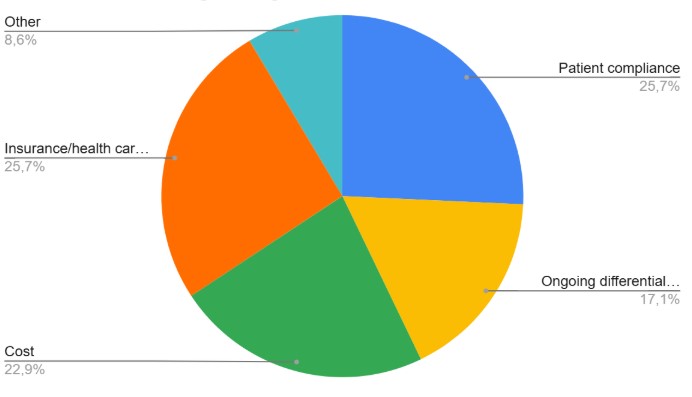
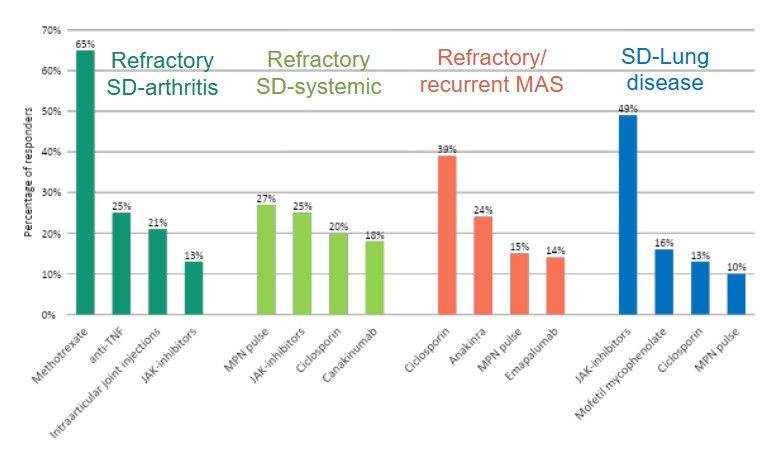
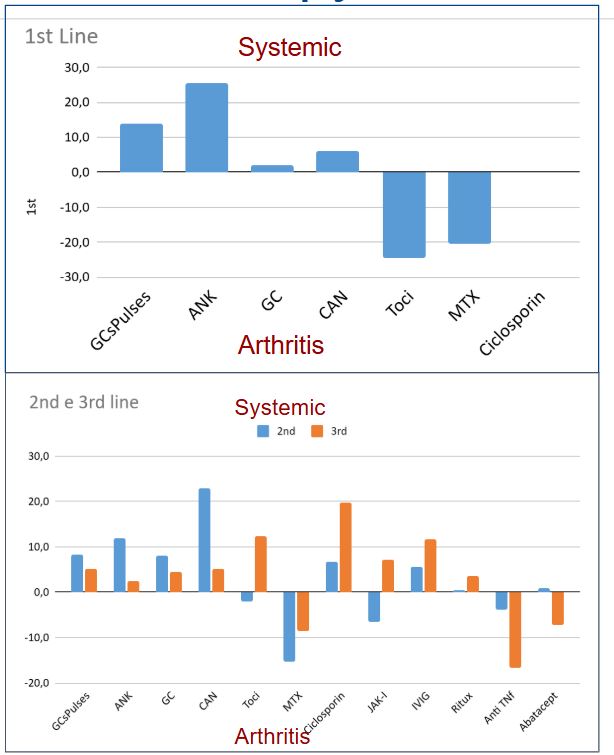
Results: .A total of 206 physicians (91% paediatric rheumatologists) from 56 countries completed the survey. Investigations performed at onset included infectious screening (80%), peripheral blood smears (85%), ferritin (100%), imaging ( 80%). Seventy % of clinician would perform additional screening tests if glucocorticoids had to be started. In newly diagnosed SD, 66% of clinicians would use GCs as 1st line (42% associated with an IL-1/IL-6 inhibitor, 24% alone), while 34% would start with IL-1/IL-6 in monotherapy. Factors favoring GCs use included severe pericarditis (64%), severe arthritis (55%), and refractory disease risk factors (16%). Biologics were used as 1st line by 76% of respondents, with anakinra being the most frequently used one (59%),followed by tocilizumab (25%). Factors driving anakinra’s choice were safety (72%), predominant systemic phenotype (73%) and cost (41%); while tocilizumab was chosen for arthritis-dominant profile (80%) and compliance (56%). Unavailability for Anakinra reached 17%, for Tocilizumab only 1.5%.In systemic-predominant SD, anakinra was the most frequently used medication (45%) in 1st line besides GCs and NSAIDs. In SD with predominant articular involvement, only half of clinicians would change the therapeutic approach, using more frequently TCZ, MTX and intra-articular steroids. Steroid tapering was guided mostly by clinical and laboratory parameters: acute phase reactants (95%) and ferritin (87%) reduction, fever resolution (82%, ≥1 week), arthritis improvement (75%).Methotrexate was the most common 1st-line choice for SD-refractory arthritis, followed by anti-TNF agents and intra-articular steroids. In SD patients with recurrent/refractory MAS, ciclosporin, anakinra, and MPN pulses were the most frequently selected medications. For SD-LD, 41% would continue ongoing biologics, 30% withdraw and 29% decide case by case. The most used 1st-line agents for SD-LD included JAK-i and mycophenolate mofetil. Most respondents (82%) would consider Hematopoietic Stem-Cell Transplantation (HSCT) in difficult-to-treat SD patients, particularly for refractory MAS or SD-LD.

Conclusion: Still’s disease still represents a therapeutic challenge, mainly due to its heterogeneity in clinical expression and limited evidences for refractory courses. Future research is essential to optimize clustering of patients to foster tailored target treatments, while ensuring equitable access to effective therapies worldwide.

Reasons affection biologic drugs choicheSupporting image 1
Top 4 preferred agents per refractory conditionsSupporting image 2
Different phenotypes, different therapy?Supporting image 3

Disclosures: F. Baldo: None; G. Rogani: None; C. Bracaglia: GlaxoSmithKlein(GSK), 6, Novartis, 2, Sobi, 2; D. Foell: None; M. Gattorno: Fresinus-Kabi, 6, Novartis, 6, SOBI, 6; J. Anton: None; M. Jelusic: None; P. Brogan: SOBI, 6; S. Canna: AB2Bio, 2, Bristol-Myers Squibb(BMS), 2, Simcha Therapeutics,, 5, SOBI, 6; R. Cron: AbbVie/Abbott, 1, 12, adjudication committee MAS, American Board of Pediatrics, 12, board question writer, AS2 Biotherapeutics, 2, 12, data safety monitoring board, CareerPhysician, 1, Neurogene, 2, Pfizer, 12, Adjudication committee for MAS, Sobi, 1, 2, Springer, 9, Vida Ventures, 2; F. De Benedetti: Abbvie, 2, 5, Apollo, 2, 5, Elixiron, 2, 5, Kiniksa, 2, 5, Novartis, 2, 5, Sanofi, 2, 5, Sobi, 2, 5; A. Grom: Novartis, 2, 5, SOBI, 2; M. Heshin Bekenstein: None; A. Horne: None; R. Khubchandani: None; M. Mizuta: None; S. Özen: Novartis, 2, 6, Sobi, 2, 6; P. Quartier Dit Maire: AbbVie/Abbott, 2, Amgen, 2, 5, Bristol-Myers Squibb(BMS), 2, 5, chugai-roche, 6, Eli Lilly, 2, 5, Novartis, 2, 5, 6, Pfizer, 2, 5, 6, sanofi, 2, 5, SOBI, 2, 5; A. Ravelli: Abbvie, 2, Galapagos, 2, Novartis, 2, Pfizer, 2, Roche, 2, Sobi, 2; N. Ruperto: AbbVie/Abbott, 2, 6, aclaris, 2, 6, Alfa Sigma, 2, 6, Amgen, 2, 5, AstraZeneca, 2, 6, Aurinia, 2, 5, Boheringer-Ingelheim, 2, 6, Bristol-Myers Squibb(BMS), 2, 6, Eli Lilly, 2, 6, Galapagos, 2, 6, Genentech, 2, 6, Guidepoint, 2, 6, idorsia, 2, 6, jannsen, 2, 6, Novartis, 2, 6, Pfizer, 2, 6, Roche, 2, 6, sanofi, 2, 6, Tekeda, 2, 6; M. Shimizu: None; G. Schulert: Novartis, 2, SOBI, 2, 6; R. Sinha: None; C. Scott: None; J. Swart: Pfizer, 2, 5; B. Fautrel: AbbVie/Abbott, 2, 5, Amgen, 2, biogen, 2, Bristol-Myers Squibb(BMS), 2, celltrion, 2, chugai, 2, Eli Lilly, 2, 5, fresenius kabi, 2, Galapagos, 2, jannsen, 2, medac, 2, Merck/MSD, 2, 5, nordic pharma, 2, Novartis, 2, OW KIN, 2, Pfizer, 2, 5, Roche, 2, Sandoz, 2, sanofi, 2, SOBI, 2, UCB, 2, viatris, 2; S. Vastert: Novartis, 2, Sobi, 2; F. Minoia: Novartis, 6, SOBI, 2.

To cite this abstract in AMA style:

Baldo F, Rogani G, Bracaglia C, Foell D, Gattorno M, Anton J, Jelusic M, Brogan P, Canna S, Cron R, De Benedetti F, Grom A, Heshin Bekenstein M, Horne A, Khubchandani R, Mizuta M, Özen S, Quartier Dit Maire P, Ravelli A, Ruperto N, Shimizu M, Schulert G, Sinha R, Scott C, Swart J, Fautrel B, Vastert S, Minoia F. HOW DO WE HANDLE STILL’S DISEASE? REAL-LIFE CLINICIANS’ CHOICES FROM THE METAPHOR PROJECT WORLDWIDE SURVEY [abstract]. Arthritis Rheumatol. 2026; 78 (suppl 3). https://acrabstracts.org/abstract/how-do-we-handle-stills-disease-real-life-clinicians-choices-from-the-metaphor-project-worldwide-survey/. Accessed .
  • Tweet
  • Email a link to a friend (Opens in new window) Email
  • Print (Opens in new window) Print

« Back to 2026 Pediatric Rheumatology Symposium

ACR Meeting Abstracts - https://acrabstracts.org/abstract/how-do-we-handle-stills-disease-real-life-clinicians-choices-from-the-metaphor-project-worldwide-survey/

Advanced Search

Your Favorites

You can save and print a list of your favorite abstracts during your browser session by clicking the “Favorite” button at the bottom of any abstract. View your favorites »

Embargo Policy

All abstracts accepted to PRYSM are under media embargo once the ACR has notified presenters of their abstract’s acceptance. They may be presented at other meetings or published as manuscripts after this time but should not be discussed in non-scholarly venues or outlets. The following embargo policies are strictly enforced by the ACR.

Accepted abstracts are made available to the public online in advance of the meeting and are published in a special online supplement of our scientific journal, Arthritis & Rheumatology. Information contained in those abstracts may not be released until the abstracts appear online. In an exception to the media embargo, academic institutions, private organizations, and companies with products whose value may be influenced by information contained in an abstract may issue a press release to coincide with the availability of an ACR abstract on the ACR website. However, the ACR continues to require that information that goes beyond that contained in the abstract (e.g., discussion of the abstract done as part of editorial news coverage) is under media embargo until 6:00 PM CT on March 18. Journalists with access to embargoed information cannot release articles or editorial news coverage before this time. Editorial news coverage is considered original articles/videos developed by employed journalists to report facts, commentary, and subject matter expert quotes in a narrative form using a variety of sources (e.g., research, announcements, press releases, events, etc.).

Violation of this policy may result in the abstract being withdrawn from the meeting and other measures deemed appropriate. Authors are responsible for notifying colleagues, institutions, communications firms, and all other stakeholders related to the development or promotion of the abstract about this policy. If you have questions about the ACR abstract embargo policy, please contact ACR abstracts staff at [email protected].

Wiley

  • Online Journal
  • Privacy Policy
  • Permissions Policies
  • Cookie Preferences

© Copyright 2026 American College of Rheumatology