ACR Meeting Abstracts

ACR Meeting Abstracts

  • Meetings
    • 2026 ACR/ARP PRSYM
    • ACR Convergence 2025
    • ACR Convergence 2024
    • ACR Convergence 2023
    • 2023 ACR/ARP PRSYM
    • ACR Convergence 2022
    • ACR Convergence 2021
    • 2020-2009 Meetings
    • Download Abstracts
  • Keyword Index
  • Advanced Search
  • Your Favorites
    • Favorites
    • Login
    • View and print all favorites
    • Clear all your favorites
  • ACR Meetings

Abstract Number: 076

Understanding Etiology (CLUE) Study: Whole Genome Sequencing of Childhood-onset Systemic Lupus Erythematosus

Linda Hiraki1, Zhaoyu Ding2, JingJing Cao2, Zuoming Deng3, Marianna Kaplan3 and Laura Lewandowski3, 1The Hospital for Sick Children, Toronto, ON, Canada, 2The Hospital for Sick Children, ON, Canada, 3NIH/NIAMS

Meeting: 2026 Pediatric Rheumatology Symposium

  • Tweet
  • Email a link to a friend (Opens in new window) Email
  • Print (Opens in new window) Print
Session Information

Date: Thursday, March 19, 2026

Title: Abstracts: Systemic Lupus Erythematosus

Session Time: 5:11PM-5:16PM

Background/Purpose: Systemic Lupus Erythematosus (SLE) is a potentially life-threatening autoimmune disease. Childhood-onset SLE (cSLE) patients have early disease onset and incur more organ damage than adults and thus may have a larger genetic burden. Previous studies describing the common variant contribution in cSLE were done in smaller, targeted cohorts. To address this gap, we completed whole genome sequencing (WGS) of cSLE patients enrolled in the Childhood Arthritis and Rheumatology Research Alliance (CARRA) Lupus Registry and Atherosclerosis Prevention in Pediatric Lupus Erythematosus (APPLE) study. We aim to common variant burden and investigate the association of common SLE risk variants with clinical features in 2 cSLE cohorts.

Methods: We recruited prevalent and incident cSLE (age of diagnosis < 19 years) patients enrolled and consented for in the CARRA Lupus Registry, and historical patients enrolled in the completed APPLE trial. All met ACR classification criteria. DNA samples were sequenced via whole genome sequencing using Illumina HiSeq X Ten (mean depth coverage 36x). Demographic and clinical data was available for both cohorts. Genetic ancestry was inferred using PEDDY and ADMIXTURE. We calculated additive HLA and non-HLA SLE polygenic risk scores and tested the association with age of SLE diagnosis and lupus nephritis (LN), adjusted for sex and ancestry separately by cohort, then meta-analyzed.

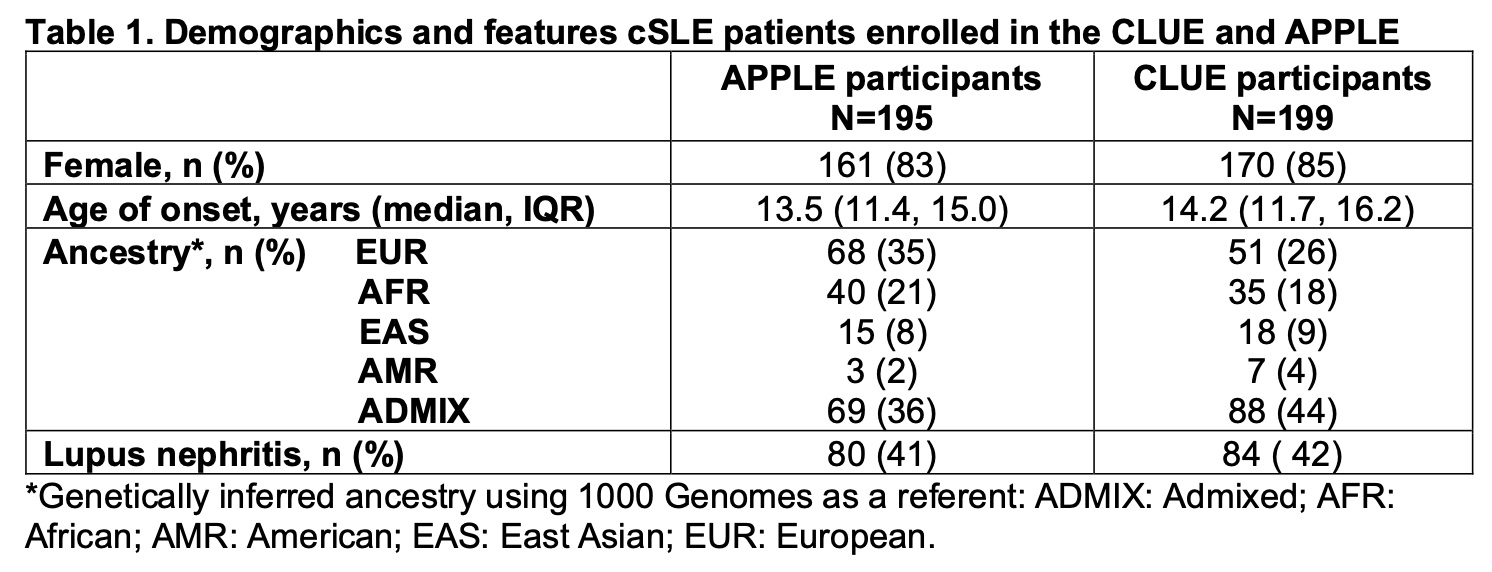
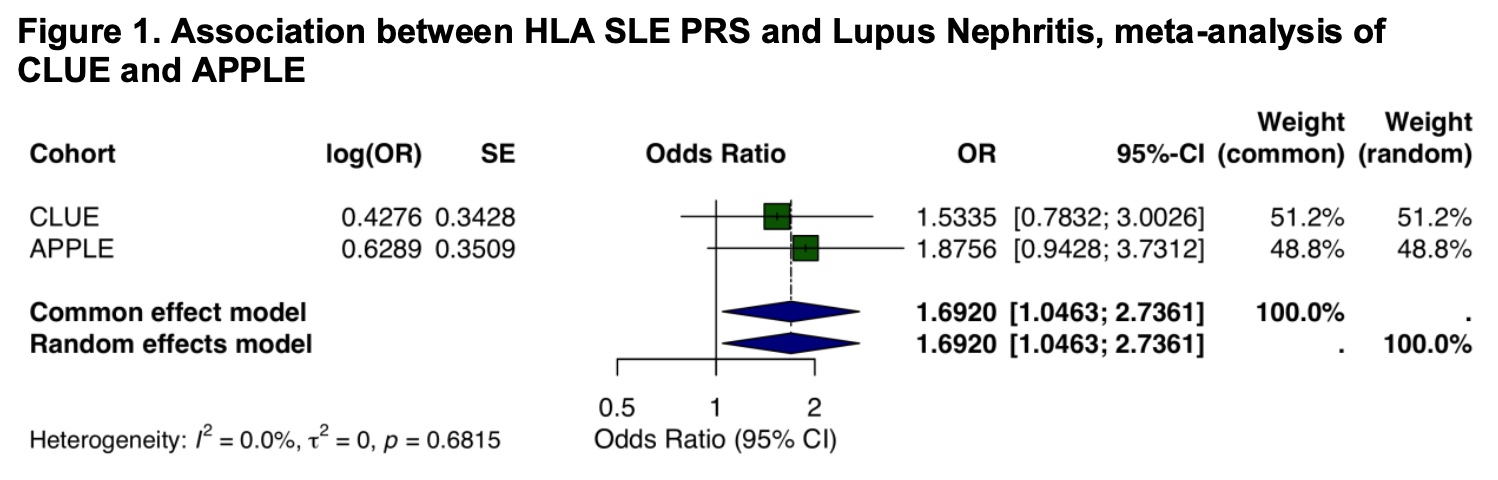
Results: Our study included n=394 (CLUE: 199; APPLE: 195). The majority were female, median age of diagnosis at 13.5 years, and approximately half of patients have lupus nephritis (Table1). We observed a significant association between HLA-PRS and LN (OR: 1.69 (95% CI:1.05, 2.74), P=0.03) (Figure 1), however HLA-PRS was not significantly associated with age of cSLE diagnosis. The non-HLA PRS was not significantly associated with either LN or of diagnosis.  

Conclusion: We observed an association between common SLE HLA risk variants and LN  in 2 cSLE cohorts. Our findings indicate that large, diverse cohorts of cSLE patients will be important for understanding genetic contributions to SLE pathogenesis. Future studies will investigate rare variants and the relationship to common variant burden in cSLE. The comprehensive genetic studies of the largest cSLE cohorts sequenced to date will improve our understanding of biologic mechanisms with genetic basis in cSLE.

Demographics and features cSLE patients enrolled in the CLUE and APPLE Supporting image 1
Association between HLA SLE PRS and Lupus Nephritis, meta-analysis of CLUE and APPLE Supporting image 2

Disclosures: L. Hiraki: Janssen, 2; Z. Ding: None; J. Cao: None; Z. Deng: None; M. Kaplan: None; L. Lewandowski: None.

To cite this abstract in AMA style:

Hiraki L, Ding Z, Cao J, Deng Z, Kaplan M, Lewandowski L. Understanding Etiology (CLUE) Study: Whole Genome Sequencing of Childhood-onset Systemic Lupus Erythematosus [abstract]. Arthritis Rheumatol. 2026; 78 (suppl 3). https://acrabstracts.org/abstract/understanding-etiology-clue-study-whole-genome-sequencing-of-childhood-onset-systemic-lupus-erythematosus/. Accessed .
  • Tweet
  • Email a link to a friend (Opens in new window) Email
  • Print (Opens in new window) Print

« Back to 2026 Pediatric Rheumatology Symposium

ACR Meeting Abstracts - https://acrabstracts.org/abstract/understanding-etiology-clue-study-whole-genome-sequencing-of-childhood-onset-systemic-lupus-erythematosus/

Advanced Search

Your Favorites

You can save and print a list of your favorite abstracts during your browser session by clicking the “Favorite” button at the bottom of any abstract. View your favorites »

Embargo Policy

All abstracts accepted to PRYSM are under media embargo once the ACR has notified presenters of their abstract’s acceptance. They may be presented at other meetings or published as manuscripts after this time but should not be discussed in non-scholarly venues or outlets. The following embargo policies are strictly enforced by the ACR.

Accepted abstracts are made available to the public online in advance of the meeting and are published in a special online supplement of our scientific journal, Arthritis & Rheumatology. Information contained in those abstracts may not be released until the abstracts appear online. In an exception to the media embargo, academic institutions, private organizations, and companies with products whose value may be influenced by information contained in an abstract may issue a press release to coincide with the availability of an ACR abstract on the ACR website. However, the ACR continues to require that information that goes beyond that contained in the abstract (e.g., discussion of the abstract done as part of editorial news coverage) is under media embargo until 6:00 PM CT on March 18. Journalists with access to embargoed information cannot release articles or editorial news coverage before this time. Editorial news coverage is considered original articles/videos developed by employed journalists to report facts, commentary, and subject matter expert quotes in a narrative form using a variety of sources (e.g., research, announcements, press releases, events, etc.).

Violation of this policy may result in the abstract being withdrawn from the meeting and other measures deemed appropriate. Authors are responsible for notifying colleagues, institutions, communications firms, and all other stakeholders related to the development or promotion of the abstract about this policy. If you have questions about the ACR abstract embargo policy, please contact ACR abstracts staff at [email protected].

Wiley

  • Online Journal
  • Privacy Policy
  • Permissions Policies
  • Cookie Preferences

© Copyright 2026 American College of Rheumatology