
Session Information
Session Time: 6:00PM-7:00PM
Background/Purpose: High-fidelity simulation is an effective tool in pediatric medical education. At our institution, residents spend two or fewer weeks rotating through pediatric rheumatology. The ACGME’s core competencies for pediatric residency training include medical knowledge, patient care, and interpersonal communication skills that could be addressed with high-fidelity simulation. We performed a needs assessment among pediatric rheumatologists, outpatient pediatricians, and pediatric hospitalists to identify important but rare rheumatologic diseases with clinically distinct and recognizable presentation patterns. Since these diagnoses are unlikely to be encountered by learners in their brief time dedicated to rheumatology, we developed 3 simulation modules with different disease states to assess learners’ knowledge and confidence for each disease.
Methods: We collaborated with our institution’s simulation center to create these modules. After several months of development, we piloted modules with learners rotating through the pediatric rheumatology elective. Local IRB approval was obtained. The participants (medical students and residents) completed the simulation module as a group. Participants completed a pre- and post-test pertaining to subject material covered in the modules and participated in a debriefing session in accordance with the standard simulation teaching modality. Descriptive statistics and one-sided t-tests assuming equal variance were used for data analysis.
Results: A multiple choice questionnaire was distributed as a pre- and post-module assessment of learner knowledge of MAS, JDM, and diffuse alveolar hemorrhage in the setting of SLE. Learner confidence in diagnostic recognition and in subspecialist consultation was measured using a 5 point Likert scale. The tables below demonstrate significant improvement in learner knowledge for all three diagnoses, with DAH in SLE having the lowest scores before and after simulation. DAH in SLE was also the only module without significant improvement in diagnostic recognition confidence. This module was based on a real patient encounter, which required multiple specialists to make the final diagnosis, likely contributing to the complexity of the case in the simulation setting. Additionally, the data shows an increase in learner confidence in the learner’s ability to successfully communicate a rheumatology consult.
Conclusion: High-fidelity simulation for pediatric learners covering pediatric rheumatology topics continue to demonstrate knowledge retention and increased learner confidence in important ACGME core competencies. The long-term goal of this work is to design additional sessions into a modular curriculum for utilization by any training program with access to a simulation center. High-fidelity simulation in pediatric rheumatology is a promising educational method that has the potential to increase access to pediatric rheumatology-specific learning during medical school and residency training. Considering pediatric rheumatology workforce challenges, significant improvement in foundational knowledge of rheumatologic disease should prompt urgent referrals and mitigate unnecessary referrals.
Pre- and Post-Simulation Multiple Choice Scores by Topic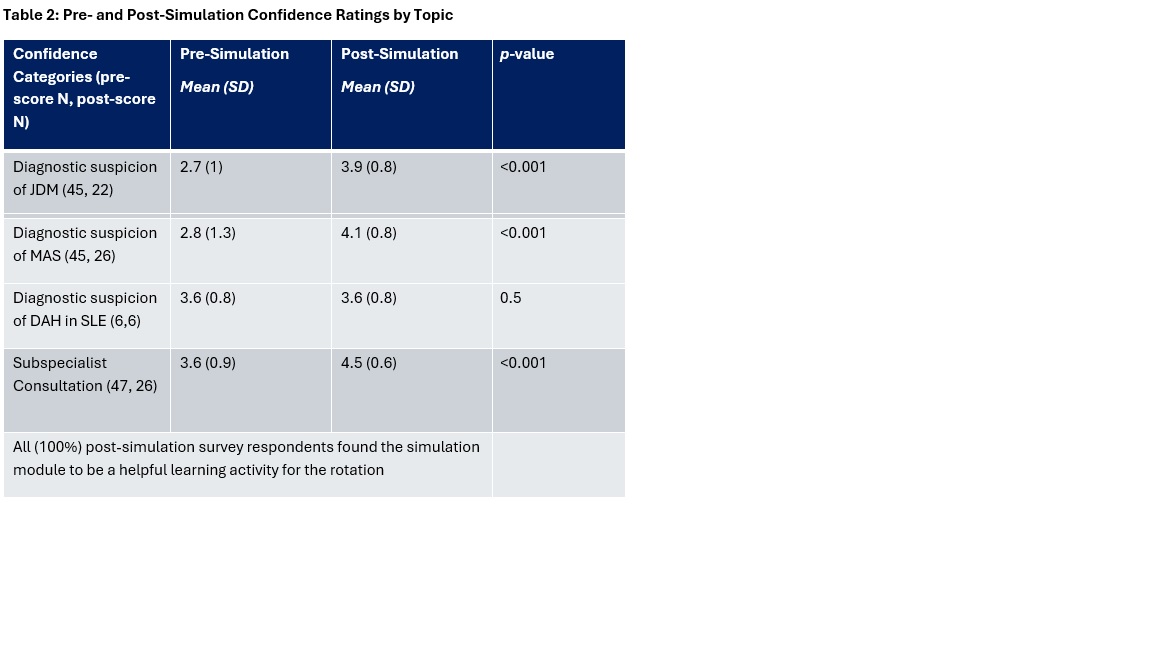
Pre- and Post-Simulation Confidence Ratings by Topic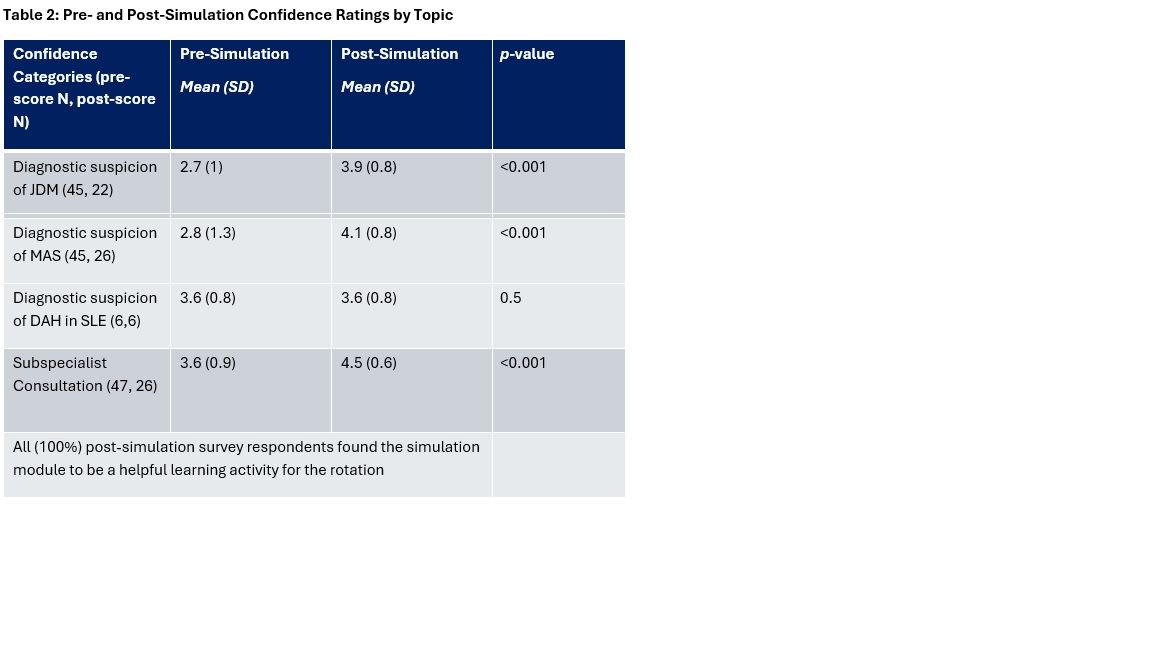
To cite this abstract in AMA style:
Dickson A, Bridges J, Tofil N, Rockwell N, Rutledge C, Blackmon L. Pediatric Learners’ Knowledge Retention and Diagnostic Confidence after High-Fidelity Pediatric Rheumatology Simulation [abstract]. Arthritis Rheumatol. 2026; 78 (suppl 3). https://acrabstracts.org/abstract/pediatric-learners-knowledge-retention-and-diagnostic-confidence-after-high-fidelity-pediatric-rheumatology-simulation/. Accessed .« Back to 2026 Pediatric Rheumatology Symposium
ACR Meeting Abstracts - https://acrabstracts.org/abstract/pediatric-learners-knowledge-retention-and-diagnostic-confidence-after-high-fidelity-pediatric-rheumatology-simulation/