
Session Information
Session Time: 5:23PM-5:28PM
Background/Purpose: Disparities in pediatric health outcomes are well described. The role of social determinants of health (SDOH) in the persistence of such disparities is increasingly of interest across subspecialties, including pediatric rheumatology. Interrelationships between SDOH and childhood-onset systemic lupus erythematosus (cSLE) are poorly characterized. Here, we sought to characterize disparities in cSLE outcomes and assess links between such disparities and markers of the SDOH.
Methods: We conducted a retrospective longitudinal cohort study of patients with cSLE followed at a large, pediatric, tertiary center in the US between January 2012 and June 2024. Eligible patients had ≥3 pediatric rheumatology visits. Outcomes of interest included: timely attendance at rheumatology and infusion visits; and hospitalizations and emergency department (ED) encounters following initial cSLE diagnosis (index visit). Clinical data and sociodemographic data, including patient address, were obtained from the electronic health record. Addresses were geocoded and linked to the census tract-level Childhood Opportunity Index (COI), an area-level depiction of the SDOH. Unadjusted and adjusted regression models, accounting for baseline SLEDAI score and COI quintile, were used to study the relationship between racial disparities and cSLE outcomes.
Results: A total of 170 patients met eligibility criteria. Within this population 53.5% had Medicaid, and 37.5% lived in low or very low COI tracts (15.5% and 22.0%, respectively) (Table 1). We observed a racial disparity in on time rheumatology visits (IRR for Black/AA vs. White: 0.84, CI 0.75-0.94), infusion visits (OR for Black/AA vs. White: 0.27, CI 0.08-0.83), and number of ED visits following the index encounter (OR for Black/AA vs White: 2.74, CI 1.31-5.92). After adjusting for COI and baseline disease severity, the racial disparity was not present for any of the aforementioned outcomes (Table 2). A statistical significance between Hispanics vs White for hospitalizations after index was observed. After adjusting for the follow up duration, the racial disparity was no longer present.
Conclusion: Racial disparities are observed in cSLE outcomes. As race is a social construct, accounting for SDOH via COI, eliminated racial disparities. Our findings suggest that structural inequities, such as living in areas of low childhood opportunity, are influential in shaping health care access and utilization experiences. Further investigation into such links will help define, develop, and evaluate interventions.
Table 1. Demographics and clinical characteristics stratified by racial disparities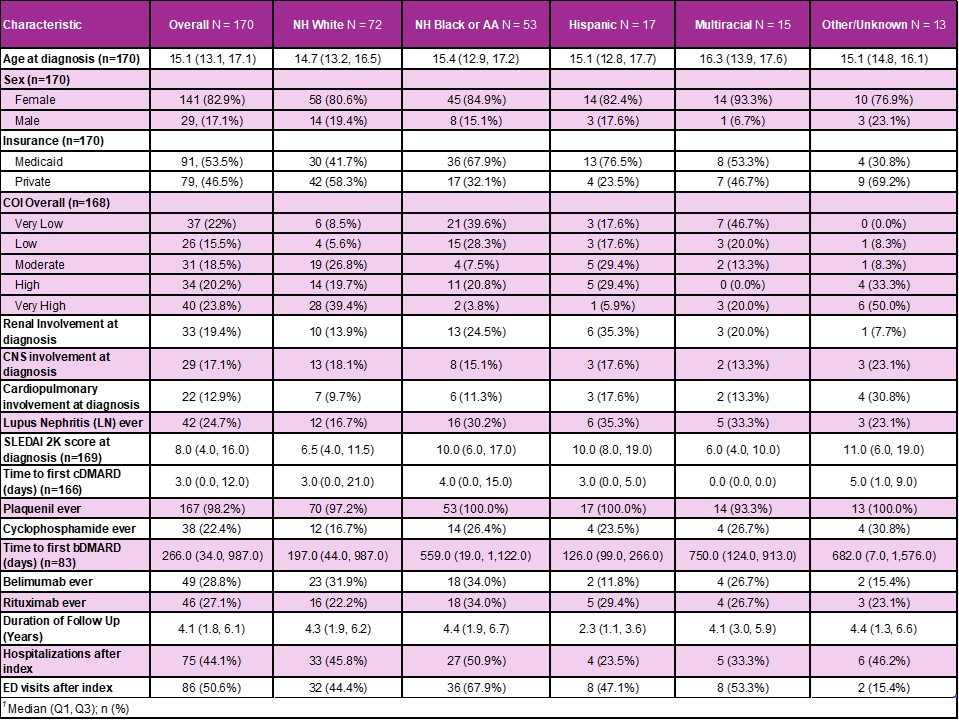
Table 2. Social determinants of health association with health care outcomes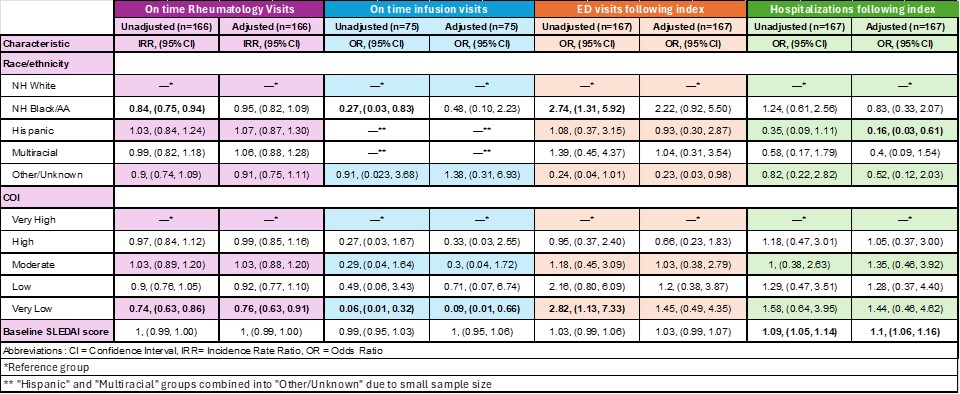
To cite this abstract in AMA style:
Jagger A, Yung E, Brunner H, Beck A, Mendonca E, Duan Q, Brokamp C, Harry G, Rodriguez-Smith J. Association between Childhood Opportunity Index and Disparities in Health Care Access and Utilization in Childhood Onset Systemic Lupus Erythematosus [abstract]. Arthritis Rheumatol. 2026; 78 (suppl 3). https://acrabstracts.org/abstract/association-between-childhood-opportunity-index-and-disparities-in-health-care-access-and-utilization-in-childhood-onset-systemic-lupus-erythematosus/. Accessed .« Back to 2026 Pediatric Rheumatology Symposium
ACR Meeting Abstracts - https://acrabstracts.org/abstract/association-between-childhood-opportunity-index-and-disparities-in-health-care-access-and-utilization-in-childhood-onset-systemic-lupus-erythematosus/