
Session Information
Session Time: 6:00PM-7:00PM
Background/Purpose: Weather is a commonly reported trigger of pain and stiffness flares in patients with Juvenile Idiopathic Arthritis (JIA). However, limited empirical data exist on the influence of weather in childhood rheumatological conditions. Understanding how weather influences JIA symptoms could help enhance disease management and improve patient well-being. This study aimed to investigate whether weather conditions, including humidity, temperature, precipitation, and wind speed, are associated with pain and stiffness in children with JIA at their baseline visit.
Methods: In this study, data were extracted from the Canadian Alliance of Pediatric Rheumatology Investigators (CAPRI) Registry, comprising children enrolled within 3 months of JIA diagnosis across 20 Canadian sites. Measures of joint pain (severity scale 1-10) and stiffness (rated yes or no, as well as quantified in minutes) from either parent or patient during visits for 653 children were matched with the preceding 2 weeks’ weather data from the weather station nearest to the child’s home postal code from the Government of Canada website. Logistic regression was used to evaluate the relationship among stiffness incidence and weather parameters (humidity, temperature, precipitation, windspeed) within 1, 7 and 14 days of symptom reporting. Multiple linear regression was used to evaluate relationships with stiffness duration and pain severity. All analysis was controlled for age and sex.
Results: At participants’ baseline visit, higher average maximum humidity in the preceding week was associated with greater odds of stiffness (OR=1.22, 95% CI 1.05-1.42, p=0.011) but not pain independent of age and sex. A similar but non-significant trend was seen over a 2 week duration (OR 1.18, 95% CI 1.00–1.40, p=0.052). Assessing for acute shifts in weather, a greater change in humidity in the preceding 2 weeks corresponded to increased stiffness duration (β=6.16, p=0.039). Additionally, a greater change in precipitation in the preceding week corresponded to an increase in pain severity (β=0.036, p=0.018). No associations were observed with temperature or wind speed within 1- or 2-week intervals, nor with any weather parameter in the preceding 1 day.
Conclusion: We found significant associations between weather parameters, humidity and precipitation, and reported symptoms of joint stiffness and pain in children with JIA. Humidity appears to play a modest but measurable role in baseline stiffness among children newly diagnosed with JIA, while short-term changes in precipitation may influence pain severity. Temperature and wind speed were not associated with symptoms. Building on insights from this research can guide better management strategies for patients and their families, allowing them to anticipate and mitigate the impacts of adverse weather conditions.
Table 1: Baseline Descriptive Characteristics of CAPRI Cohort 2017-2020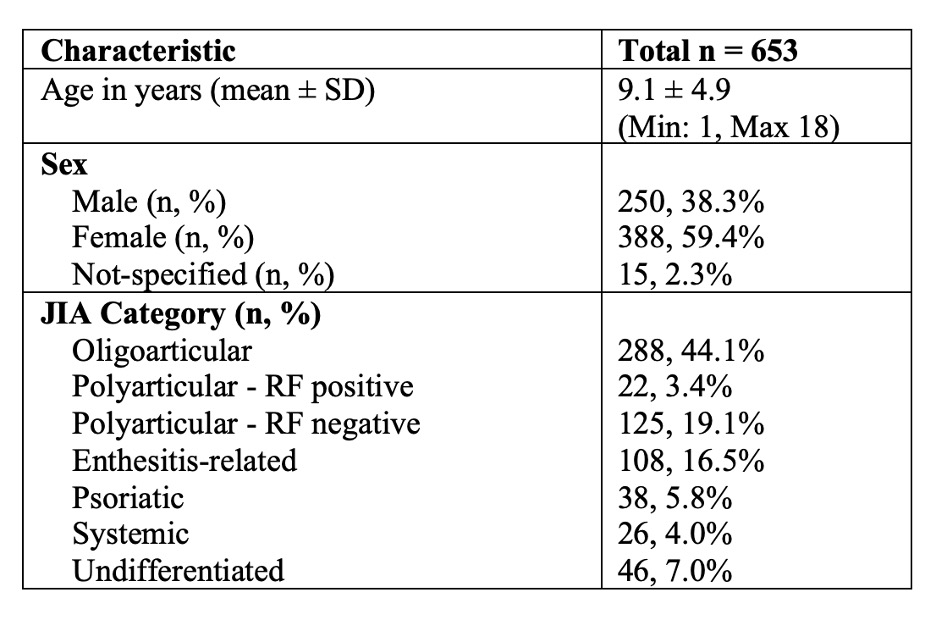
Influence of Weather in the 1- and 2-Weeks Prior to Visit on Reported Stiffness in Patients with JIA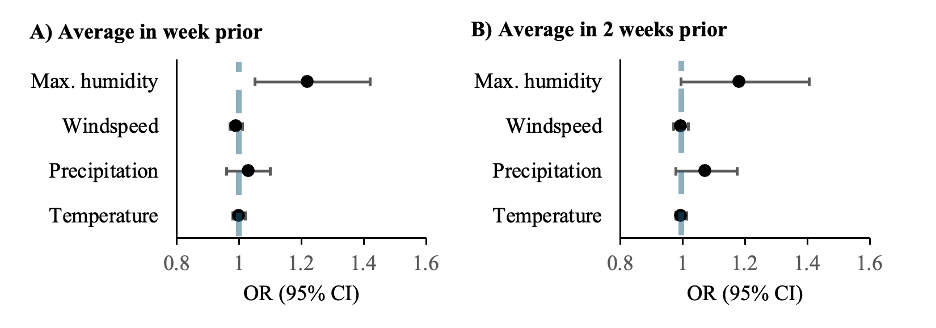
Association of stiffness incidence in JIA patients at baseline visit and weather averages for humidity, windspeed, precipitation, temperature in the week (A) or 2 weeks (B) preceding symptom reporting by patient’s parent using logistic regression. (OR, 95% CI = Odds ratios with 95% confidence intervals)
Relationships Between Reported Stiffness Duration and Various Weather Variables 1 and 2 Weeks Prior to Visit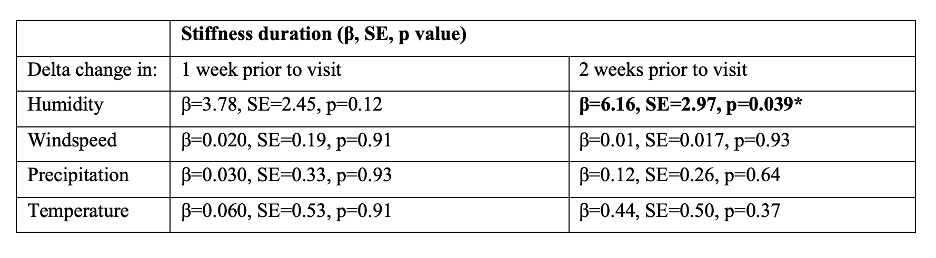
Relationships between stiffness duration in patients with JIA at baseline visit and weather deltas (maximum-minimum averages) for humidity, windspeed, precipitation, temperature in the 1- and 2-weeks preceding symptom reporting by patient using multilinear regression controlled for age and sex.
To cite this abstract in AMA style:
Yung T, Ball G, Guzman J, Gilliland J, Batara J, Yaskina M, Rumsey D. Do Changes in the Weather Influence Joint Pain and Stiffness in Children with Juvenile Idiopathic Arthritis? [abstract]. Arthritis Rheumatol. 2026; 78 (suppl 3). https://acrabstracts.org/abstract/do-changes-in-the-weather-influence-joint-pain-and-stiffness-in-children-with-juvenile-idiopathic-arthritis/. Accessed .« Back to 2026 Pediatric Rheumatology Symposium
ACR Meeting Abstracts - https://acrabstracts.org/abstract/do-changes-in-the-weather-influence-joint-pain-and-stiffness-in-children-with-juvenile-idiopathic-arthritis/