
Session Information
Session Time: 6:00PM-7:00PM
Background/Purpose: The ANA 23 panel is widely requested in patients with positive ANA to guide their association with autoimmune diseases; however, the anti-DFS70 antibody has been identified more frequently in healthy individuals in both the adult and pediatric populations. The objective of this study was to evaluate the association of anti-DFS70 with other autoimmune diseases in children.
Methods: A retrospective analysis was performed on 392 patients under 18 years of age who underwent the ANA 23 panel between 2020 and 2023. Statistical analysis was based on descriptive statistics. Variables are described using percentages and means ± standard deviation. Systemic lupus erythematosus, dermatomyositis, juvenile arthritis, neurological disorders (encephalitis, multiple sclerosis, polyneuropathy, optic neuritis), dermatological disorders (vitiligo, alopecia areata, lichen planus, cutaneous lupus), ophthalmological disorders (nodular scleritis, uveitis), gastrointestinal disorders (inflammatory bowel disease, autoimmune hepatitis), and other disorders (hemolytic anemia, eosinophilic fasciitis, sarcoidosis, IgA nephropathy, IgG4-related disease) were considered autoimmune diseases.
Results: Of the 392 patients included in the study, 311 were female, representing 79.3%. The mean age of the sample was 11.6 years. Musculoskeletal pain in patients with positive ANA was the main reason for undergoing ANA23 panel testing (45%). Unlike the female patients, no male patient presented with more than three autoantibodies. The most frequently positive autoantibodies in the total population were anti-DFS70 (37.5%), followed by anti-Mi-2 beta (8.16%) and anti-CENP B (7.65%). Anti-PM-Scl75, anti-Ro-52, anti-Mi-2 alpha, and anti-SS-B antibodies showed positivity rates ranging from 4.5% to 5.6%. The remaining autoantibodies were positive in less than 4% of patients, with anti-Sm being the least frequent, detected in only 4 patients. Of patients tested positive for anti-DFS70, 42.8% had autoimmune diseases, the most frequent being dermatological conditions (32%) (vitiligo, alopecia, lichen planus, cutaneous lupus). There was no significant difference in having a strong positive anti-DFS70 between patients with autoimmune diseases and those without autoimmune diseases (89% vs 90%). Of the patients with a positive DFS70 and an autoimmune disease, 49% had more than one positive antibody versus 46% of those without autoimmune diseases. In the group without autoimmune diseases, DFS70 was most frequently associated with anti-MI-2 beta, and in the group with autoimmune diseases, with anti-CENP-B. Of patients without an autoimmune disease and primary Raynaud’s phenomenon, all had a strongly positive DFS70, and only one had other positive antibodies on the panel.
Conclusion: Previous studies have shown that up to 20% of children without autoimmune diseases have a positive ANA; therefore, the ANA23 panel was used to determine its association. The finding of strong anti-DFS-70 positivity in children appears to be more frequently associated with autoimmune diseases than in adults, and its association with other positive autoantibodies in the panel makes a non-autoimmune diagnosis less likely.
Number of positive antibodies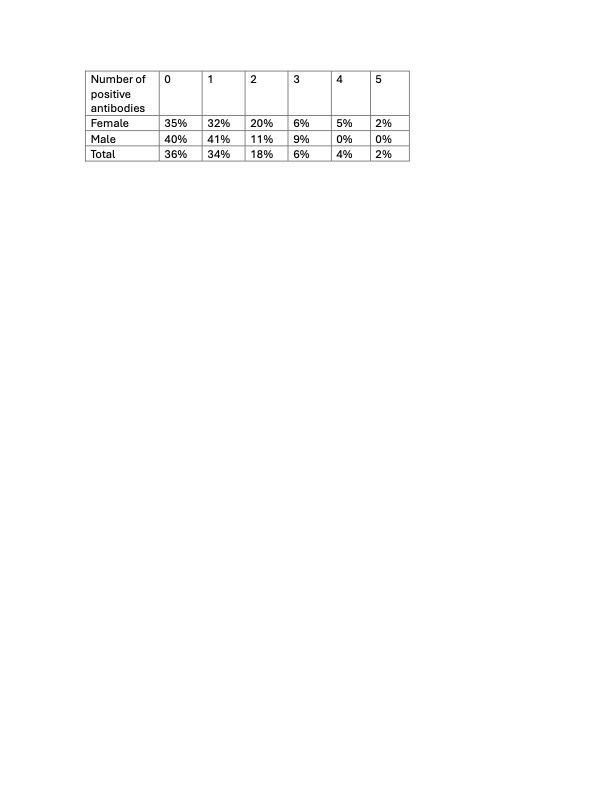
Positive antibodies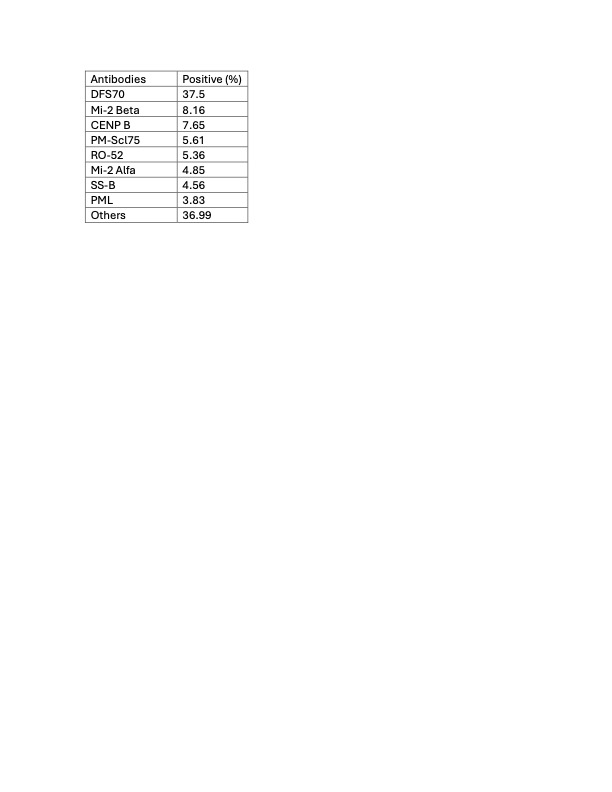
To cite this abstract in AMA style:
Concha S. Association of anti-DFS70 with autoimmune diseases in children [abstract]. Arthritis Rheumatol. 2026; 78 (suppl 3). https://acrabstracts.org/abstract/association-of-anti-dfs70-with-autoimmune-diseases-in-children/. Accessed .« Back to 2026 Pediatric Rheumatology Symposium
ACR Meeting Abstracts - https://acrabstracts.org/abstract/association-of-anti-dfs70-with-autoimmune-diseases-in-children/