
Session Information
Session Time: 5:29PM-5:34PM
Background/Purpose: Poor mental health (MH) in the pediatric rheumatology population has been shown to affect quality of life, educational attainment, and disease-related outcomes, such as medication adherence, healthcare utilization, and transition to adult care. Although patients with juvenile idiopathic arthritis (JIA) represent the single largest disease group in pediatric rheumatology practice, there are gaps in our understanding of the co-morbid mental health effects in JIA, and in research on interventions to optimize MH for these patients. Preventive, skills-based approaches may strengthen coping and resilience, addressing the scarcity of pediatric MH resources. The Making Mindfulness Matter JIA (M3©-JIA) trial evaluates the feasibility, acceptability, and preliminary impact of an online mindfulness-based intervention in children with JIA and their caregivers.
Methods: M3©-JIA is a three-site, parallel, randomized controlled trial recruiting caregiver–child dyads (ages 4–12) into either an 8-week M3© intervention or wait-list control. Weekly online sessions are led by trained facilitators, with caregivers and children attending separate groups. The M3© program incorporates neuropsychology, social-emotional learning and positive psychology. Quantitative data include demographics, attendance, and pre-/post-intervention questionnaires assessing mindfulness and parenting practices; qualitative feedback was collected through open-text responses.
Results: Of 67 dyads screened to date, 22 (33%) were randomized (11 intervention, 11 control). Most caregivers were mothers (86%), mean age 40.6 ± 6.5 years. Children were predominantly female (82%) with a mean age at enrolment of 9.3 ± 2.7 years and disease duration of 5.3 ± 3.1 years. Attendance was higher among caregivers than children (≥80% session attendance: 75% vs. 50%), with strong engagement in both groups (camera on ≥85% of session: 75% vs. 88%).
Post-intervention, children reported greater awareness and use of mindfulness skills—for example, knowledge of “breathing breaks” increased from 42% to 100%, and understanding emotional regulation from 50% to 95%. Caregivers showed improvements in mindfulness and parenting confidence (e.g., practicing mindfulness regularly: 31% to 63%; confidence in helping their child calm down: 69% to 90%) (Table 1). Qualitative feedback highlighted enjoyment, connection, and the value of creative, hands-on activities.
Conclusion: Preliminary findings demonstrate that M3© is feasible, engaging, and positively received by children with JIA and their caregivers. Early data suggest improvements in mindfulness awareness and parenting practices. While primarily scheduling challenges limited randomization rates, strong adherence and satisfaction support the promise of M3© as a scalable mental health support strategy within JIA care.
Table 1 Participant demographics, adherence and satisfaction of the M3© program 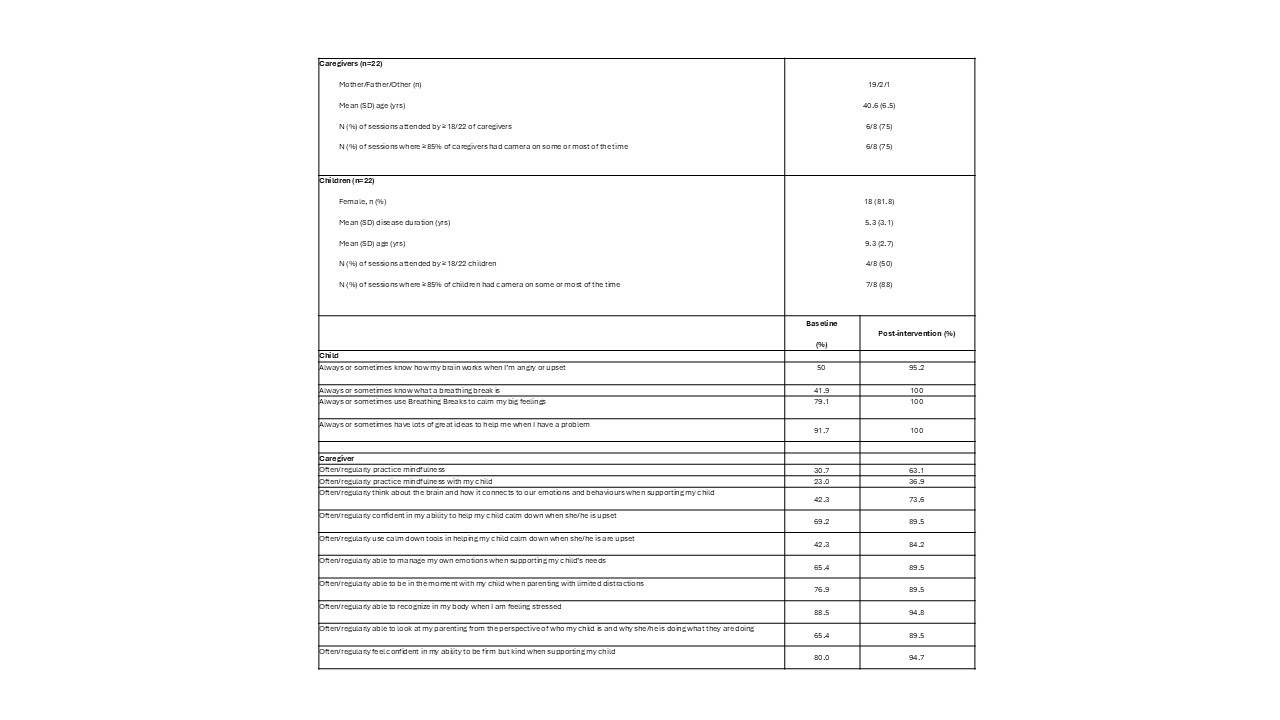
To cite this abstract in AMA style:
Berard R, BEATTIE K, Wells S, Batthish M, Jeyanathan A, Montemurro F, Bax K, Knight A. Mindfulness Matters: Early Insights from the Making Mindfulness Matter© in children with Juvenile Idiopathic Arthritis Study. [abstract]. Arthritis Rheumatol. 2026; 78 (suppl 3). https://acrabstracts.org/abstract/mindfulness-matters-early-insights-from-the-making-mindfulness-matter-in-children-with-juvenile-idiopathic-arthritis-study/. Accessed .« Back to 2026 Pediatric Rheumatology Symposium
ACR Meeting Abstracts - https://acrabstracts.org/abstract/mindfulness-matters-early-insights-from-the-making-mindfulness-matter-in-children-with-juvenile-idiopathic-arthritis-study/