ACR Meeting Abstracts

ACR Meeting Abstracts

  • Meetings
    • 2026 ACR/ARP PRSYM
    • ACR Convergence 2025
    • ACR Convergence 2024
    • ACR Convergence 2023
    • 2023 ACR/ARP PRSYM
    • ACR Convergence 2022
    • ACR Convergence 2021
    • 2020-2009 Meetings
    • Download Abstracts
  • Keyword Index
  • Advanced Search
  • Your Favorites
    • Favorites
    • Login
    • View and print all favorites
    • Clear all your favorites
  • ACR Meetings

Abstract Number: 028

Are You Positive About this Positive ANA Referral? Outcomes for ANA Based Referrals to Pediatric Rheumatology and Subsequent Disease Development

Josh Umland1, Elizabeth Volkmann2, Annabelle Lee3, Nicholas Jackson2, Deborah McCurdy4, Alice Hoftman5, Miriam Parsa6, John Fitzgerald7 and Alexis Stephens8, 1UCLA, 2University of California, Los Angeles, Los Angeles, CA, 3UCLA Department of Medicine Statistics Core, San Diego, CA, 4UCLA Medical Center, Los Angeles, CA, 5David Geffen School of Medicine, UCLA, Los Angeles, CA, 6Cottage Childrens Medical Center, SANTA BARBARA, CA, 7UCLA, Los Angeles, CA, 8University of California, Los Angeles

Meeting: 2026 Pediatric Rheumatology Symposium

  • Tweet
  • Email a link to a friend (Opens in new window) Email
  • Print (Opens in new window) Print
Session Information

Date: Thursday, March 19, 2026

Title: Posters: Clinical and Therapeutic Aspects I

Session Time: 6:00PM-7:00PM

Background/Purpose: ANA positivity is a frequent finding in pediatric rheumatology referrals, but infrequently reflects underlying autoimmune disease. Earlier studies found that most ANA positive patients without a diagnosis at referral seldom progressed to develop clinical autoimmunity. However, these studies predated the widespread use of electronic health records (EHR) and were limited to patients followed by pediatric rheumatology, restricting long-term outcome assessment. Modern data describing the extended clinical course of ANA positive children across healthcare settings are lacking. This study addresses this gap by leveraging EHR data to evaluate ANA based referrals and their progression to autoimmune disease over time.

Methods: This study utilized a retrospective chart review of all new patient referrals to a single pediatric rheumatology center in California from July 2015 through June 2017. Eligible patients were those referred with an ANA as either a part of, or the sole reason, for referral. Patients were excluded with preexisting rheumatologic diagnoses, second opinions, and hospital follow up appointments. Demographic characteristics, laboratory data, and eventual autoimmune diagnoses were manually abstracted from the available EHR records through August of 2025. 

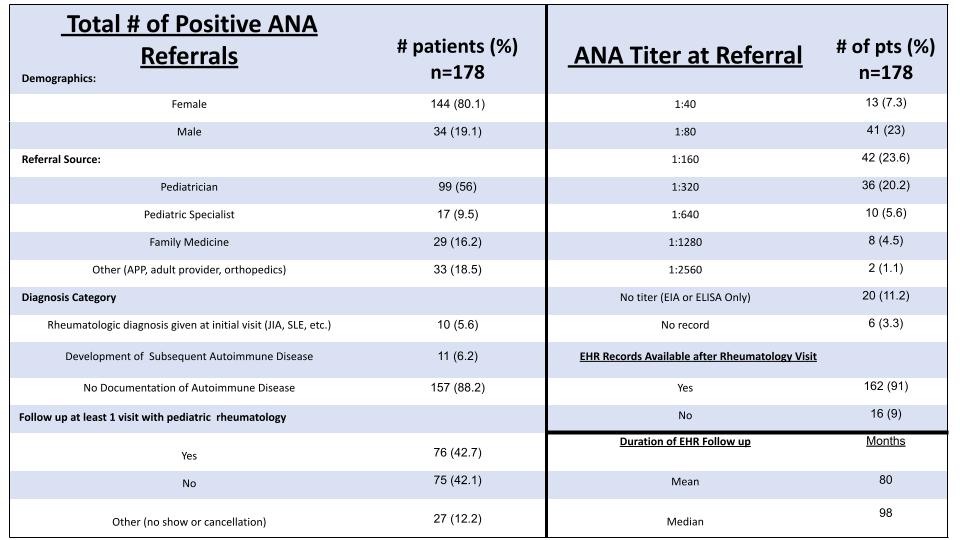
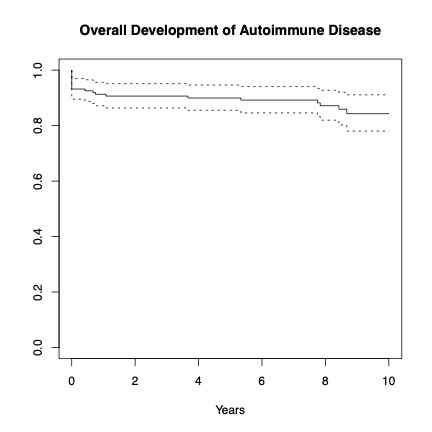
Results: A total of 720 new referrals to pediatric rheumatology were reviewed from July 2015 through June 2017. In 178 referrals (24.7%) were for ANA related reasons. Of these, 10 patients (5.6%) received a rheumatologic diagnosis at the initial evaluation. Over a median duration of 98 months of available EHR records, 11 patients (6.2%) subsequently developed an autoimmune disease, including Crohn’s disease (1), Hashimoto’s thyroiditis (1), ITP (1), PsA (3), RA (1), SLE (2), and UCTD (2). Among all ANA based referrals, SLE was diagnosed in only 3 patients, 1 at presentation and 2 later in adulthood.

Conclusion: In this single-center cohort with over 8 years of EHR-based follow-up, most children referred for a positive ANA without clinical features of autoimmunity remained healthy. Autoimmune disease occurred in 11.8% of referrals—5.6% at presentation and 6.2% developing later—indicating that ANA positivity can have clinical relevance in a minority of cases. These findings reaffirm that ANA positivity is generally benign in pediatric populations, while providing updated long-term data on progression in otherwise “benign” referrals. The results underscore the value of selective ANA testing, appropriate longitudinal monitoring, and thoughtful referral triage, particularly given the ongoing pediatric rheumatology workforce shortage.

Overall Development of Autoimmune Disease Supporting image 1
Supporting image 2


Disclosures: J. Umland: None; E. Volkmann: AbbVie/Abbott, 2, Boehringer-Ingelheim, 2, 5, 6, GlaxoSmithKlein(GSK), 2, 5; A. Lee: None; N. Jackson: None; D. McCurdy: None; A. Hoftman: None; M. Parsa: None; J. Fitzgerald: None; A. Stephens: None.

To cite this abstract in AMA style:

Umland J, Volkmann E, Lee A, Jackson N, McCurdy D, Hoftman A, Parsa M, Fitzgerald J, Stephens A. Are You Positive About this Positive ANA Referral? Outcomes for ANA Based Referrals to Pediatric Rheumatology and Subsequent Disease Development [abstract]. Arthritis Rheumatol. 2026; 78 (suppl 3). https://acrabstracts.org/abstract/are-you-positive-about-this-positive-ana-referral-outcomes-for-ana-based-referrals-to-pediatric-rheumatology-and-subsequent-disease-development/. Accessed .
  • Tweet
  • Email a link to a friend (Opens in new window) Email
  • Print (Opens in new window) Print

« Back to 2026 Pediatric Rheumatology Symposium

ACR Meeting Abstracts - https://acrabstracts.org/abstract/are-you-positive-about-this-positive-ana-referral-outcomes-for-ana-based-referrals-to-pediatric-rheumatology-and-subsequent-disease-development/

Advanced Search

Your Favorites

You can save and print a list of your favorite abstracts during your browser session by clicking the “Favorite” button at the bottom of any abstract. View your favorites »

Embargo Policy

All abstracts accepted to PRYSM are under media embargo once the ACR has notified presenters of their abstract’s acceptance. They may be presented at other meetings or published as manuscripts after this time but should not be discussed in non-scholarly venues or outlets. The following embargo policies are strictly enforced by the ACR.

Accepted abstracts are made available to the public online in advance of the meeting and are published in a special online supplement of our scientific journal, Arthritis & Rheumatology. Information contained in those abstracts may not be released until the abstracts appear online. In an exception to the media embargo, academic institutions, private organizations, and companies with products whose value may be influenced by information contained in an abstract may issue a press release to coincide with the availability of an ACR abstract on the ACR website. However, the ACR continues to require that information that goes beyond that contained in the abstract (e.g., discussion of the abstract done as part of editorial news coverage) is under media embargo until 6:00 PM CT on March 18. Journalists with access to embargoed information cannot release articles or editorial news coverage before this time. Editorial news coverage is considered original articles/videos developed by employed journalists to report facts, commentary, and subject matter expert quotes in a narrative form using a variety of sources (e.g., research, announcements, press releases, events, etc.).

Violation of this policy may result in the abstract being withdrawn from the meeting and other measures deemed appropriate. Authors are responsible for notifying colleagues, institutions, communications firms, and all other stakeholders related to the development or promotion of the abstract about this policy. If you have questions about the ACR abstract embargo policy, please contact ACR abstracts staff at [email protected].

Wiley

  • Online Journal
  • Privacy Policy
  • Permissions Policies
  • Cookie Preferences

© Copyright 2026 American College of Rheumatology