ACR Meeting Abstracts

ACR Meeting Abstracts

  • Meetings
    • 2026 ACR/ARP PRSYM
    • ACR Convergence 2025
    • ACR Convergence 2024
    • ACR Convergence 2023
    • 2023 ACR/ARP PRSYM
    • ACR Convergence 2022
    • ACR Convergence 2021
    • 2020-2009 Meetings
    • Download Abstracts
  • Keyword Index
  • Advanced Search
  • Your Favorites
    • Favorites
    • Login
    • View and print all favorites
    • Clear all your favorites
  • ACR Meetings

Abstract Number: 026

Treatment strategies for articular flares in JIA patients receiving biologic therapy

Jonatan zalcman, Yoel Levinsky, Liora Harel, Ruth Livny and gil amarilyo, Schneider Children's medical center of Israel

Meeting: 2026 Pediatric Rheumatology Symposium

  • Tweet
  • Email a link to a friend (Opens in new window) Email
  • Print (Opens in new window) Print
Session Information

Date: Thursday, March 19, 2026

Title: Posters: Clinical and Therapeutic Aspects I

Session Time: 6:00PM-7:00PM

Background/Purpose: Biologic agents form the cornerstone of therapy for Juvenile Idiopathic Arthritis (JIA); however, the optimal management of flares that occur during ongoing treatment remains unclear. This study aimed to to compare various flare-management strategies.

Methods: A multicenter retrospective cohort study was conducted across four Israeli tertiary pediatric centers, analyzing data from January 2005 to December 2024. The study included non-systemic polyarticular JIA patients who had achieved clinically inactive disease (CID) on a biologic agent and subsequently experienced an articular flare. The primary outcome was maintaining CID for more than three months after a flare intervention. Multivariable logistic regression, Kaplan–Meier curves, and Cox models were used for statistical analysis.

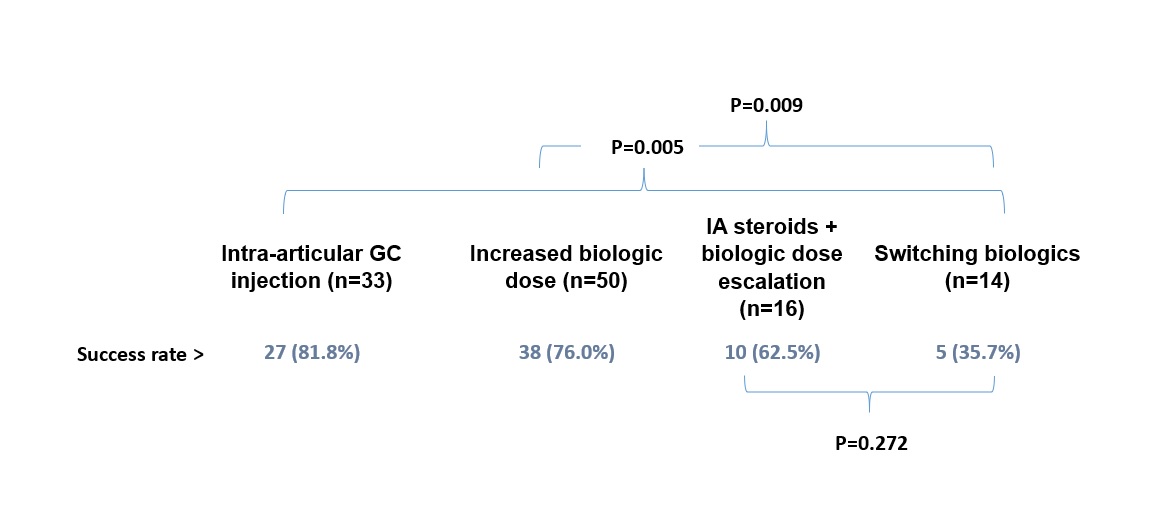
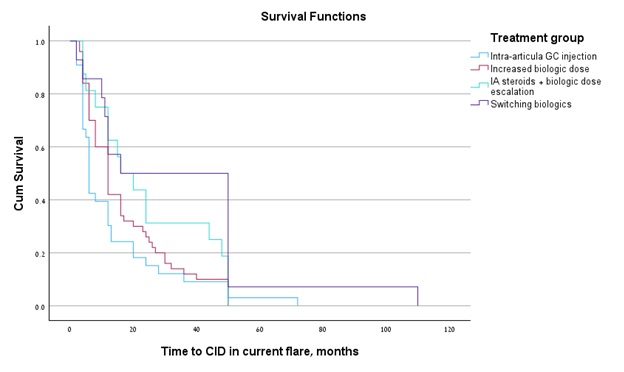
Results: Among 65 patients who experienced a total of 116 flares, five treatment strategies were compared: NSAIDs alone (3/116), intra-articular corticosteroid injection (ICSI, 33/116), biologic dose escalation or interval shortening (50/116), ICSI combined with dose escalation (16/116), and switching biologics (14/116). Overall, 71.6% of flares achieved CID following intervention. The highest success rates were observed with NSAIDs (100%) and ICSI (81.8%), followed by dose escalation (76.0%), ICSI+escalation (62.5%), and the lowest rate with biologic switching (35.7%). Multivariable analysis identified biologic switching as an independent predictor of lower CID success (adjusted OR ~0.27; p=0.036) and delayed remission (HR=0.40; P=0.006).  Dose escalation and ICSI+escalation did not differ significantly from ICSI alone.

Conclusion: These findings suggest that in managing non-systemic polyarticular JIA flares occurring while on biologics, local and incremental strategies such as ICSI and optimization of the current biologic agent result in better CID outcomes and faster remission compared to immediately switching biologics. A pragmatic, stepwise algorithm that prioritizes ICSI and biologic optimization before considering a switch may maximize a rapid return to CID and minimize unnecessary cycling of biologic medications.

Comparison of the success probabilities between each of the treatment armsSupporting image 1
Kaplan-Meier curve showing the success probabilities of the therapeutic strategy according to the different groupsSupporting image 2
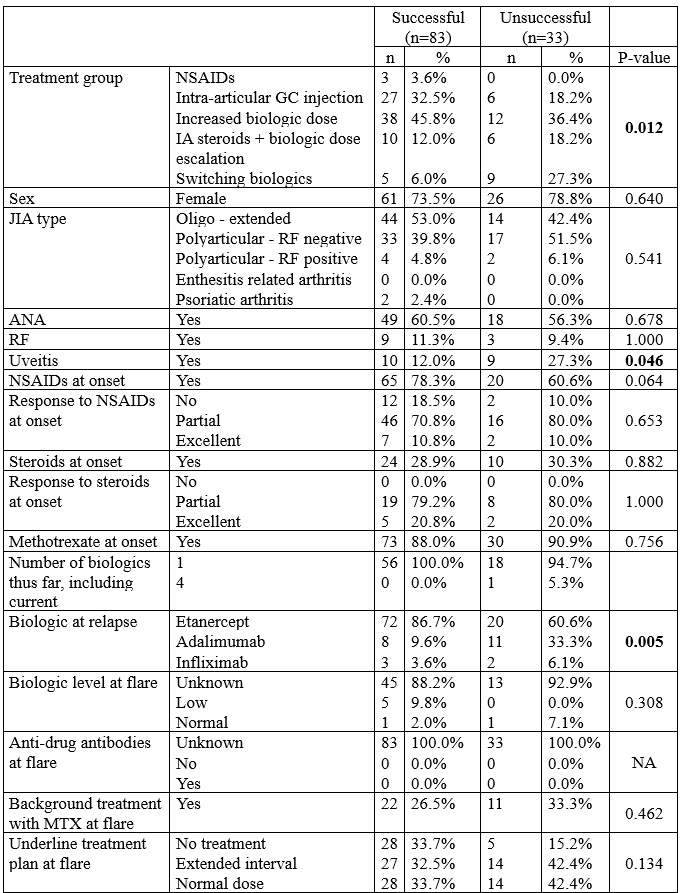
Comparison of clinical and demographic characteristics by treatment outcome (successful vs. unsuccessful)Supporting image 3

Disclosures: J. zalcman: None; Y. Levinsky: None; L. Harel: None; R. Livny: None; g. amarilyo: None.

To cite this abstract in AMA style:

zalcman J, Levinsky Y, Harel L, Livny R, amarilyo g. Treatment strategies for articular flares in JIA patients receiving biologic therapy [abstract]. Arthritis Rheumatol. 2026; 78 (suppl 3). https://acrabstracts.org/abstract/treatment-strategies-for-articular-flares-in-jia-patients-receiving-biologic-therapy/. Accessed .
  • Tweet
  • Email a link to a friend (Opens in new window) Email
  • Print (Opens in new window) Print

« Back to 2026 Pediatric Rheumatology Symposium

ACR Meeting Abstracts - https://acrabstracts.org/abstract/treatment-strategies-for-articular-flares-in-jia-patients-receiving-biologic-therapy/

Advanced Search

Your Favorites

You can save and print a list of your favorite abstracts during your browser session by clicking the “Favorite” button at the bottom of any abstract. View your favorites »

Embargo Policy

All abstracts accepted to PRYSM are under media embargo once the ACR has notified presenters of their abstract’s acceptance. They may be presented at other meetings or published as manuscripts after this time but should not be discussed in non-scholarly venues or outlets. The following embargo policies are strictly enforced by the ACR.

Accepted abstracts are made available to the public online in advance of the meeting and are published in a special online supplement of our scientific journal, Arthritis & Rheumatology. Information contained in those abstracts may not be released until the abstracts appear online. In an exception to the media embargo, academic institutions, private organizations, and companies with products whose value may be influenced by information contained in an abstract may issue a press release to coincide with the availability of an ACR abstract on the ACR website. However, the ACR continues to require that information that goes beyond that contained in the abstract (e.g., discussion of the abstract done as part of editorial news coverage) is under media embargo until 6:00 PM CT on March 18. Journalists with access to embargoed information cannot release articles or editorial news coverage before this time. Editorial news coverage is considered original articles/videos developed by employed journalists to report facts, commentary, and subject matter expert quotes in a narrative form using a variety of sources (e.g., research, announcements, press releases, events, etc.).

Violation of this policy may result in the abstract being withdrawn from the meeting and other measures deemed appropriate. Authors are responsible for notifying colleagues, institutions, communications firms, and all other stakeholders related to the development or promotion of the abstract about this policy. If you have questions about the ACR abstract embargo policy, please contact ACR abstracts staff at [email protected].

Wiley

  • Online Journal
  • Privacy Policy
  • Permissions Policies
  • Cookie Preferences

© Copyright 2026 American College of Rheumatology