ACR Meeting Abstracts

ACR Meeting Abstracts

  • Meetings
    • 2026 ACR/ARP PRSYM
    • ACR Convergence 2025
    • ACR Convergence 2024
    • ACR Convergence 2023
    • 2023 ACR/ARP PRSYM
    • ACR Convergence 2022
    • ACR Convergence 2021
    • 2020-2009 Meetings
    • Download Abstracts
  • Keyword Index
  • Advanced Search
  • Your Favorites
    • Favorites
    • Login
    • View and print all favorites
    • Clear all your favorites
  • ACR Meetings

Abstract Number: 010

Efficacy and Safety of Emapalumab in Patients with Macrophage Activation Syndrome (MAS) in Systemic Lupus Erythematosus (SLE)

Alexei Grom1, Shoghik Akoghlanian2, melissa elder3, Renee Modica4, Steve Mallett5, Brian D. Jamieson6 and Fabrizio De Benedetti7, 1Cincinnati Children’s Hospital, Division of Rheumatology, Cincinnati, OH, 2Nationwide Childrens Hospital, Columbus, OH, 3Division of Allergy, Immunology, and Rheumatology, Department of Pediatrics, University of Florida, GAINESVILLE, FL, 4Division of Allergy, Immunology, and Rheumatology, Department of Pediatrics, University of Florida, Orlando, FL, 5Sobi, 6Sobi, Inc., 7Bambino Gesu Children's Hospital, Rome, Rome, Italy

Meeting: 2026 Pediatric Rheumatology Symposium

  • Tweet
  • Email a link to a friend (Opens in new window) Email
  • Print (Opens in new window) Print
Session Information

Date: Thursday, March 19, 2026

Title: Abstracts: Systemic Lupus Erythematosus

Session Time: 5:17PM-5:22PM

Background/Purpose: MAS is a life-threatening complication of SLE, characterized by interferon-gamma (IFNg)-driven macrophage activation and systemic hyperinflammation. There is substantial preclinical evidence of IFNg having a role in MAS in SLE, but there is limited clinical data to confirm these observations. Emapalumab, an anti-IFNg antibody, binds free and receptor-bound IFNg, providing rapid and targeted neutralization of IFNg. Emapalumab has previously demonstrated sustained control of MAS in patients (pts) with Still’s disease. This report presents the first clinical trial data from pts with MAS in SLE administered emapalumab
 

Methods: Cohort 2 of Study NI-0501-14 (EMERALD; NCT05001737) investigated the efficacy and safety of emapalumab in pts with MAS in SLE who had an inadequate response to high-dose glucocorticoids (GCs). Pts were planned to be treated with emapalumab for 4 weeks: a 6 mg/kg loading dose, followed by 3 mg/kg every 3 days from days 4–16, then 3 mg/kg twice weekly until Day 28 (or longer if insufficient clinical response). The primary efficacy endpoint was complete response (CR) at Week 8, defined as resolution of clinical signs according to investigator assessment (visual analog scale [VAS] ≤1/10 cm) and normalization of 7 MAS-related laboratory parameters). Overall response (OR) was defined as CR or a partial response (VAS < 4/10 cm and normalization of ≥3 MAS-related laboratory parameters). Other endpoints included GC tapering, survival, biomarkers, and safety.

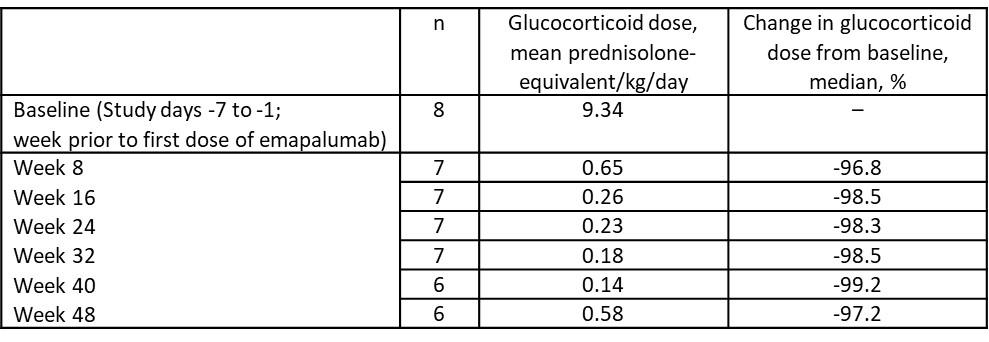
Results: Eight pts with an inadequate response to high-dose GCs were enrolled (5 [67.5%] females), with a median age of 16 years (range, 2–24; Table 1). All pts had lung and/or hepatic involvement. Six (75%) pts received 3–10 doses of emapalumab and treatment was administered for 1–< 4 weeks in 5 (63%) pts. Seven (88%) pts completed the study. One pt discontinued because of an adverse event (progressive decreased prothrombin activity). At Week 8, 4 (50%) pts achieved a CR with a median time to first CR of 5.9 weeks. Seven (88%) pts achieved a CR at any time. Six (75%) pts achieved an OR at Week 8 with a median time to first OR of 3.7 weeks. No pt had a recurrence of MAS during 1 year of follow-up. Mean GC dose reduced by 93% from 9.34 mg/kg/day at baseline to 0.65 mg/kg/day at Week 8 (Table 2). Median time to any GC tapering (50% reduction from baseline or reduction to dose prior to MAS episode) was 1.0 week. Median time to weekly average daily GC dose of ≤1 mg prednisolone-equivalent/kg/day was 5.5 weeks. No new safety concerns were identified. Four serious adverse drug reactions were reported in 4 pts. No infusion-related reactions occurred. No deaths occurred.

Conclusion: Emapalumab rapidly controlled MAS in SLE in 75% of pts with an initial inadequate response to high-dose GC treatment administered emapalumab. This suggests that IFNg is a pivotal cytokine in pts with MAS in SLE and similar outcomes can be achieved for patients with MAS treated with emapalumab, independently of the underlying rheumatic disease (Still’s disease or SLE).

Table 1: Demographics, baseline characteristics and treatment outcomes for in patients with macrophage activation syndrome in systemic lupus erythematosus administered emapalumabSupporting image 1
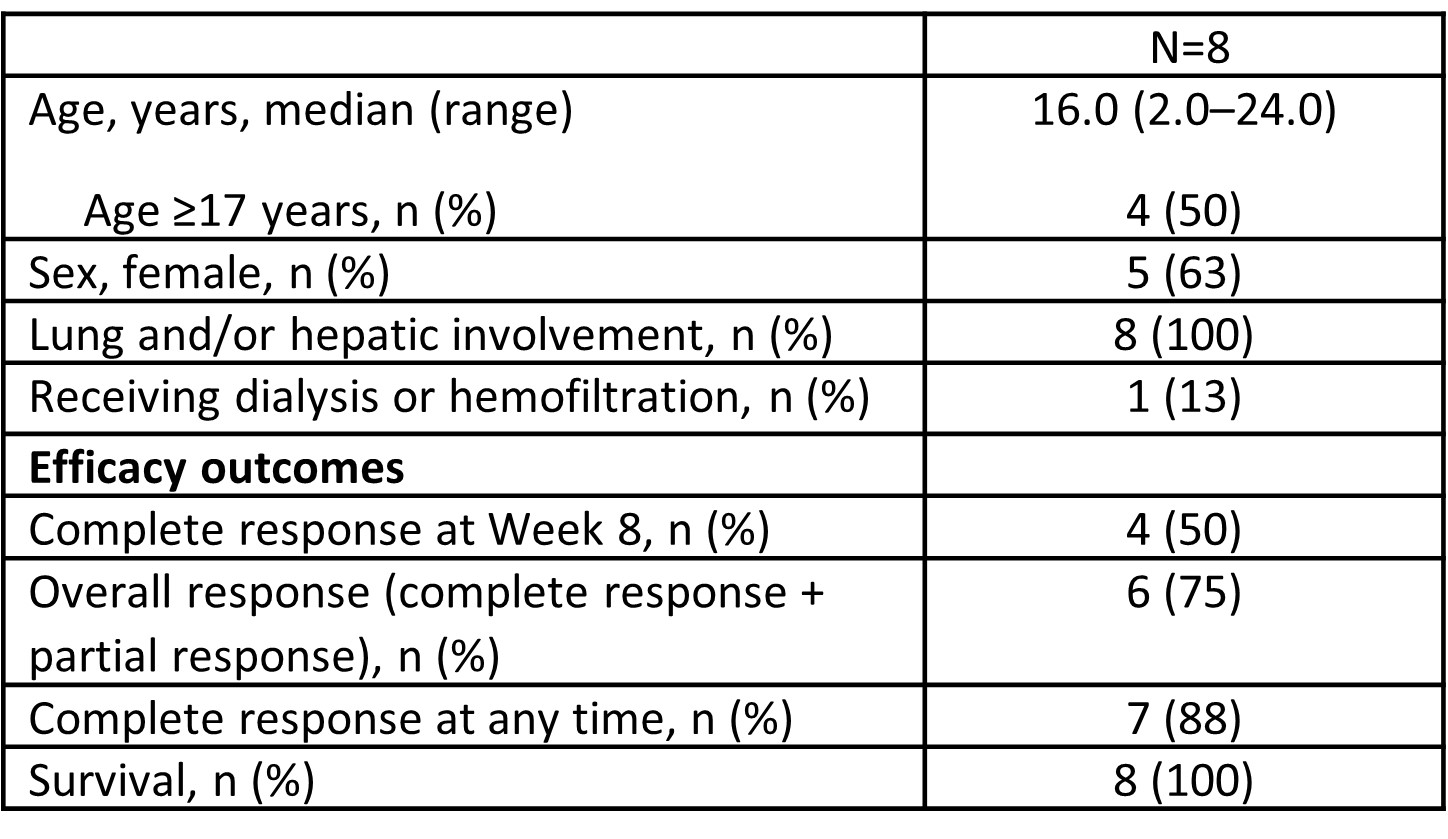
Table 2: Glucocorticoid dosing in patients with macrophage activation syndrome in systemic lupus erythematosus administered emapalumabSupporting image 2

Disclosures: A. Grom: Lilly, 1, Novartis, 2, 5, SJIA Foundation, 5, Sobi, 2, 5, Up-to-Date, 9; S. Akoghlanian: Sobi, 2, 5; m. elder: None; R. Modica: Sobi, 1; S. Mallett: Sobi, 2; B. Jamieson: Sobi, Inc., 3; F. De Benedetti: Abbvie, 2, 5, Apollo, 2, 5, Elixiron, 2, 5, Kiniksa, 2, 5, Novartis, 2, 5, Sanofi, 2, 5, Sobi, 2, 5.

To cite this abstract in AMA style:

Grom A, Akoghlanian S, elder m, Modica R, Mallett S, Jamieson B, De Benedetti F. Efficacy and Safety of Emapalumab in Patients with Macrophage Activation Syndrome (MAS) in Systemic Lupus Erythematosus (SLE) [abstract]. Arthritis Rheumatol. 2026; 78 (suppl 3). https://acrabstracts.org/abstract/efficacy-and-safety-of-emapalumab-in-patients-with-macrophage-activation-syndrome-mas-in-systemic-lupus-erythematosus-sle/. Accessed .
  • Tweet
  • Email a link to a friend (Opens in new window) Email
  • Print (Opens in new window) Print

« Back to 2026 Pediatric Rheumatology Symposium

ACR Meeting Abstracts - https://acrabstracts.org/abstract/efficacy-and-safety-of-emapalumab-in-patients-with-macrophage-activation-syndrome-mas-in-systemic-lupus-erythematosus-sle/

Advanced Search

Your Favorites

You can save and print a list of your favorite abstracts during your browser session by clicking the “Favorite” button at the bottom of any abstract. View your favorites »

Embargo Policy

All abstracts accepted to PRYSM are under media embargo once the ACR has notified presenters of their abstract’s acceptance. They may be presented at other meetings or published as manuscripts after this time but should not be discussed in non-scholarly venues or outlets. The following embargo policies are strictly enforced by the ACR.

Accepted abstracts are made available to the public online in advance of the meeting and are published in a special online supplement of our scientific journal, Arthritis & Rheumatology. Information contained in those abstracts may not be released until the abstracts appear online. In an exception to the media embargo, academic institutions, private organizations, and companies with products whose value may be influenced by information contained in an abstract may issue a press release to coincide with the availability of an ACR abstract on the ACR website. However, the ACR continues to require that information that goes beyond that contained in the abstract (e.g., discussion of the abstract done as part of editorial news coverage) is under media embargo until 6:00 PM CT on March 18. Journalists with access to embargoed information cannot release articles or editorial news coverage before this time. Editorial news coverage is considered original articles/videos developed by employed journalists to report facts, commentary, and subject matter expert quotes in a narrative form using a variety of sources (e.g., research, announcements, press releases, events, etc.).

Violation of this policy may result in the abstract being withdrawn from the meeting and other measures deemed appropriate. Authors are responsible for notifying colleagues, institutions, communications firms, and all other stakeholders related to the development or promotion of the abstract about this policy. If you have questions about the ACR abstract embargo policy, please contact ACR abstracts staff at [email protected].

Wiley

  • Online Journal
  • Privacy Policy
  • Permissions Policies
  • Cookie Preferences

© Copyright 2026 American College of Rheumatology