
Session Information
Session Time: 6:00PM-7:00PM
Background/Purpose: Juvenile systemic sclerosis (jSSc) is a rare autoimmune and fibrosing disease associated with significant morbidity and mortality. Gastrointestinal involvement is common in jSSc, with the esophagus most commonly affected. High-resolution esophageal manometry (HREM) is the gold standard to evaluate dysphagia in jSSc, though it is a challenging procedure to perform in an awake child. Functional lumen imaging probe (FLIP) is an endoluminal device that measures esophageal diameter, distensibility, and contractility using impedance planimetry during volume-controlled balloon inflation while sedated. To date, no published studies have evaluated FLIP for assessing esophageal dysmotility in jSSc. This study aims to characterize FLIP findings and determine its clinical utility in children with SSc.
Methods: A retrospective review of jSSc patients that had an esophagogastroduodenoscopy (EGD) with FLIP from 2023-2025 was performed. Demographic, serologic, clinical, endoscopic, and FLIP data were extracted. FLIP measures assessed included luminal diameters, esophagogastric junction distensibility index (EGJ-DI) (mm2/mmHg), and esophageal contractile patterns.
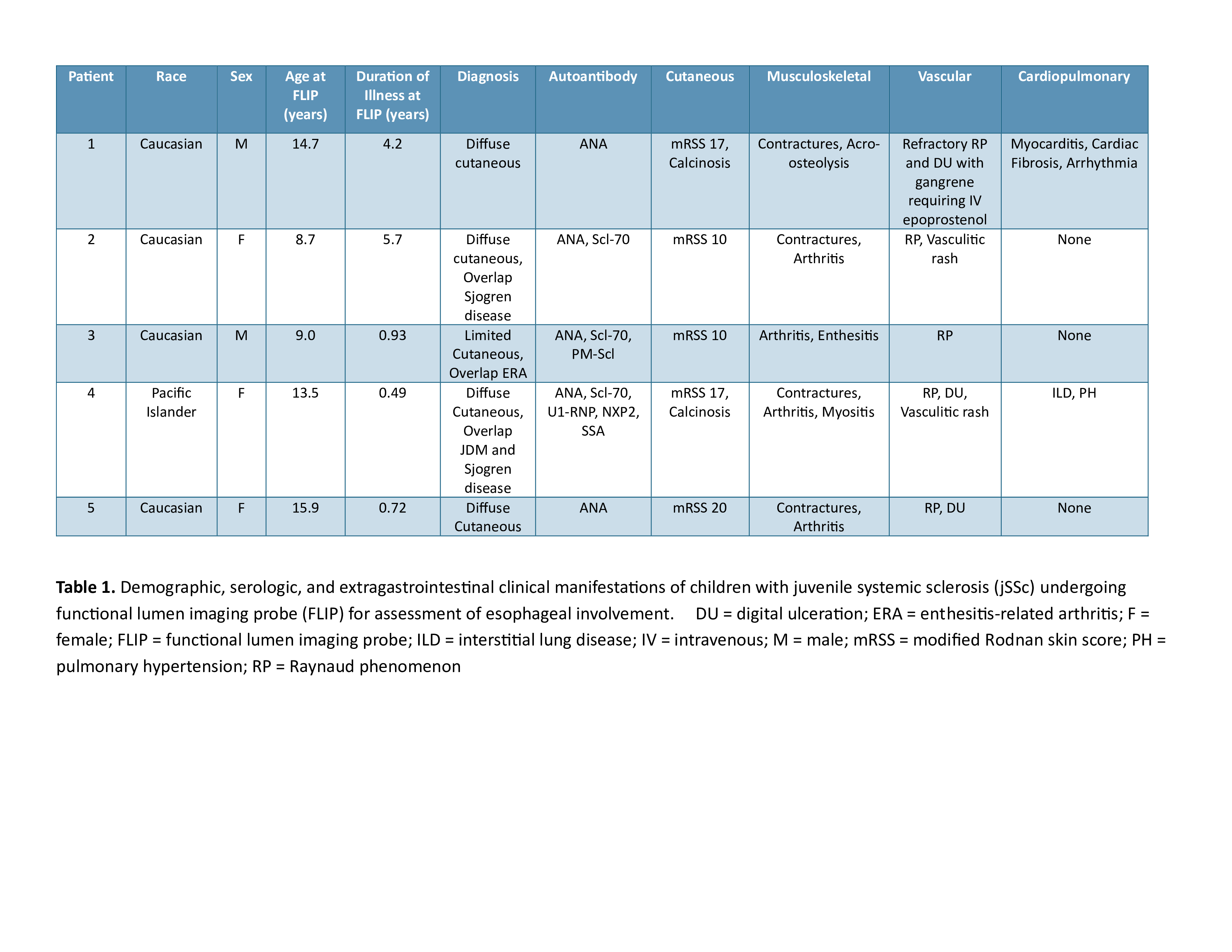
Results: Five jSSc patients who underwent FLIP were identified, the majority Caucasian (80%) females (60%) with diffuse cutaneous systemic sclerosis (80%). Overlap with another connective tissue disease was common (60%), the majority Sjogren disease. Mean age and disease duration at time of FLIP were 12.4 (SD 2.8) and 2.6 (SD 2.2) years, respectively. Demographic, serologic, and extragastrointestinal clinical characteristics are summarized in Table 1.
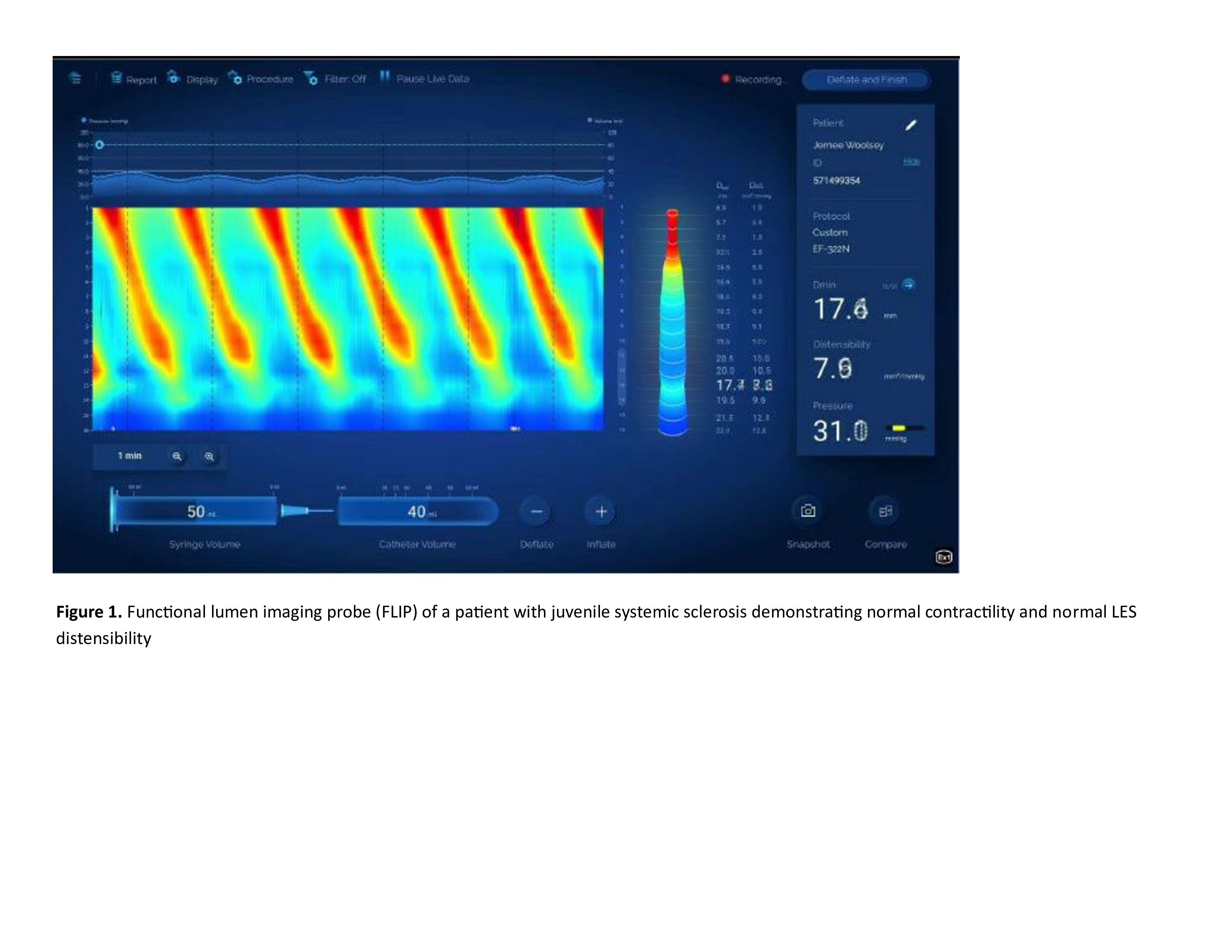
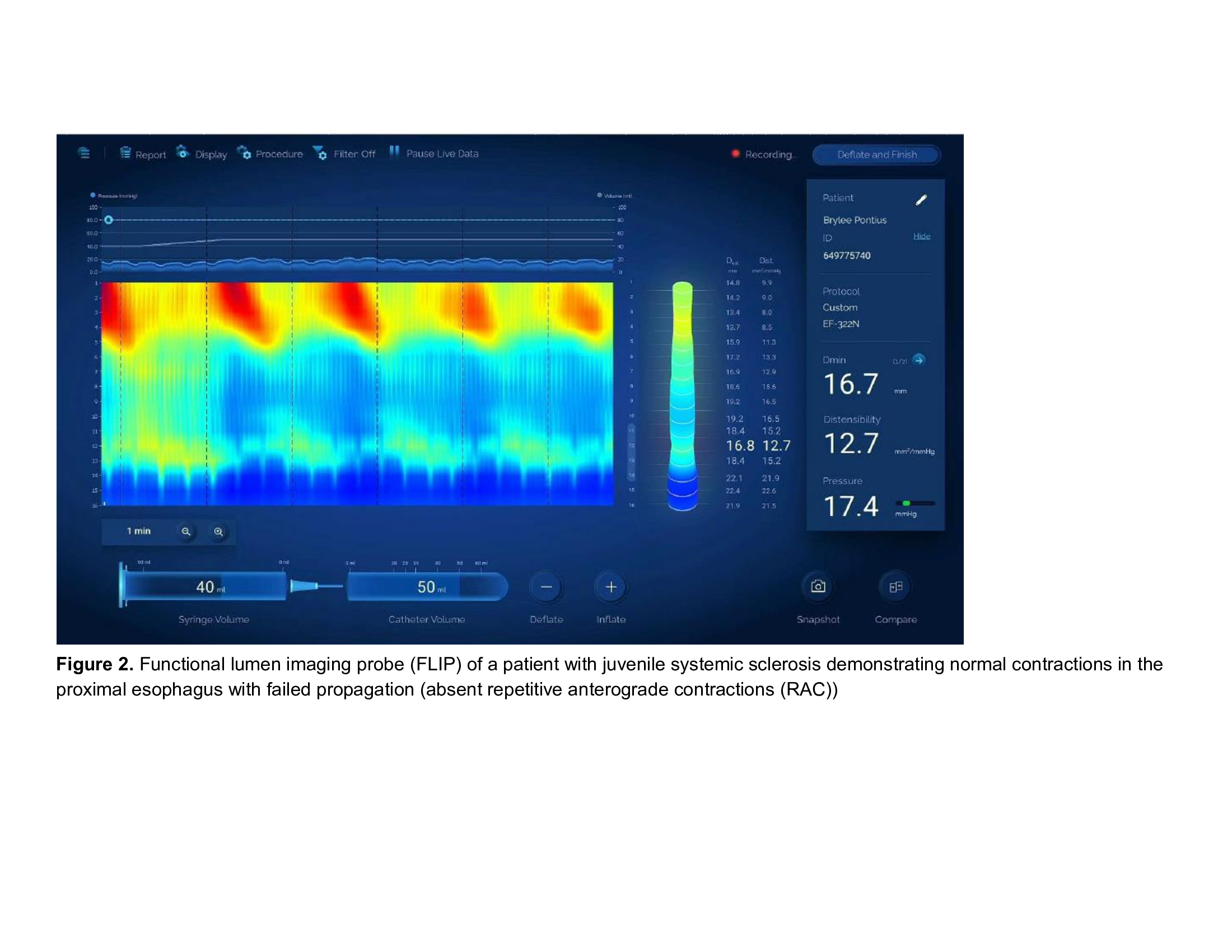
All patients reported symptoms of dysphagia. EGD with FLIP was tolerated without complications. Normal EGD with FLIP was noted in 40% of patients (Figure 1). Histologic esophagitis was noted in 60% of patients. Repetitive anterograde contractions (RAC), the normal esophageal motor response to sustained distention, were absent in 60% of patients and repetitive retrograde contractions (RRC) were present in 20% (Figure 2). In one patient who had subsequent HREM, FLIP findings correlated with HREM results (absent RAC and absent contractility).
Conclusion: To our knowledge, this is the first study to describe the use of FLIP to assess esophageal involvement in jSSc. FLIP was safe, well tolerated, and provided clinically meaningful information. Absent distal contractility and esophageal inflammation were found in 60% of patients. In one patient who subsequently underwent HREM, FLIP findings were consistent with HREM results. These observations suggest that FLIP may serve as a viable alternative or complementary tool to the current gold standard evaluation of dysphagia in pediatric patients with SSc.
Children with SSc and gastrointestinal involvement experience poor quality of life and fluoroscopic esophageal abnormalities correlate with risk of pulmonary disease. Early identification of esophageal involvement is therefore of paramount importance. Larger studies are needed to validate these findings, evaluate how FLIP metrics respond to treatment, and ultimately guide optimal care in patients with jSSc.
To cite this abstract in AMA style:
Cohen A, Patel R, Wheeler J, Robinson A. Functional Lumen Imaging Probe (FLIP) for the Assessment of Esophageal Involvement in Juvenile Systemic Sclerosis: Characteristics and Clinical Utility [abstract]. Arthritis Rheumatol. 2026; 78 (suppl 3). https://acrabstracts.org/abstract/functional-lumen-imaging-probe-flip-for-the-assessment-of-esophageal-involvement-in-juvenile-systemic-sclerosis-characteristics-and-clinical-utility/. Accessed .« Back to 2026 Pediatric Rheumatology Symposium
ACR Meeting Abstracts - https://acrabstracts.org/abstract/functional-lumen-imaging-probe-flip-for-the-assessment-of-esophageal-involvement-in-juvenile-systemic-sclerosis-characteristics-and-clinical-utility/