
Session Information
Date: Thursday, March 19, 2026
Title: Plenary Abstract Session I
Session Time: 3:15PM-3:30PM
Background/Purpose: Prior studies demonstrate low levels of teratogenicity knowledge among adolescents and young adults (AYAs) with rheumatic disease. This study sought to describe barriers and facilitators to teratogenicity knowledge and its application to their reproductive lives.
Methods: In 2024, AYAs age 14-21 years, assigned female at birth, with a rheumatic disease, and taking teratogenic medications were recruited from pediatric rheumatology clinics in Indiana to participate in semi structured interviews to assess barriers and facilitators influencing teratogenicity knowledge and its application. Interviews were recorded and transcribed by a professional service. Data were analyzed in Dedoose by two of the authors (BH, EP) who engaged in inductive initial coding to identify themes from the data, resolving differences through discussions until theoretical saturation was reached. After identifying key themes and creating a codebook, categories were developed through exploration of how key concepts fit together. Analysis proceeded using constant comparison analysis, the standard analysis technique utilized in grounded theory as described by Charmaz (2014). Hypothesized relationships among categories were explored through reexamination of the data using an iterative approach. We then reanalyzed the transcripts to perform a priori coding to develop and confirm our theoretical framework.
Results: 21 AYAs with a variety of rheumatic diseases participated in interviews (background characteristics in Table 1). Participants were on average 16.3 years old. 33% were sexually experienced and 38% on birth control. 29% had teratogenicity knowledge and 33% had limited knowledge. 43% reported teratogenicity counseling.
Some reporting counseling had limited understanding of teratogenicity or its application to their lives. Most participants connected importance to future planned pregnancies. Many did not acknowledge risk of unintended pregnancy or consideration of contraception at time of interview or in the future.
Barriers to teratogenicity knowledge despite counseling fell into 3 categories: disease or medication factors overshadowing teratogenicity; perceived irrelevance of information at time of counseling due to abstinence or desire to remain child-free; and hesitation to ask questions or engage in discussion with providers due to reproductive health issues being perceived as awkward/taboo, parental presence, or strategic avoidance.Facilitators included personal or social network with medical knowledge from training or lived experience, detailed and repeated teratogenicity counseling, and open reproductive health conversations with those in social networks. (Table 2)
Conclusion: Identified barriers and facilitators reveal opportunities to facilitate AYA understanding of teratogenicity’s effect on their reproductive lives. This includes highlighting reproductive health considerations after sexual debut, repeat counseling to capture AYAs when information is perceived to apply to their lives, and alone time with provider to promote open discussion regarding teratogenicity and reproductive health considerations.
Charmaz, K. (2014). Constructing grounded theory (2nd ed.). Sage.
Table 1. Participant Characteristics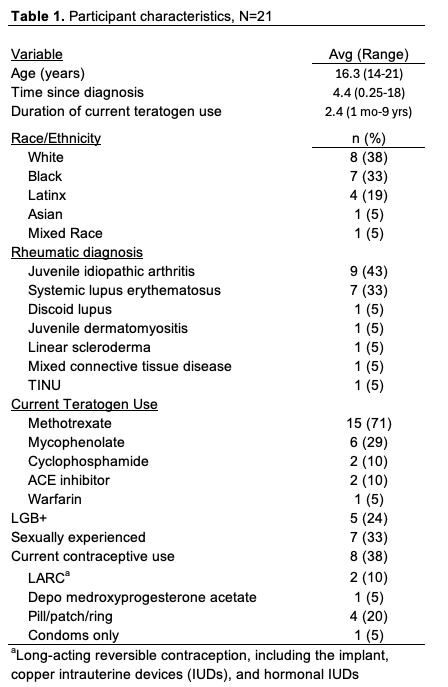
Table 2. Representative quotes from adolescents and young adults (AYAs) regarding barriers and facilitators to teratogenicity knowledge and application to their reproductive lives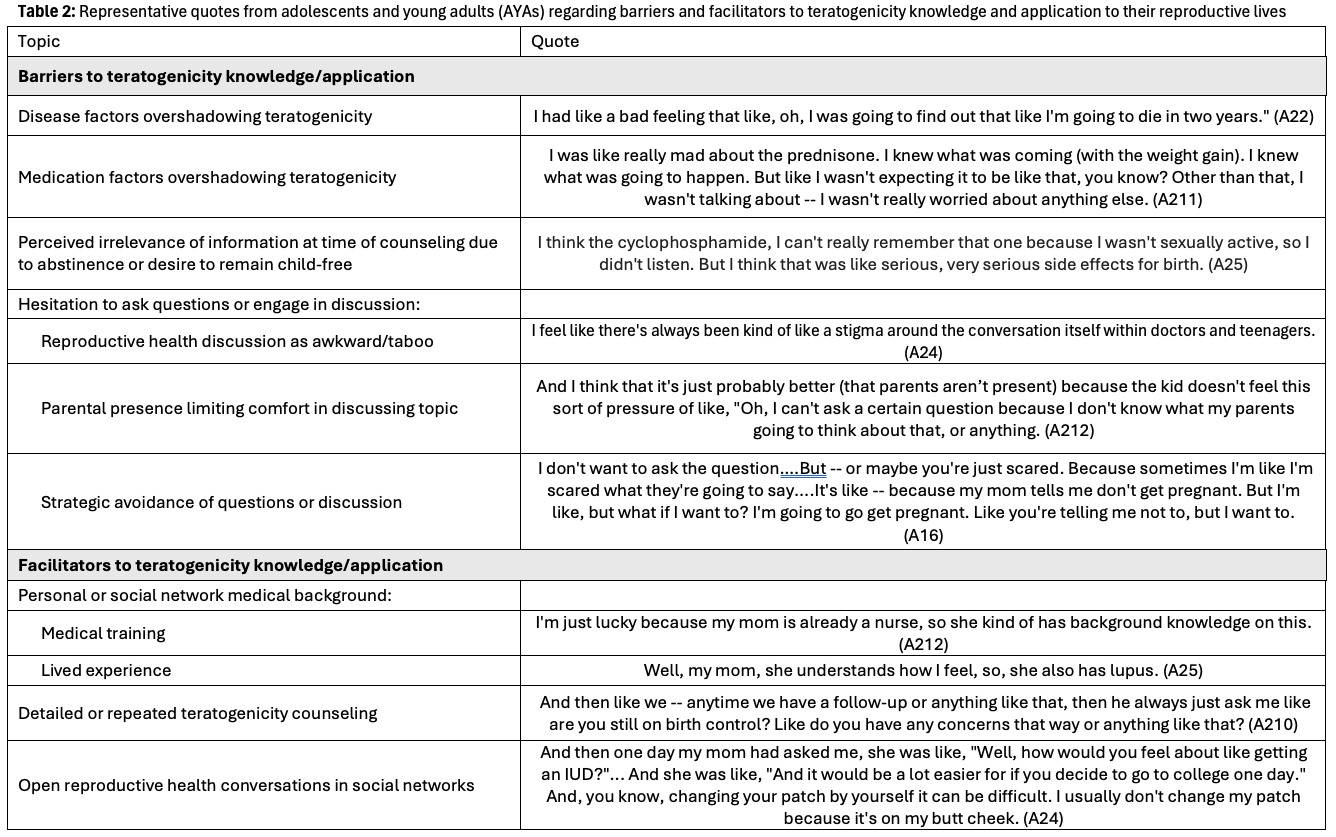
To cite this abstract in AMA style:
Huynh B, Pfeiffer E, Tarvin S. Barriers and Facilitators to Teratogenicity Knowledge and Application among Adolescents and Young Adults with Rheumatic Disease [abstract]. Arthritis Rheumatol. 2026; 78 (suppl 3). https://acrabstracts.org/abstract/barriers-and-facilitators-to-teratogenicity-knowledge-and-application-among-adolescents-and-young-adults-with-rheumatic-disease/. Accessed .« Back to 2026 Pediatric Rheumatology Symposium
ACR Meeting Abstracts - https://acrabstracts.org/abstract/barriers-and-facilitators-to-teratogenicity-knowledge-and-application-among-adolescents-and-young-adults-with-rheumatic-disease/